




SRINAGAR, Kashmir — Kashmir is many things. It is a disputed borderland that India and Pakistan have fought over for more than three-quarters of a century, making it one of the world’s most strife-torn and militarized zones. It is a Bollywood cinematographer’s alpine dream, its fabled beauty and trauma providing grist for tales of love, longing, and war.
Since 2019, when the government of Indian Prime Minister Narendra Modi tightened its grip on the Indian-controlled part of Kashmir, promising security and economic development, it has become a tourist hotspot drawing millions of visitors a year. In the government’s narrative of progress, Kashmir is a shining success.
The region’s people have their own story to tell. It is one of festering alienation, magnified by last week’s horrific terrorist attack in Kashmir, after years of living under the watchful eyes of security forces while being deprived of many democratic rights.
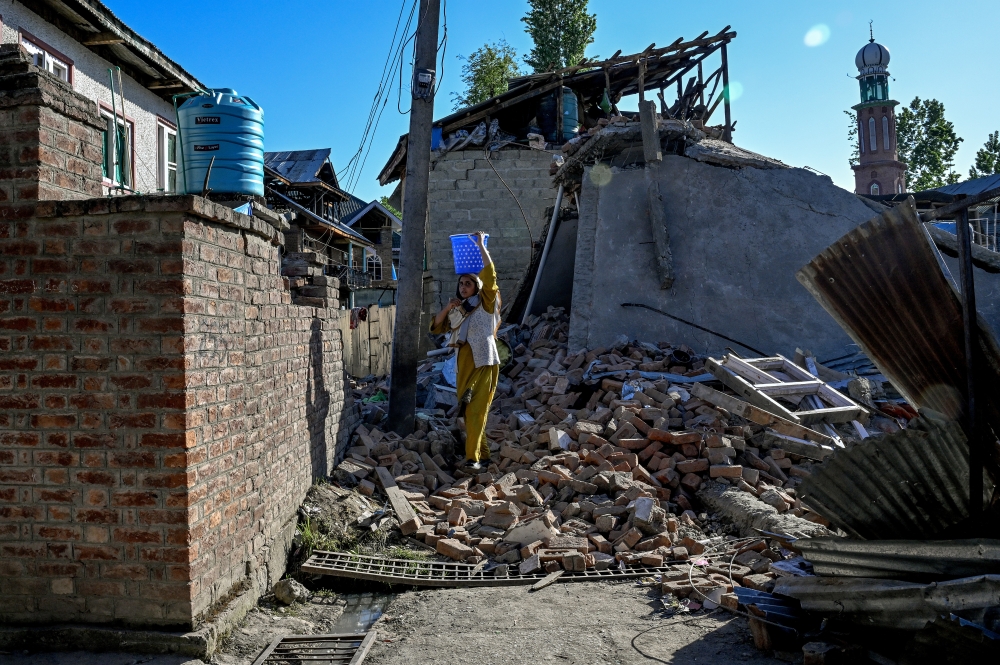
Indian troops have launched an aggressive, widespread hunt for the killers that feels like collective punishment to many in the Muslim-majority region. Authorities have detained thousands of Kashmiris for questioning and demolished the homes of at least 10 people accused of the attack.
“We are treated as suspects,” said Sheikh Aamir, a lawyer in northern Kashmir. “Whenever something happens, they punish us all.”
India has said the terrorist attack, which killed 26 innocent people near the town of Pahalgam, has “cross-border linkages,” implying the involvement of its neighbor Pakistan. Officials in Pakistan, who deny any role in the attack, said Wednesday that they had detected signs that India was preparing to take retaliatory military action.
India has not commented on its military planning, but Modi has condemned the attackers and promised to “raze” terrorist safe havens. Airstrikes by India along the border, or even an incursion into Pakistani territory, are possible, analysts said.
Before the massacre, Kashmir had been in a period of relative calm since the Indian government brought the region under its direct control, removing the semiautonomy guaranteed to Kashmir in the Indian Constitution and moving in thousands of troops.
But as the Indian government claimed it had brought normalcy to the region, some Kashmiris expressed anger at what they called false propaganda.
Normalcy in Kashmir has always been “superficial and deceptive,” said Sumantra Bose, a political scientist and author who has studied Kashmir. He described life in the region as a “real-life hybrid of Orwellian and Kafkaesque.”
Primarily driven by local grievances, an insurgency in the Indian-administered part of Kashmir began in the 1980s, with Pakistan eventually supporting and harboring some groups, experts say. Attacks by militant groups often targeted Hindus, forcing an exodus of the minority community from Kashmir.
The idea pushed by insurgent outfits that Kashmir should be an independent state or join with Pakistan has faded as Kashmiris have largely given up the idea of separatism.
Militancy has been “replaced by a deep alienation of the Kashmiri polity,” said Siddiq Wahid, a professor of humanities and social sciences at Shiv Nadar University, near Delhi.
The disaffection, coupled with brutish armed forces who show little mercy for innocent Kashmiris in their search for violent ones, could make it easier for new militant groups to emerge, analysts said. It could also impel disgruntled Kashmiris to look away from militant activities, the analysts said.
“Villagers just have to turn their heads away and not report at all,” said Gunaratna. “So they close their eyes.”
An outcry that followed Indian troops’ killing of the young leader of a banned Islamist outfit in 2016 offered clues that there could be “passive support” for militancy, Gunaratna said.
But the Indian government became complacent because “they bought into their hubris,” he said. Less than three weeks before the attack near Pahalgam, Amit Shah, India’s minister for home affairs, said the Modi government had “crippled” the “entire terror ecosystem nurtured by elements against our country” in Kashmir.
The attack was a monumental security lapse for a government that had heavily promoted Kashmir as a dream destination for tourists, thinking that “militants would not attack tourists because they are so integral to the local economy,” Gunaratna said.
About 10 million people live on the Indian side of Kashmir, roughly 90% of whom are Muslim, according to India’s 2011 census. It is the country’s only Muslim-majority region.
India and Pakistan lay claim to all of Kashmir, but each controls only part of it. They have fought multiple wars over the land.
India’s defensive stance has meant the continuous presence of military and paramilitary troops in Kashmir, who have effectively turned the region into a police state.
Analysts say there could be as many as 500,000 Indian troops in Kashmir. The armed forces have often used excessive force to flush out Kashmiri militants. Thousands of innocent Kashmiris have died during demolitions and shootouts. Others have been abducted, disappeared,d or killed in “encounters,” or extrajudicial killings. Government estimates put the number of deaths at 45,000, but human rights groups say it is much higher.
Terrorism-related deaths have fallen sharply over the past 25 years, according to data from the South
Oman Observer is now on the WhatsApp channel. Click here