




WASHINGTON: In a potential landmark discovery, scientists using the James Webb Space Telescope have obtained what they call the strongest signs yet of possible life beyond our solar system, detecting in an alien planet's atmosphere the chemical fingerprints of gases that on Earth are produced only by biological processes.
The two gases - dimethyl sulfide, or DMS, and dimethyl disulfide, or DMDS - involved in Webb's observations of the planet named K2-18b are generated on Earth by living organisms, primarily microbial life such as marine phytoplankton - algae.
This suggests the planet may be teeming with microbial life, the researchers said. They stressed, however, that they are not announcing the discovery of actual living organisms but rather a possible biosignature - an indicator of a biological process - and that the findings should be viewed cautiously, with more observations needed.
Nonetheless, they voiced excitement. These are the first hints of an alien world that is possibly inhabited, said astrophysicist Nikku Madhusudhan of the University of Cambridge's Institute of Astronomy, lead author of the study published in the Astrophysical Journal Letters.
"This is a transformational moment in the search for life beyond the solar system, where we have demonstrated that it is possible to detect biosignatures in potentially habitable planets with current facilities. We have entered the era of observational astrobiology," Madhusudhan said.
Madhusudhan noted that there are various efforts underway searching for signs of life in our solar system, including various claims of environments that might be conducive to life in places like Mars, Venus and various icy moons.
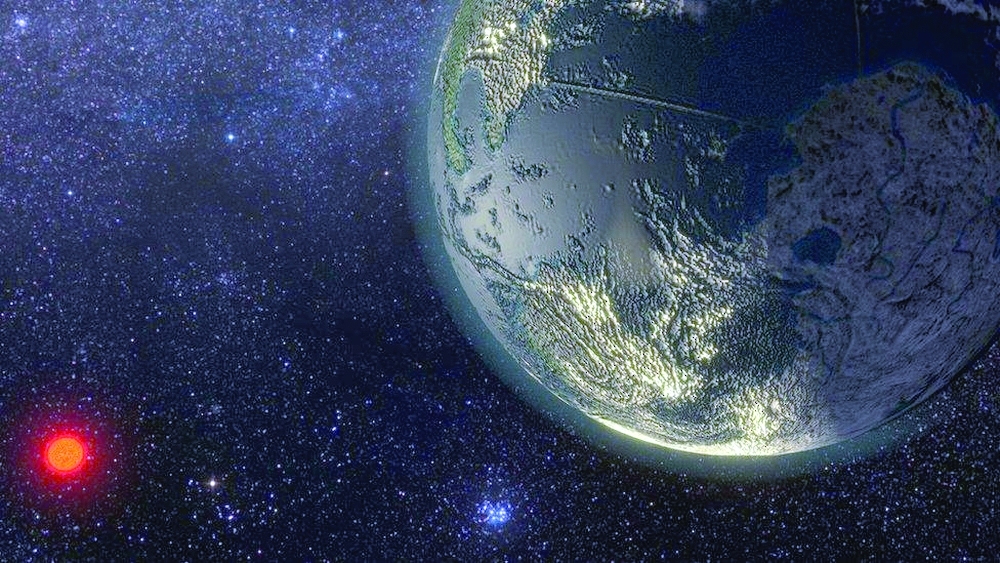
K2-18b is 8.6 times as massive as Earth and has a diameter about 2.6 times as large as our planet.
It orbits in the "habitable zone" - a distance where liquid water, a key ingredient for life, can exist on a planetary surface - around a red dwarf star smaller and less luminous than our sun, located about 124 light-years from Earth in the constellation Leo. A light-year is the distance light travels in a year, 9.5 trillion km. One other planet also has been identified orbiting this star.
About 5,800 planets beyond our solar system, called exoplanets, have been discovered since the 1990s. Scientists have hypothesised the existence of exoplanets called hycean worlds - covered by a liquid water ocean habitable by microorganisms and with a hydrogen-rich atmosphere.
Earlier observations by Webb, which was launched in 2021 and became operational in 2022, had identified methane and carbon dioxide in K2-18b's atmosphere, the first time that carbon-based molecules were discovered in the atmosphere of an exoplanet in a star's habitable zone.
Sara Seager, a professor of planetary science at MIT, called for patience, pointing to previous claims of water vapour in K2-18b's atmosphere that turned out to be a different gas. And within our solar system, Mars, Venus and moons such as Saturn's Enceladus all have "more chance to be realised as life-hosting," she said.
Madhusudhan estimated that it would take just 16 to 24 more hours of Webb's time to confirm their findings, which could happen in the next few years. - AFP
Oman Observer is now on the WhatsApp channel. Click here