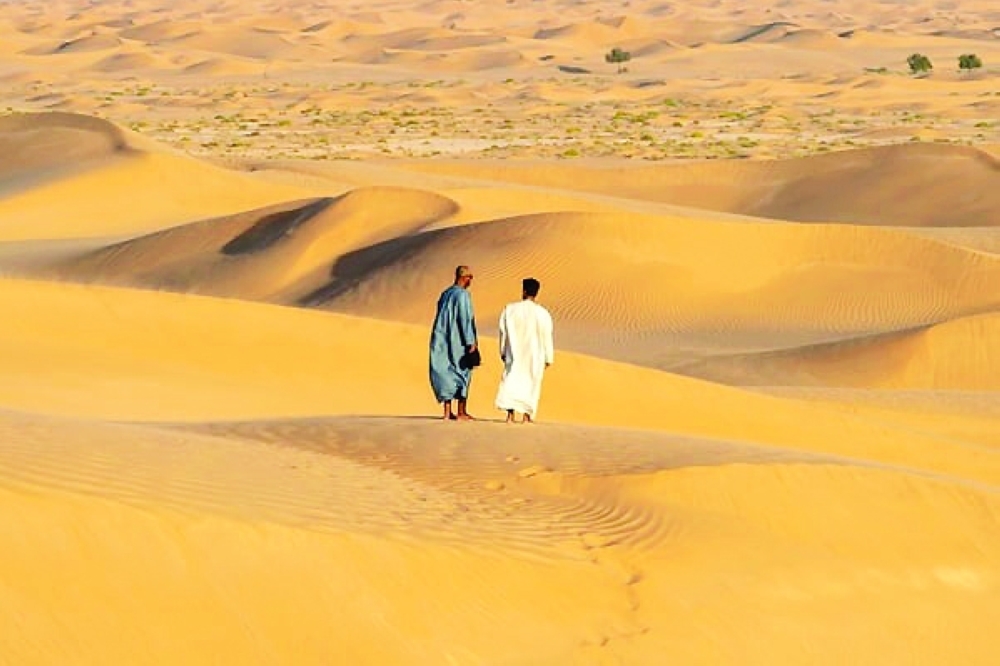





One of the world's largest deserts was once home to avast lake and river system, an international team revealed in research published on Wednesday.
Recent research suggested the so-called Empty Quarter, the vast desert of the Arabian Peninsula, had been in place for at least 11million years, making it one of the largest biogeographic barriers on Earth. Its presence limited the dispersal of early humans and animals between Africa and Eurasia.
But a new study published in Nature says the Empty Quarter, Rubal-Khali in Arabic, was regularly lush and green over a period of 8million years. At one point it featured a lake that reached a depth of 42 metres and an area of 1,100 square kilometres some 9,000 yearsago.
Favourable conditions in the area fostered grasslands and savannas and enabled human and animal migration until drought returned,according to the international team.
"Our work highlights the presence of an ancient lake, which reached its peak around 8,000 years ago, as well as rivers and a large valley shaped by water," said Abdallah Zaki, a postdoctoral fellow at the Jackson School of Geosciences, University of Texas.
Michael Petraglia, professor at Australia's Griffith University, said the "formation of lake and riverine landscapes, together with grasslands and savanna conditions, would have led to the expansion of hunting and gathering groups and pastoral populations across what is now a dry and barren desert."
"This is borne out by the presence of abundant archaeological evidence in the Empty Quarter and along its ancient lake and river networks."
"By 6,000 years ago, the Empty Quarter experienced a strong decline in rainfall, which would have created dry, arid conditions, forcing populations to move into more hospitable settings and changing thelifestyle of nomadic populations," Petraglia said.
The authors say that fossil evidence from the late Miocene suggests the presence at times of "water-dependent fauna (for example,crocodiles, equids, hippopotamids and proboscideans), sustained byrivers and lakes that are largely absent from today's arid landscape." —dpa
Oman Observer is now on the WhatsApp channel. Click here