




Global stocks tumbled for a second day on Friday over US President Donald Trump's sweeping tariff plans, with the sell-off deepening after China said it would impose additional tariffs of 34 per cent on all US goods.
Banking stocks cratered as investors fretted about growth and priced in far more central bank rate cuts, with benchmark 10-year US Treasury yields sliding to their lowest since October, after Trump slapped a 10 per cent tariff on most US imports and much higher levies on dozens of countries.
"If the current slate of tariffs holds, a Q2 or Q3 recession is very possible, as is a bear market," said David Bahnsen, chief investment officer at The Bahnsen Group.
"The question is, does President Trump seek some sort of off-ramp for these policies if and when we see a bear market in the stock market."
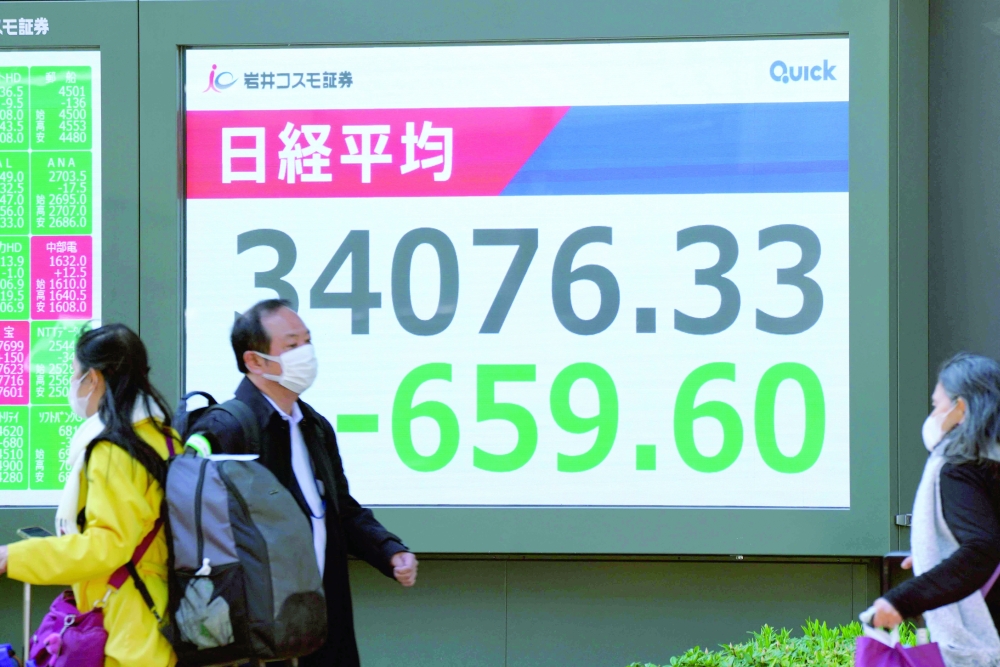
Europe's STOXX 600 dropped 4.4 per cent after sliding on Thursday and was on track for its biggest daily fall since the Covid-19 pandemic in 2020. Japan's Nikkei 225 slumped 2.8 per cent overnight for a second session running.
Futures for the US S&P 500 slumped 2.7 per cent after the cash index plunged 4.8 per cent on Thursday — the biggest drop since 2020.
Nasdaq futures were down 2.8 per cent after the index dropped 5.4 per cent on Thursday. The VIX index, a closely watched measure of expected volatility in US stocks, rose sharply to the highest since August, at 36. Oil prices slid on worries about growth and demand, with Brent crude futures down 6 per cent to $65.90 a barrel, the lowest in more than three years.
Traders on Friday were pricing in more than 100 basis points of Federal Reserve rate cuts this year, up from around 75 basis points on Wednesday and increased their bets on Bank of England and European Central Bank reductions too.
The risk of a US and global recession this year has risen to 60 per cent from 40 per cent after Trump's tariff announcements, J P Morgan said.
Lower interest rates — which dent lenders' margins — and worries about growth battered banking stocks, with the STOXX 600 banking index slumping 9.5 per cent.
That followed an 8 per cent rout for Japanese banks overnight and a sharp sell-off of Wall Street lenders on Thursday. Citigroup dropped more than 12 per cent, Bank of America sank 11 per cent and a host of other major lenders suffered similar falls.
"If we start seeing negotiations taking place, or Trump dialling back on some of these tariffs, that is the only possible route to allow for an abatement of the sell-off," said Aneeka Gupta, equity strategist and economist at WisdomTree.
"But for now that seems very unlikely."
As investors continued to hunt for safety, 10-year US government bond, or Treasury, yields dropped 17 basis points to 3.897 per cent, after falling 14 basis points on Thursday. Yields move inversely to prices.
The most obvious sign of nerves about the health of the US economy and markets was a 1.9 per cent drop in the dollar index on Thursday, the biggest fall since November 2022.
The dollar initially rebounded somewhat on Friday, but that faded after the China tariff announcement. The euro was last down 0.2 per cent after rallying 1.9 per cent on Thursday, with the dollar index 0.1 per cent higher.
The Japanese yen and Swiss franc, safe-haven currencies, rose around 0.6 per cent and 1 per cent respectively . The Australian dollar — sometimes seen as a barometer of investors' risk appetite and a proxy for the Chinese yuan — plunged 2.6 per cent.
Japanese 10-year government bond yields were set for their biggest weekly fall — at 37 basis points — since 1992 and last traded at 1.175 per cent. — Reuters
Oman Observer is now on the WhatsApp channel. Click here