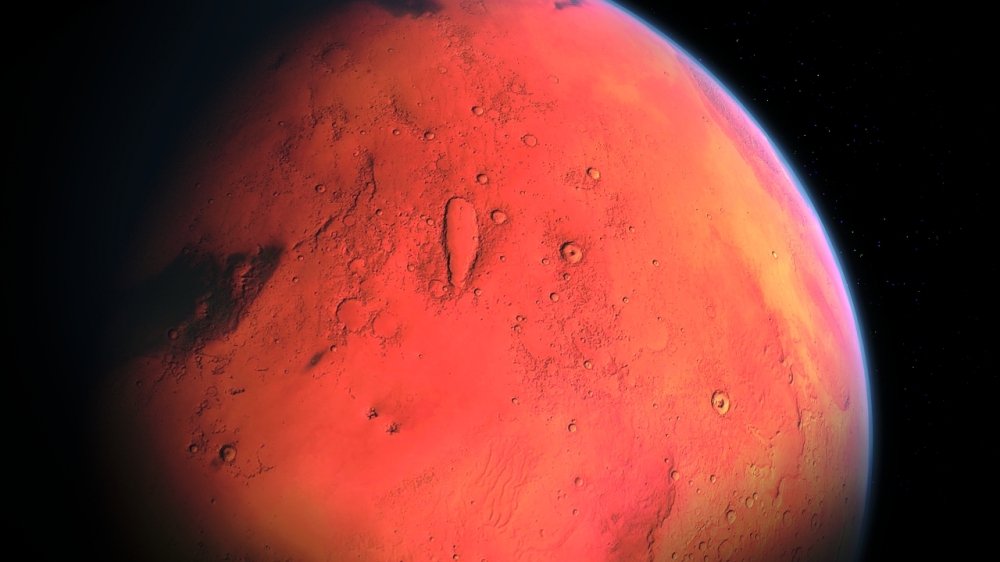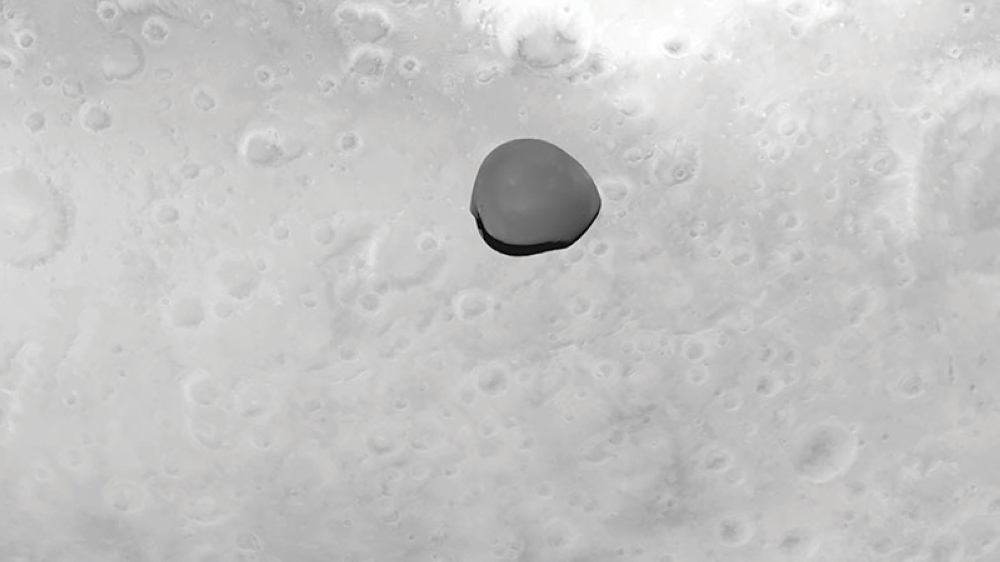





An asteroid-chasing spacecraft just swung past Mars on Wednesday. As it zipped by, it took hundreds of shots of the Red Planet, as well as several snaps of Deimos, one of the two small Martian moons.
The operators of the European Space Agency’s Hera spacecraft were bewitched by the sci-fi aesthetics of the pictures.
“We were waiting with impatience to get these images,” said Patrick Michel, the principal investigator for Hera, during a Thursday news conference at mission control in Darmstadt, Germany. When the first shots of the moon appeared, many of the Hera team members burst into cheers. “We’ve never seen Deimos in that way,” Michel said.
Navigators managed to fly Hera about 600 miles above Deimos, a craggy moon just 9 miles long. The pass shows the object in remarkable detail — a small island gliding above the crater-scarred Martian desert.
During the news conference, Ian Carnelli, the Hera project manager, was misty-eyed. “I’m going to get emotional,” he said. “The excitement was such that we didn’t get any sleep.” Hera was using Mars in what is known as a gravity assist, both accelerating the spacecraft and adjusting its flight path. But its mission operators also wanted to take advantage of the Martian flyby and use it to test the mechanical eyes that will allow Hera to study the asteroid it is targeting, Dimorphos. In the coming days, the mission’s scientists will reveal more photographs from Hera’s encounter with Mars, which may include shots of Phobos, the planet’s other moon.
As with any planetary flyby, there were some nerves about whether Hera would conduct its manoeuvres properly and end up on the right trajectory. “The spacecraft behaved very well,” said Sylvain Lodiot, the Hera operations manager. “We’re on track to the asteroid system.” Hera is headed to Dimorphos as a follow-up to a 2022 Nasa mission, the Double Asteroid Redirection Test. DART deliberately crashed a spacecraft into that asteroid, aiming to change its orbit around a larger asteroid, Didymos. That was a test of whether a dangerous space rock bound for Earth could be deflected in a similar manner.
The experiment successfully changed the orbit of Dimorphos. But the asteroid’s physical nature, and its full response to DART’s collision, remains unclear; some evidence suggests that it acted like a fluid when hit, rather than a solid, causing it to eject a lot of debris and reshape itself. — NYT
Oman Observer is now on the WhatsApp channel. Click here