




Muscat - A new study commissioned by Visa reveals a rise in consumer awareness and proactive security measures for digital payments in Oman.
The ninth annual Stay Secure study, which surveyed 5,800 adults across 17 diverse CEMEA markets, found that 98% of consumers in Oman now actively take precautions to secure their online transactions, showcasing increased savviness as digital payments gain momentum.
While over half (59%) of surveyed consumers in Oman acknowledge their vulnerability to scams, the increased adoption of security measures and preference for stronger authentication indicate a positive shift in consumer behavior since the last edition of the Stay Secure study in 2023. Consumers are now actively spotting red flags and verifying the legitimacy of online interactions, showing a marked increase in awareness.
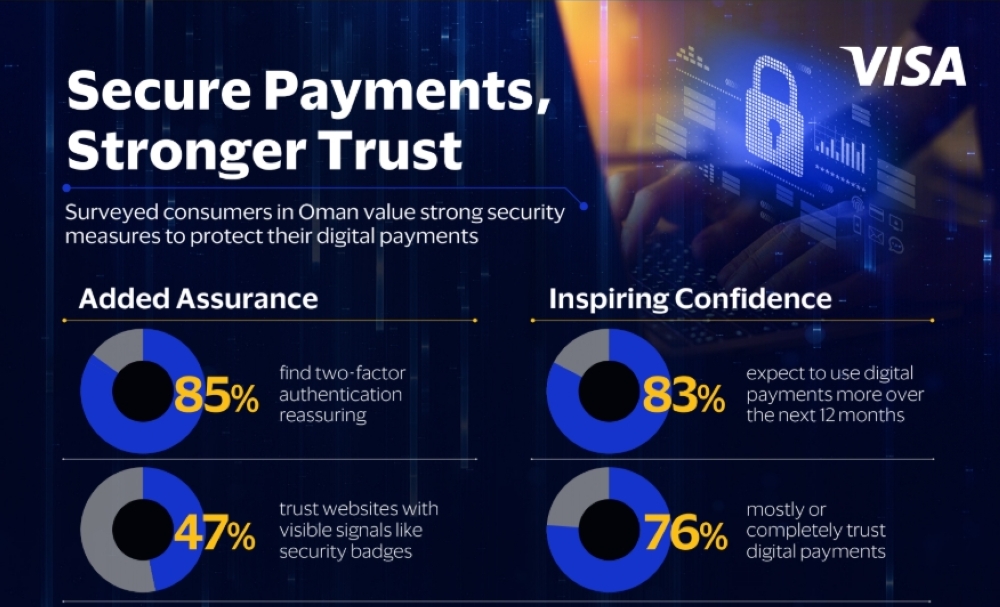
Other key insights emerging from the research bode well for the continued acceleration of digital payments in Oman, with over three-quarters (76%) of all respondents stating that they mostly or completely trust digital payments. Eighty-three percent (83%) of surveyed consumers anticipate that they will increase their use of digital payments over the next year.
"The digital payments landscape is evolving rapidly, and consumers across Oman are embracing its convenience while becoming more vigilant about security," said Neil Fernandes, Visa's Head of Risk for Middle East and North Africa. "Consumer education is our best defense against fraud, and industry collaboration makes this possible. As scams grow more sophisticated, the battle for security never stops. Consumers increasingly trust partners who take tangible steps to protect them.”
“We are delighted to launch Visa's latest Stay Secure research for Oman which underscores the important role retailers and financial institutions play in building and maintaining consumer trust in digital payments. Our latest research provides valuable insights that can inform industry strategies to enhance consumer trust protect the payments system and support the Oman government's efforts to grow the digital economy," said Manish Gautam, Visa’s Country Manager for Oman.
Falling for Scams. With growing reliance on digital payments, scams continue to proliferate. Over half (59%) of consumers in Oman have fallen for a scam, with 6% being victims on multiple occasions.
For example, 73% have been approached by someone requesting them to transfer money on their behalf.
Despite this, only 38% admit to being primarily responsible for falling victim to a scam, while 55% believe others are to blame.
While 51% of surveyed consumers in Oman have some degree of confidence in their ability to spot fraud, 99% worry their family or friends might fall for a scam. Eighty-one percent (81%) believe that Gen X digital payment users are most likely to get scammed online.
Consumers are highly wary of suspicious text messages or emails, recognizing these as potential scams designed to steal their money. The biggest red flag for fraud is a request to reset passwords or account information due to a data breach, with 60% of respondents ranking it as one of the top three most suspicious messages.
Nearly all (98%) surveyed consumers in Oman take measures to secure their payments. Fifty-six percent (56%) decline to respond to emails asking them to transfer money on someone else’s behalf, while 52% refrain from sharing card or account credentials. Forty-six percent (46%) have set also up text message alerts that notify them of any account transactions.
Consumers in Oman use a variety of digital payment methods, the most common being mobile payments (60%), bank transfers via mobile banking apps or platforms (56%), and card payments (55%). Sixty-five percent (65%) of the respondents find digital payments quicker and simpler than other methods, and 60% appreciate that they allow payments anytime, anywhere.
Mobile payments are also seen as one of the most secure digital payment methods. Meanwhile, peer-to-peer (P2P) payments are used by 43% of adults in Oman, yet only 7% consider them the easiest payment option. This highlights an opportunity to improve the user experience and simplify the process for greater adoption.
As digital payments gain traction, retailers, banks, and payment processors can build trust by requiring users to confirm purchases via texted codes or links and displaying trusted security badges. Eighty-five percent (85%) of the consumers in Oman feel safer when they must confirm their identity through a text code, while nearly half (47%) value visible security icons.
Oman Observer is now on the WhatsApp channel. Click here