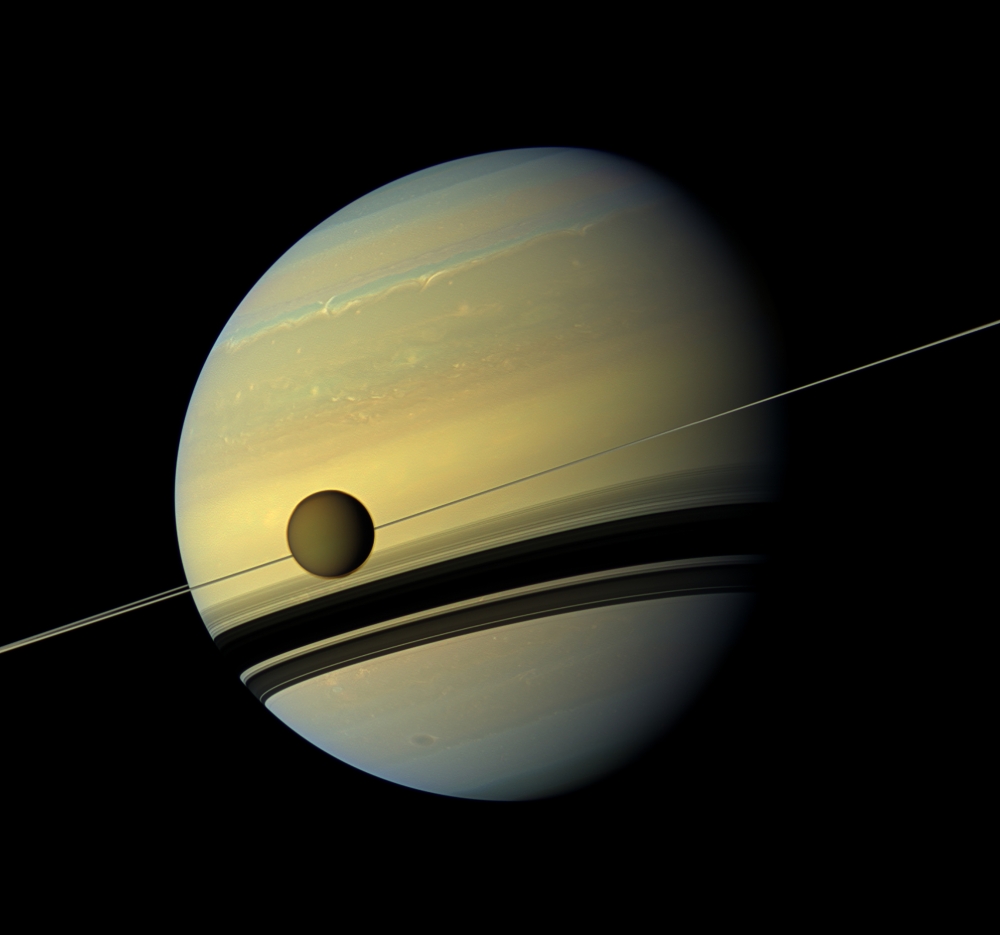





Astronomers say they have discovered more than 100 new moons around Saturn, possibly the result of cosmic smashups that left debris in the planet’s orbit as recently as 100 million years ago.
The gas giant planets of our solar system have many moons, which are defined as objects that orbit around planets or other bodies that are not stars. Jupiter has 95 moons, Uranus has 28 and Neptune has 16. The 128 in the latest haul around Saturn bring its total to 274.
“It’s the largest batch of new moons,” said Mike Alexandersen at the Harvard-Smithsonian Center for Astrophysics, an author of a paper announcing the discovery that will be published in Research Notes of the American Astronomical Society.
Many of these moons are rocks only a few miles across — small compared with our moon, which is 2,159 miles across. But as long as the rocks have trackable orbits around their parent body, the scientists who catalog objects in the solar system consider them to be moons. That is the responsibility of the International Astronomical Union, which ratified the 128 new moons of Saturn.
The forthcoming paper’s lead author, Edward Ashton of the Academia Sinica Institute of Astronomy and Astrophysics in Taiwan, will have naming rights for the objects. The moons were discovered in 2023 using the Canada France Hawaii Telescope at Mauna Kea in Hawaii. — JONATHAN O’CALLAGHAN
This article originally appeared in The New York Times.
Oman Observer is now on the WhatsApp channel. Click here