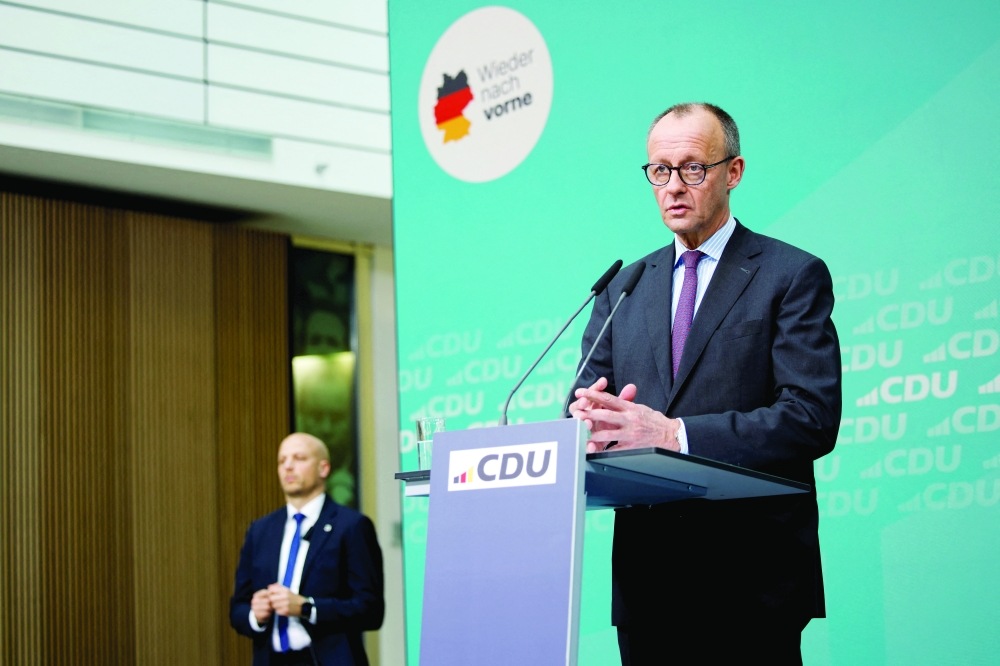





BERLIN: The prospect of a military spending boom by Germany unprecedented since the Cold War sent Europe's defence stocks soaring after Reuters reported the likely next government was mulling a fiscal sea change for Europe's biggest economy. Germany's likely next chancellor, Friedrich Merz, did not confirm that his conservatives and the Social Democrats were mulling setting up special funds worth nearly a trillion euros to finance urgent defence and infrastructure spending. But he said spending decisions had to be taken "with great urgency" after US President Donald Trump and his deputy harangued Ukraine's President Volodymyr Zelenskiy in the Oval Office on Friday, crystallising European fears that Washington had cooled on backstopping Europe's defence. "We must now show that we are in a position to act independently in Europe," he said. "The question of defence has priority."
News of the proposed funds sent shares in defence contractors including Thyssenkrupp, Hensoldt , Renk, Rheinmetall, BAE Systems and Leonardo jump by double-digit percentages on Monday morning. Neither party has confirmed that a special fund for defence worth 400 billion euros and for infrastructure worth as much as 500 billion euros were under discussion, a sum which combined would amount to 20% of German GDP. "There is an enormous need for investment and we won't create consent for it if we just invest in defence," said SPD General Secretary Matthias Miersch on Monday. "The two need to be considered together."
Merz made no comment on the numbers which, if confirmed, would amount to an extra 2% of economic output in spending over the next 10 years, kicking in from next year. "This would be about as much as the country has invested in East Germany since reunification," Deutsche Bank wrote in a note. "It would be a fiscal regime shift of historic proportions." Bild newspaper reported that an extraordinary session of parliament might be called for next Monday, which would allow the measure to be passed with the backing of the Greens — who on Monday urged Chancellor Olaf Scholz's outgoing government to approve a further 3 billion euros' funding for Ukraine.
The soaring shares reflect investor confidence that the makers of military vehicles, ammunition and other battlefield kit will be big winners from the bonanza.
Scholz's previous attempts to boost military spending also relied on a special fund, formally separate from Germany's 2 trillion euros in public spending.
They are legally tricky: a court ruling against his use of another fund paved the way for the collapse of his government and the election he lost last month, while the state auditor has called for their use to be reined in. The economic impact of the defence fund would be modest in the short term, Deutsche Bank wrote, since much of it would be spent on imports. The infrastructure fund, badly needed after years of frugality have left much of Germany's public realm, from bridges to railways, in a ragged state, would have a bigger impact. — Reuters
Oman Observer is now on the WhatsApp channel. Click here