




President Vladimir Putin has offered the US the opportunity under a future economic deal to jointly explore Russia's rare earth metal deposits that he says are greater than those of Ukraine. Putin's offer followed negotiations between the US and Ukraine over a draft minerals deal that is expected to be signed during Ukrainian President Volodymyr Zelenskiy's visit to Washington on Friday.
"I'd like to buy minerals on Russian land too. If we can, the rare earth. They have very good rare earth also, they both do (Russia and Ukraine)," Trump said, adding the deal would be beneficial for Russia as well as for the US.
China's control of 95 per cent of global production and supplies of rare earth metals, crucial for industries such as defence and consumer electronics, has focused the rest of the world on trying to develop their own supplies.
According to the Natural Resources Ministry, Russia has reserves of 15 rare earth metals totalling 28.7 million tonnes as of January 1, 2023 and that 3.8 million tonnes is the amount of reserves under development or ready for development.
Russia aims to become one of the top five rare earth metals producers with up to 12 per cent of the global market share by 2030, according to its sector development strategy.
Tomtor, located in the northern Siberian region of Yakutia, along with Zashikhinskoye in the Irkutsk region of Siberia, are central projects to Russia's plans to boost metals output. The launch of both extraction sites has been delayed.
High technology enterprises, which are part of Rosatom or industrial and defence conglomerate Rostech, are likely to be the main domestic consumers of rare earth metals.
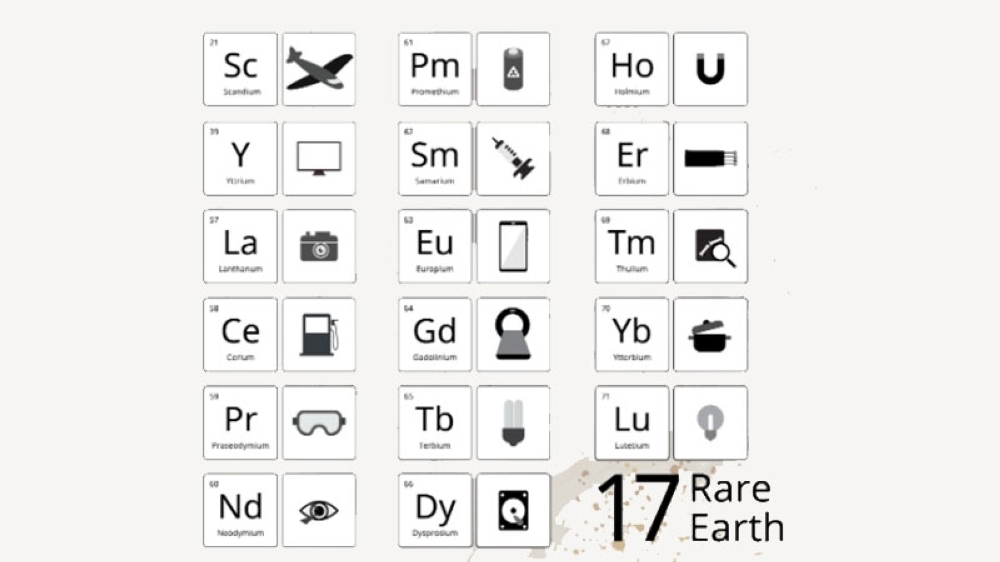
WHAT ARE THEY? Rare earths are a group of 17 elements including 15 silvery-white metals called lanthanides, or lanthanoids, plus scandium and yttrium.
WHAT ARE THEY USED FOR? They are used in a wide range of products including consumer electronics, electric vehicles (EVs), aircraft engines, medical equipment, oil refining and military applications such as missiles and radar systems.
WHAT COUNTRY IS THE BIGGEST PRODUCER? China accounts for about 60 per cent of global mine production and 90 per cent of processed and permanent magnet output. Beijing sets quotas on output, smelting and separation, which are closely monitored as a barometer of global supply.
WHAT ARE THEIR NAMES? In their periodic table order, they are: scandium, yttrium, lanthanum, cerium, praseodymium, neodymium, promethium, samarium, europium, gadolinium, terbium, dysprosium, holmium, erbium, thulium, ytterbium and lutetium.
WHICH ONES ARE MOST COMMON? Lanthanum and cerium are among the most common rare earth metals. Lanthanum is used in camera lenses and lighting. Cerium is used in catalytic converters, which reduce combustion engine emissions.
Neodymium and praseodymium are in demand for permanent magnets used in EV motors and wind turbines.
ARE THEY RARE? They are not rare in the sense that they are uncommon; some are more common than lead, for example. But they tend to be spread thin around the Earth's crust in small quantities and mixed together or with other minerals, so larger deposits are difficult to find and costly to extract.
WHAT ENVIRONMENTAL IMPACT DO THEY HAVE? Processing rare earths often involves the use of solvents, which can produce toxic waste that pollutes the soil, water and atmosphere. More environmentally friendly technologies are being developed, but they are not yet widely used.
Certain types of rare earth ores also contain radioactive thorium or uranium, which is often removed using acid.
For this reason, development of the sector faces health and environmental regulatory hurdles. — Reuters
Oman Observer is now on the WhatsApp channel. Click here