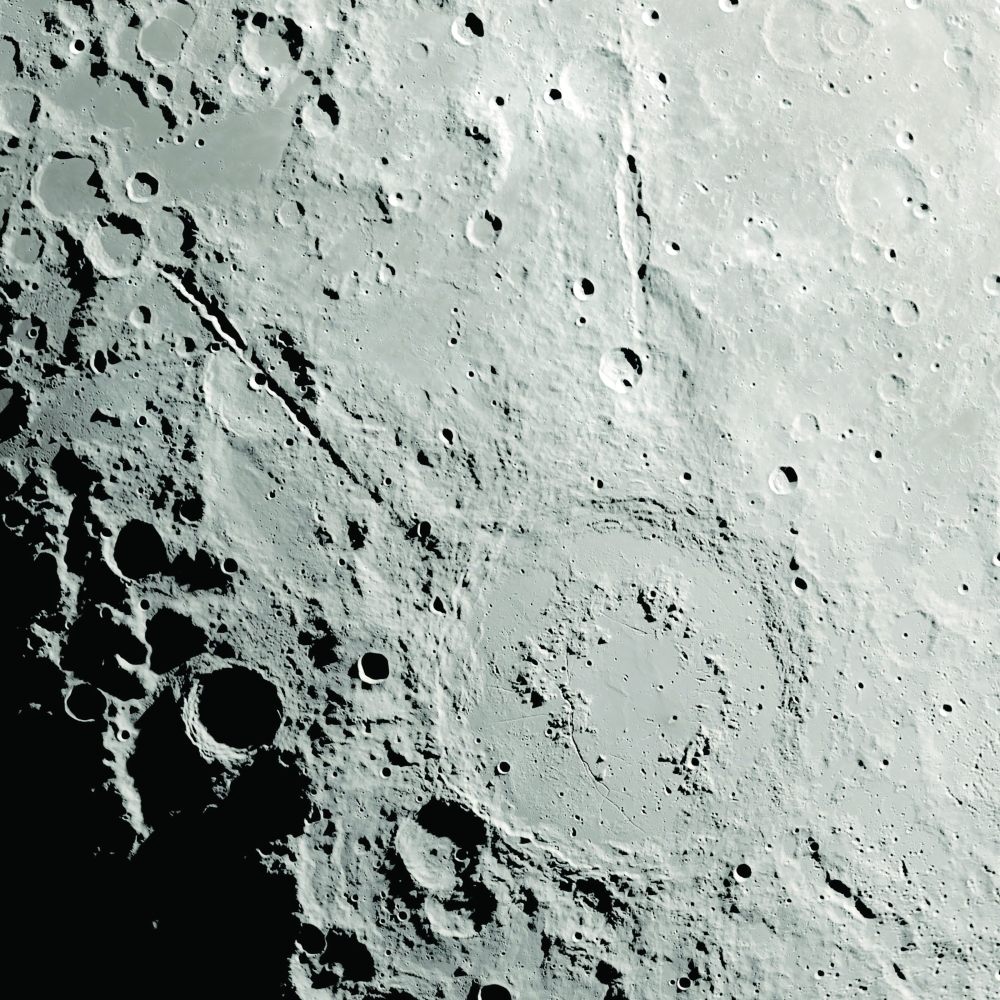





Two remarkable canyons, located near the Moon's south pole, challenge the Grand Canyon in both depth and length. These lunar formations, known as Vallis Schrödinger and Vallis Planck, contrast sharply with the winding expanse of the Grand Canyon in Arizona, appearing instead as straight channels that seem as if the Moon's crust were sliced cleanly.
Unlike the Grand Canyon, which was sculpted gradually over millions of years by the Colorado River, Vallis Schrödinger and Vallis Planck were formed in a matter of minutes. This rapid formation followed a cataclysmic event approximately 3.8 billion years ago, when a 15-mile-wide meteor collided with the Moon. The impact was so intense that it created a crater about 200 miles wide, penetrating as deep as 15 miles into the lunar crust.
The process that shaped these vast canyons was astonishingly quick, taking less time than it would to bake a frozen pizza. The meteor impact, reminiscent of the one that led to the extinction of the dinosaurs on Earth 66 million years ago, unleashed a barrage of rocks—referred to by planetary scientists as ejecta rays—that cascaded down in quick succession, sculpting the canyons, which measure over 165 miles in length and more than 1.5 miles in depth.
David Kring, a scientist from the Lunar and Planetary Institute in Houston, remarked on their extraordinary scale, highlighting that these formations were carved within ten minutes, compared to the 5 to 6 million years taken to form the Grand Canyon. In a recent study published in the journal Nature Communications, Kring and colleagues, including Danielle Kallenborn and Gareth Collins from Imperial College London, developed a mathematical model to analyze the sequential impacts of giant rocks that created the canyons, using NASA's photographic evidence of craters along their paths.
Kring illustrated the violent nature of the impacts, comparing the striking of rocks between one and five kilometers in diameter hitting the Moon at speeds exceeding 2, 000 miles per hour to a series of explosions. Their analysis determined that the energy required for the canyon formations was more than 130 times that of a simultaneous detonation of every nuclear weapon on Earth.
Interestingly, the canyons suggest that the impacting asteroid or comet struck at an angle, even though the resulting crater is nearly circular. The linear formations of Vallis Schrödinger and Vallis Planck radiate from the Schrödinger basin, but their projected intersection point lies to the south, indicating the meteor's trajectory and suggesting an absence of debris in the south pole area. This finding offers a positive outlook for NASA's Artemis program, which aims to land astronauts near the Moon's south pole.
The complexities of how the impact generated the narrow ejecta rays, instead of a more uniform dispersion, remain a topic of debate amongst scientists. Kring speculated that pre-existing craters might have focused the debris, contributing to the distinctive patterns observed. Anderson emphasized that even small-scale laboratory experiments she conducted demonstrated similar ejecta ray phenomena. The exact reasons for these variations in density and arrangement within the ejecta curtain remain a puzzle, underscoring the intricate and chaotic nature of planetary impacts. —NYT
Oman Observer is now on the WhatsApp channel. Click here