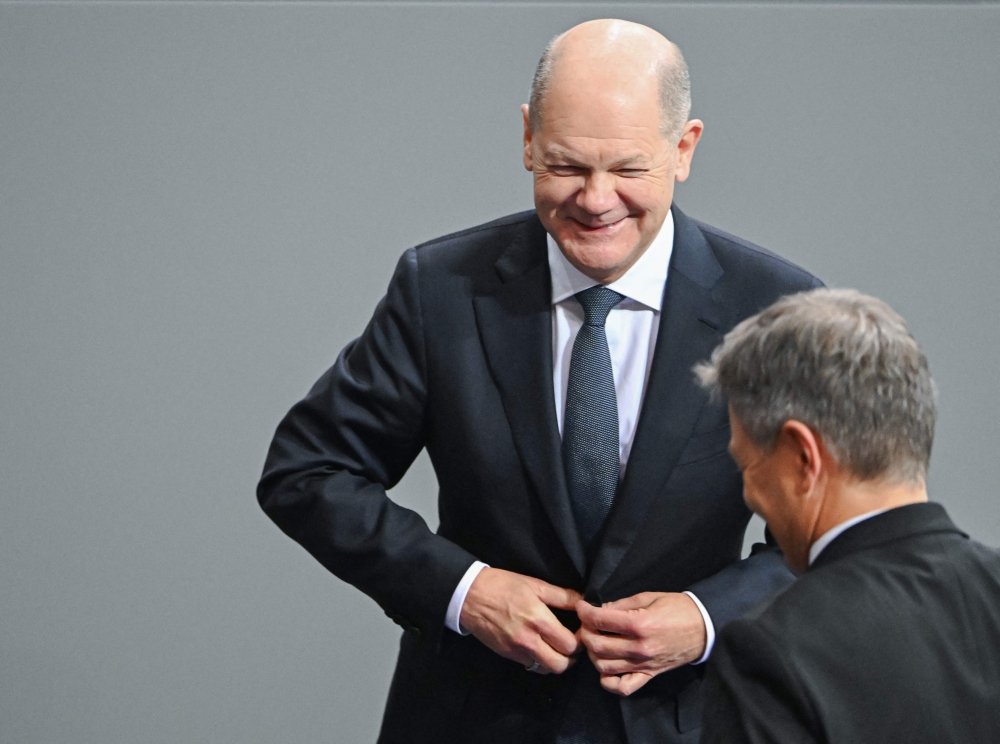





BERLIN—The German government collapsed Monday as Chancellor Olaf Scholz lost a confidence vote in parliament, deepening a crisis of leadership across Europe amid mounting economic and security challenges.
The war in Ukraine has escalated. President-elect Donald Trump is set to take office in the United States, raising new questions over Europeans’ trade relations and military defense. And France’s government fell this month.
Now, Europe’s largest economy is in the hands of a caretaker government, before elections early next year.
German lawmakers voted to dissolve the existing government by 394-207, with 116 abstaining.
The collapse of the government, just nine months before parliamentary elections had been scheduled, was an extraordinary moment for Germany. The elections, now expected Feb. 23, will be only the fourth snap election in the 75 years since the modern state was founded, reflecting a new era of more fractious and unstable politics in a country long known for durable coalitions built on plodding consensus.
Scholz had little choice but to call for the confidence vote after his three-party coalition splintered in November. This ended months of bitter internal squabbling and left him without a parliamentary majority to pass laws or a budget.
The country’s political uncertainty could last for months, with a new permanent government potentially not forming until April or May.
Seven parties will go into the campaign for parliament with a realistic chance of gaining seats, and some on the political fringes — especially on the right — are poised for strong showings, according to polls. Scholz is widely expected to be ousted as chancellor. Polls currently suggest the conservative Christian Democrats are poised to finish first.
The campaign is likely to be dominated by several issues that have roiled Europe in recent years. Germany and France, traditionally the two most influential countries in the European Union, are mired in debates over how best to revive their struggling economies, breach growing social divides, ease voter anxieties over immigration and buttress national defense.
They and their EU partners are looking warily toward Russia, where President Vladimir Putin has escalated threats about the use of nuclear weapons amid Moscow’s war against Ukraine.
They are also vexed by their economic relationship with China, which has grown into a formidable competitor for many of their most important industries but has not become the booming consumer market for European products that leaders long envisioned.
And they are bracing for the start of the new presidential term for Trump, who has threatened a trade war and the end of the United States’ commitment to the NATO alliance that has guaranteed Europe’s security for 75 years.
The combination of challenges has proved politically unsettling. President Emmanuel Macron of France on Friday named his fourth prime minister in a year and is under mounting pressure to resign. Macron says he will stay in office and try to repair the deep fissures in his government over the 2025 budget.
Scholz’s government faced similar budget challenges, along with growing concerns about how to rebuild the German military in the face of a belligerent Russia and Trump’s criticism of NATO.
It is an inopportune time for Germany to be plunged into a grueling winter election campaign and a political freeze that could last until a new government takes power.
“The timing is absolutely terrible for the EU — basically, these multiple crises are hitting the EU at the worst possible time, because the bloc’s traditional engine is busy with itself,” Jana Puglierin, of the European Council on Foreign Relations, said, referring to Germany and France.
The war in Ukraine and the need to bolster Germany’s military — and what that will cost — will be among the urgent issues likely to dominate the election campaign, along with the floundering economy, failing infrastructure, immigration and the rise of the political extremes.
Badly behind in the polls, Scholz is planning to highlight his caution when supplying Ukraine with weapons, especially sophisticated offensive hardware.
Under Scholz’s watch, Germany became the biggest European donor of weapons to Ukraine, according to a ranking by the Kiel Institute for the World Economy, a research organization in Germany. But he prefers to point to his decision not to export the long-range missile system Taurus. Many in Berlin saw the chancellor’s phone call with Putin in November as a way to attract those voters who are nervous about Germany’s passive involvement in the war.
During what was billed as his first campaign speech last month, Scholz criticized his main opponent, Friedrich Merz, leader of the Christian Democratic Union, accusing him of provoking Russia with remarks that suggested he would provide Ukraine with more military aid if Russian forces continued bombing civilian infrastructure.
“I can only say: Be careful! You shouldn’t play Russian roulette with the security of Germany,” Scholz said.
The strategy appears to be working. Since the end of the three-party coalition, Scholz’s personal approval ratings have risen somewhat. But his party is still polling at around 17%, about half of what the conservatives are projected to win.
Scholz will have to fight hard to persuade voters to give him another chance. For now, it is Merz, a longtime figure on the political stage, who is widely expected to be the next chancellor, given his party’s strong lead in polls.
The three other mainstream parties are also led by well-known politicians, two of whom held important posts in the government: Christian Lindner, leader of the pro-business Free Democrats, whose falling out with the chancellor helped precipitate the collapse of the coalition; and Robert Habeck, the economic minister and lead candidate for the left-leaning Greens.
But in Germany’s fractious political landscape, no single party is likely to win an outright majority, leading to potentially tricky negotiations to build a coalition more functional and durable than the one that failed.
That necessity probably means that opponents cannot be criticized too heavily because they are all potential coalition partners. But it may also present mainstream parties with difficult decisions about whom they chose to work with.
All of the mainstream parties have said they would refuse to partner with the far-right Alternative for Germany, parts of which are being monitored as a threat to the constitution by the domestic security services. Nonetheless, the party — which is known as the AfD and is polling at about 18% — appears to be gaining ground.
In closely watched state elections in September, both the AfD and a newer, extreme-left party, the Sahra Wagenknecht Alliance, had their best showings ever. But mainstream parties still consider them an anathema, making it hard to form governing coalitions in those states.
The results could portend equally messy coalition haggling in Berlin after a national vote, though the political fringes are less popular nationally than they are in those eastern states.
But given the likely vote tally, many political watchers predict a return of the grand coalition of the center between the Christian Democrats and the progressive Social Democratic Party, which governed Germany for 12 of the past 20 years.
This article originally appeared in The New York Times.
Oman Observer is now on the WhatsApp channel. Click here