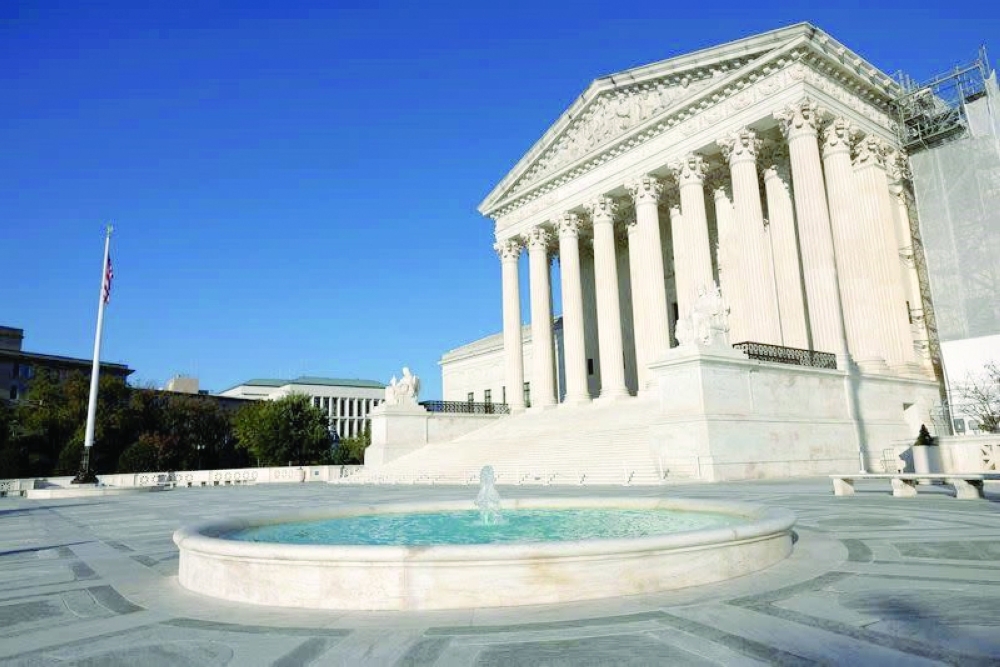





Following the 2020 election that he lost to Joe Biden, Donald Trump and his allies brought a storm of legal cases challenging the outcome. After losses in lower courts, some of these cases made their way to the US Supreme Court, whose conservative justices Trump was hoping would ultimately come through for him. They did not, as the court opted not to hear his appeals.
The last three of these were rejected four months post election. Even before Election Day on Tuesday, a few cases already have reached the justices, one echoing an issue litigated four years ago over Pennsylvania mail-in ballots.
These cases may herald the beginning of what legal experts expect would be a wave of litigation after the election, in particular if Trump loses again in a race that opinion polls indicate is very tight.
"The question isn't whether they're going to bring these claims. The question is whether the court is going to even give them the slightest time of day. And the likelihood is they won't," said David Becker, executive director of the Center for Election Innovation & Research, a non-partisan group that promotes voter participation and election security.
The Supreme Court, whose 6-3 conservative majority includes three justices appointed by Trump, this year already has boosted his campaign, reversing in March a decision by Colorado's top court to disqualify him from the Republican primary election ballot in that state under a US constitutional provision involving insurrection. And in July it also ruled that he has broad immunity from criminal prosecution over his efforts to overturn his 2020 loss.
Following the 2020 election, Trump and his allies unsuccessfully filed more than 60 lawsuits trying to overturn the results, often based on false claims of widespread voting fraud or other irregularities.
This election cycle, federal and state courts around the country have been inundated with pre-election litigation - 196 challenges across 40 states so far in 2024, according to Democracy Docket, a litigation tracking website founded by Democratic election lawyer Marc Elias. The Republican National Committee is involved in dozens of suits as part of a massive "election integrity" effort it has said is aimed at making sure votes are properly counted and that people do not vote illegally. The effort has suffered a string of setbacks in courts.
Democrats see this litigation blitz as a prelude to Republicans again contesting a potential Trump loss.
Challengers would face high hurdles leveraging pre-election legal claims - particularly ones unsuccessful in lower courts - into post-election attempts to contest the results, said attorney Jason Torchinsky, an election law expert who often has represented Republicans.
"I am skeptical that the Supreme Court is going to determine the outcome of the election unless it is shockingly close," Torchinsky said.
There is precedent for the Supreme Court deciding a presidential election's outcome. In 2000, the justices halted a Florida vote recount in a fight over a few hundred votes, effectively handing the presidency to Republican George W Bush over Democrat Al Gore.
There currently are fewer avenues for Supreme Court intervention than in the past. Unlike in 2020, when the justices overturned certain federal courts that had ordered last-minute rules changes to facilitate voting amid the Covid pandemic, such developments this time have been rare. State courts, too, have dealt quickly with numerous lawsuits ahead of the election, notably in Georgia, which like Pennsylvania is among several closely contested states expected to decide the presidential race. In Georgia, judges blocked new rules devised by an election board controlled by Trump allies that could have impeded certification of the state's results.
Congress also reduced the potential for post-election chaos by passing the bipartisan Electoral Count Reform Act. That 2022 law revamped the way a presidential election's outcome is certified in Congress in an effort to avert a repeat of January 6, 2021, when Trump supporters stormed the US Capitol in a failed attempt to prevent lawmakers from certifying Biden's victory.
Both Trump and Harris will use "whatever legal tools are available to them," said Wendy Weiser, a voting rights expert at New York University's Brennan Center for Justice.
But, Weiser added, "All of the scenarios where (the justices) might be invited to get involved are either farfetched or so legally implausible that I think that they're not high risk."
There are, nevertheless, certain circumstances under which the Supreme Court could get involved, with the likelihood increasing as the winner's margin of victory narrows.
The Pennsylvania mail-in ballots case in which Republicans are seeking Supreme Court intervention could take on greater significance if the state emerges as decisive in the race. - Reuters
Oman Observer is now on the WhatsApp channel. Click here