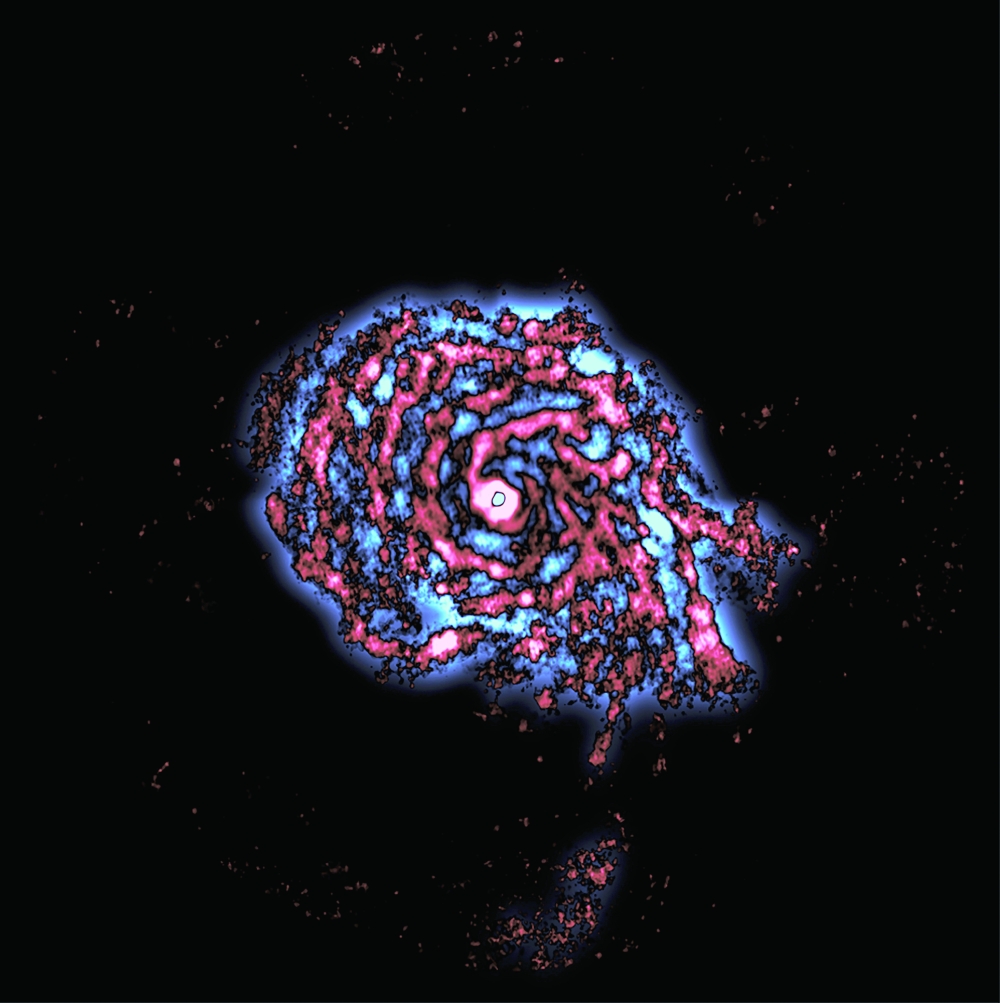





When it comes to making a planet, astronomers have long subscribed to what Cassandra Hall, an astronomer at the University of Georgia, refers to as the “bottom up” approach: The gas and dust swirling around a young star slowly clumps together over millions of years, and its gravity shapes it into a rounded object.
But a discovery by Hall and her colleagues, published in the journal Nature, suggests that the picture might be more complex.
In a star system 508 light-years from Earth, the researchers found conditions that support an alternative “top down” approach to planet formation, in which the fertile material circling a young star rapidly collapses into a planet. The mechanism, known as gravitational instability, could explain the existence of mysterious worlds known to follow wide orbits around relatively young stars.
The cosmic matter stirring around an infant star is ripe with planet-forming potential. The matter is known as a protoplanetary disk, and its rotation is generally driven by the gravity of its host star. But if that disk gets large enough, it can be influenced by its own gravity, causing the young star system to become unstable. Regions of higher density in the disk emerge in the form of spiral arms.
If those arms pull in enough material, they can fragment into clumps, which could further collapse into giant gas planets, said Jess Speedie, a graduate student in Canada who led the study under the supervision of Ruobing Dong, an astrophysicist. And this could happen in only a few hundred years, rather than the millions of years theorized for the “bottom up” approach known as core accretion.
Gravitationally unstable disks might be the wombs of planets too enormous and distant from their host stars to be explained by core accretion. In 2022, astronomers reported the discovery of a protoplanet with nine times the mass of Jupiter around AB Aurigae, a star that is no more than 4 million years old. — KATRINA MILLER/NYT
Oman Observer is now on the WhatsApp channel. Click here