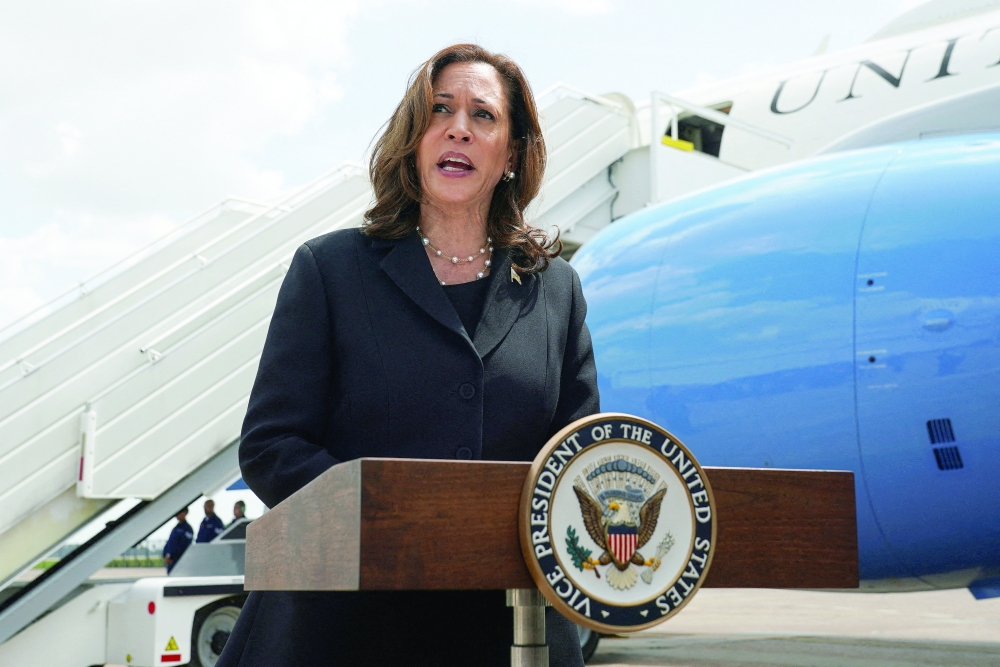
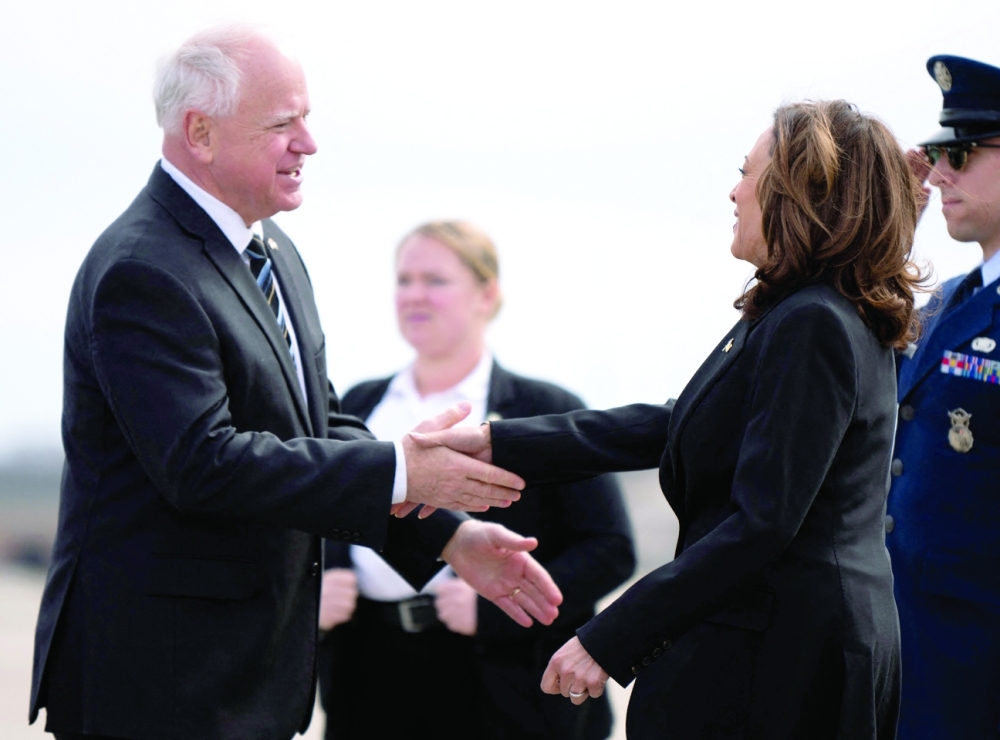
LONDON — When Vice President Kamala Harris said last week in Chicago, “You can always trust me to put country above party,” it struck a familiar note in Britain, where the new prime minister, Keir Starmer, used much the same phrase throughout the Labour Party’s relentless march to power earlier this summer.
It’s not the only parallel between Starmer and Harris, the Democratic presidential nominee. Both have shaken off or soft-pedaled some of their earlier positions as they try to broaden their party’s appeal. Both are former public prosecutors, who declare a ringing commitment to the rule of law. Both are operating in a volatile environment, where law and order is threatened by extremist elements.
In Starmer’s case, he was hit with anti-immigrant riots only weeks after his victory, after a deadly knife attack on a children’s dance class was followed by false claims, amplified by people on the far right, that the assailant was a Muslim asylum-seeker. (The attacker was born in Britain, police said, and his parents were Rwandan Christians.) In Harris’ case, some analysts believe she could face unrest if she defeats former President Donald Trump in a close race and Trump or his supporters reject the results.
“These are different countries with different political systems, but there often seem to be parallels in their political trajectories,” said Steven Fielding, an emeritus professor of political history at the University of Nottingham.
Labor and the Democratic Party have long shared tips and swapped strategies, most vividly during the era of Bill Clinton and Tony Blair. So it was little surprise that key members of Starmer’s political brain trust were in demand at the Democratic National Convention to offer lessons from Labour’s recent victory.
“There was huge interest in how we won our campaign,” said Jonathan Ashworth, a close ally of Starmer and a former Labour member of Parliament, who was part of a British delegation that included the party’s political strategist, Morgan McSweeney, and Starmer’s communications director, Matthew Doyle.
Ashworth also served as a cautionary tale. A rising Labour star, he unexpectedly lost his seat because of a backlash over his party’s stance on the war in the Gaza Strip, which critics said was too slow to condemn the killing of Palestinian civilians. Drawing on that bitter experience, he said he had warned Democrats not to be complacent, even if the Gaza protests in Chicago were not as disruptive as expected.
“The anger was not captured in the polling; it wasn’t captured in my street campaigning until the last few days,” Ashworth said. “They’ve got to make sure people don’t stay home because of Gaza.”
On the plus side, Ashworth said he saw parallels in how Starmer and Harris have framed the challenge of immigration, with both emphasizing the need to crack down on the gangs that traffic migrants across borders.
Geoff Garin, a Democratic pollster who is advising Harris, said there were common threads in voter behavior in the British and American elections, but that the similarities between the campaigns was a coincidence. “The way Vice President Harris is meeting the moment is organic to her,” Garin said, “and I’m sure that is true of Prime Minister Starmer as well.”
A Polling Divide
The last time Britain and the United States seemed on the same political circadian rhythm was in 2016 when the Brexit vote in June presaged Trump’s election that fall. The calendar has lined up similarly this year, with Britons going to the polls on July 4, five months before the Americans.
Yet until an embattled President Joe Biden withdrew from the race last month, the two countries appeared to be diverging, at least in terms of the outcome for the major parties. Now the swift ascent of Harris has political analysts wondering whether the left-of-center victory in Britain could foretell a similar result in the United States.
There are many caveats, however: Trump is polling neck and neck with Harris, nationally as well as in several swing states, while Labour held a double-digit lead over the incumbent Conservative Party for 18 months before the election. In a year of anti-incumbent fervor around the world, Starmer ran as a challenger against a deeply unpopular government. Harris, meanwhile, represents the Biden administration against a challenger, albeit a polarizing one who also served in the White House.
Fielding noted the difference between Britain’s winner-take-all system, which amplified the Labour majority, and America’s Electoral College. “Harris could get a majority of the popular vote and still lose,” he said.
However different the mechanics of their races, Labour and the Democrats have sounded several of the same themes. The “country above party” phrase is calculated to identify both parties as patriotic, challenging the traditional claim of Conservatives and Republicans to that mantle.
For the first time, Labour opened its conference in Liverpool in October by singing the national anthem, “God Save the King.” In Chicago, the crowd waved a sea of American flags, a spectacle more common at a GOP convention.
Like Starmer, who ran for party leader in 2020 on a more left-wing platform than his election campaign this year, Harris has changed some positions. She hardened her stance on border policy and reversed her opposition to fracking. He, after being elected, suspended Labour ministers in Parliament who balked at his refusal to abolish a cap on child welfare payments to families.
Also like Starmer, Harris has been a cautious campaigner, refusing to be drawn out on sensitive issues. In Britain, that is known as the “Ming vase strategy,” after Blair, who was likened to a man “carrying a priceless Ming vase across a highly polished floor,” as he nursed his party’s lead before the 1997 vote.
Blair and Clinton were both adherents of the “third way,” a 1990s-era centrist political philosophy, which they adapted to modernize their parties and make them more appealing to a broader pool of voters.
Three decades later, there is no comparable formula for Harris to fend off Trump. His populist message parallels that of Britain’s Nigel Farage and his insurgent hard-right party, Reform UK, which racked up more than 4 million votes. The anti-immigrant passions that fueled Reform’s vote found a more violent expression in the riots.
To some observers, the shared background of Harris and Starmer as prosecutors raises questions about whether she would respond to any postelection unrest like he did. Encouraged by the prime minister, British authorities arrested more than 1,000 people who took part in the riots and have charged more than 700.
Although Harris shares Starmer’s left-of-center political instincts, she presented herself in Chicago as an unyielding protector of the rule of law. She accused Trump of sending “an armed mob to the U.S. Capitol, where they assaulted law enforcement officers,” and painted him as a serial lawbreaker.
“What if, instead of another Jan. 6, we have a series of right-wing riots around immigration?” said Harold Hongju Koh, a professor at Yale Law School and a former legal official in the Obama administration, who has taught at Oxford. “It’s really about what Kamala Harris would do.”
This article originally appeared in The New York Times.
Oman Observer is now on the WhatsApp channel. Click here