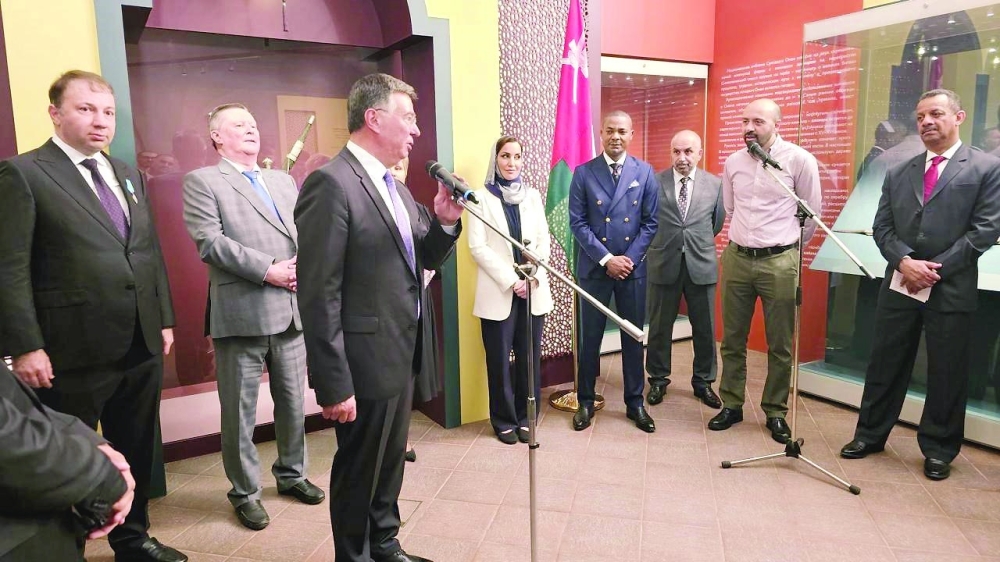





MUSCAT: The National Museum on July 11, inaugurated the exhibition and events of 'Oman Day' under the title 'The Splendour of Silver: Treasures from the Omani Court' at the Kremlin Museums in Moscow, Russian Federation.
The event was held under the auspices of Olga Lyubimova, Minister of Culture of the Russian Federation. The exhibition celebrates the manifestations of Omani silver as a historically leading industry, showcasing a curated collection of items belonging to the Sultans of Oman in Muscat and Zanzibar. The exhibition will run until September 29.
The opening ceremony was attended by Her Highness Dr Mona bint Fahd al Said, Assistant Vice-Chancellor for International Cooperation at Sultan Qaboos University and Vice-Chairperson of the Board of Trustees of the National Museum; Jamal bin Hassan al Mousawi, Secretary-General of the National Museum; Hamood bin Salim al Towaiya, Ambassador of the Sultanate of Oman to the Russian Federation; Sergei Ivanov, Special Representative of the President of the Russian Federation for Environmental Protection, Ecology, and Transport; Vladimir Osintsev, Deputy Minister of Culture of the Russian Federation; Dr Elena Gagarina, Director-General of the Kremlin Museums in Moscow, along with several officials and cultural and museum enthusiasts.
The exhibition features several museum artefacts that highlight the charm of silver within the cultural context of the Sultanate of Oman, showcasing opulence and elegance. The exhibition sheds light on the diverse roles of silver, a precious metal that was not only used in royal courts but also in everyday life. It highlights the craftsmanship of Omani silversmiths and offers visitors the opportunity to explore a world where silver becomes a symbol of beauty, protection, and the essence of Omani craftsmanship.
The exhibition is divided into five main sections namely the Omani khanjar (dagger), the Culture of Scent, the Art of Silversmithing, Traditional Fashionwear, and the Nobility Fashionwear of prominent Omani figures in East Africa at that time.
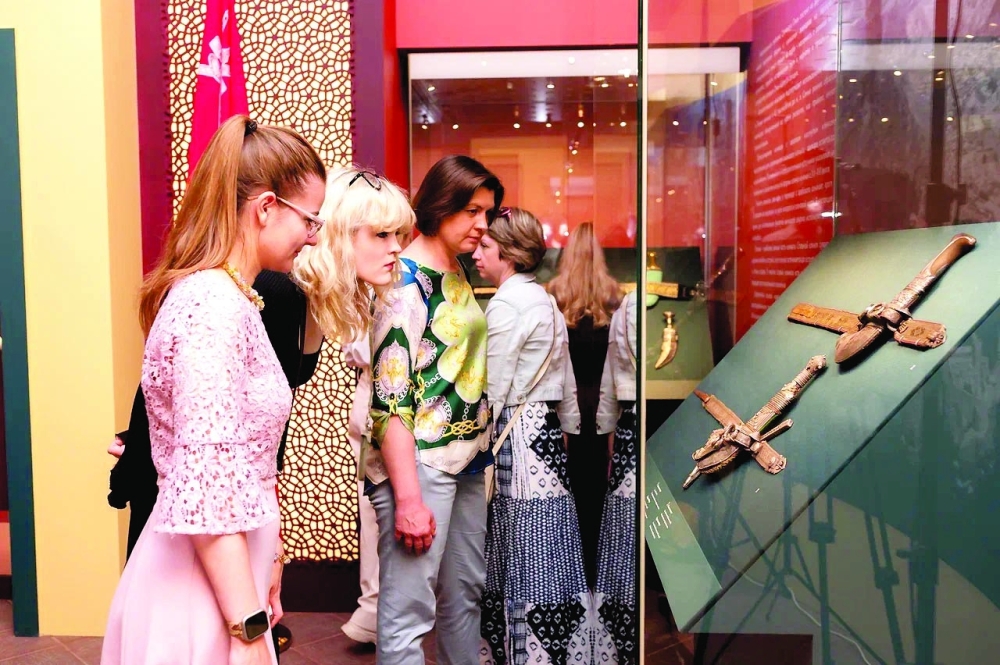
The Omani khanjar section highlights the emblem of Oman, featuring two crossed swords and a khanjar. It showcases the evolution of the Omani khanjar throughout history, dating back to the third millennium BCE. Dutch East India Company documents from 1672 mention Imam Sultan bin Saif al Yaarubi wearing a khanjar similar to those worn today, stating, "“His Highness ... had a belt around his middle, in which he wore a dagger which was crosswise covered with silks yarns.”
This section also focuses on key accessories of the khanjar, including various types of Omani khanjars such as the Saidi khanjar, named after the ruling al-Said family and distinct in its design. The section also includes a Janbiya gifted by former Yemeni President the late Ali Abdullah Saleh to the late His Majesty Sultan Qaboos bin Said.
The Culture of Scent section highlights how fragrant scents are an integral part of Omani daily life, joyous occasions, and welcoming and bidding farewell to guests. Among the items displayed are perfume bottles from 1983 made of crystal, 24-karat gold, and silver, representing the first aromatic innovations by Amouage perfumes named 'Amouage Gold.' The shape of the men's perfume bottle is inspired by the Omani khanjar, often gifted by the late His Majesty Sultan Qaboos bin Said to his guests and dubbed "the Gift of Kings." These bottles contain three natural treasures of Oman – frankincense, rose, and amber – alongside other rare ingredients.
The Art of Silversmithing section focuses on silver jewellery, linking the design and shape of the piece to the region, market, or workshop where it was crafted. Some distinctive designs have remained unchanged for centuries. Jewellery serves for adornment or protection, often featuring Quranic verses for safeguarding. Silver jewellery adorned with natural materials such as coral and red agate wards off evil and brings good luck, while red and orange beads offer protection. Silver jewellery was traditionally given to women as part of their dowry, providing financial stability.
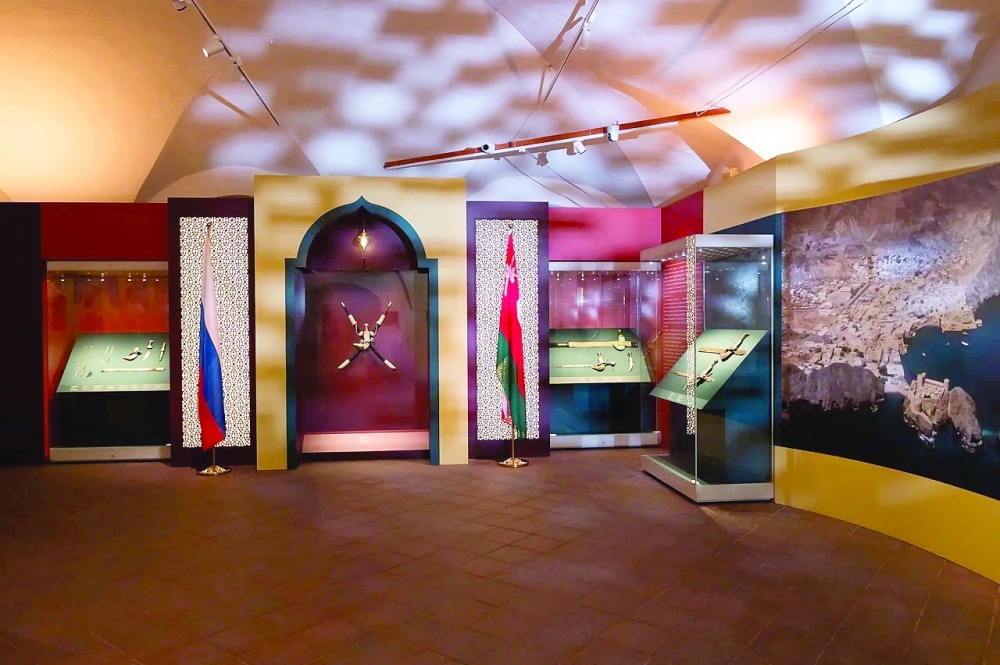
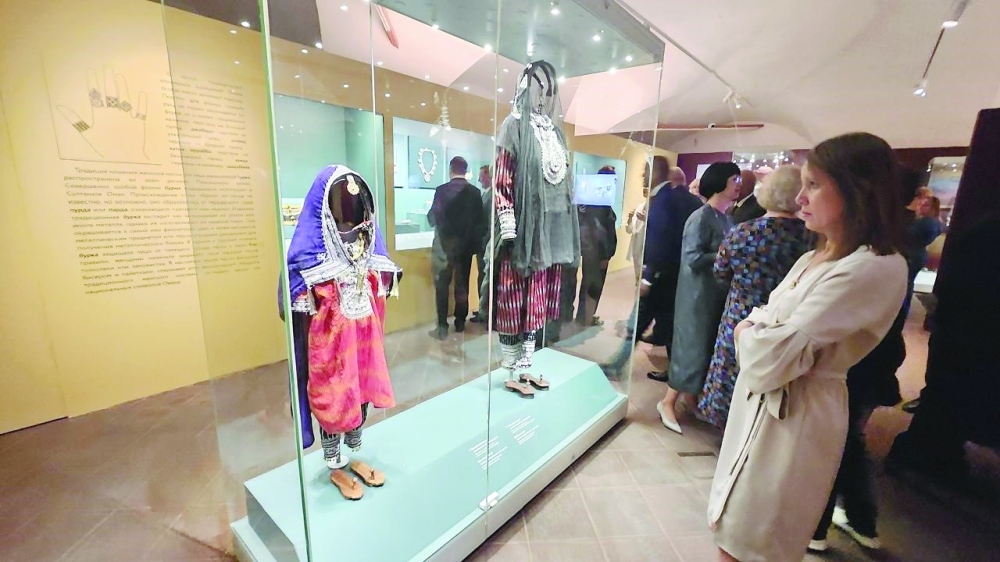
The Traditional Fashionwear section illustrates the functions of Omani attire, stemming from religious beliefs, identity affirmation, modesty, protection, and adornment. Women's attire includes headpieces, jewellery, masks, and beauty tools, while men's clothing is practical, comprising belts, clips, and silver-decorated weapons, including the khanjar. Notable exhibits in this section include a shield and weapon belonging to His Majesty Sultan Haitham bin Tarik.
The Nobility Fashionwear section features items such as the attire of Shaikh Sir Mbarak bin Ali al Hinawy, a prominent Omani figure in East Africa born in Mombasa in 1896, appointed as its governor in 1937, and later as the representative of the Sultan of Zanzibar along the entire East African coast. He was a renowned historian and scholar of Swahili culture, awarded several honours, including the Order of the British Empire in 1959, which conferred upon him the title "Sir." This section also includes jewellery and a mask belonging Sayyidah Salma bint Said al Busaidiyah from the 19th century. Sayyidah Salma bint Said is notable for writing her autobiography in German, titled "Memoirs of an Arabian Princess from Zanzibar," the first autobiography by an Arab woman in history, offering a fascinating glimpse into life at the royal court in the 19th century and showcasing the quality and variety of attire and jewellery worn by court women.
Additionally, the exhibition includes a portrait of Sultan Said bin Sultan al Busaidy, Sultan of Oman and Zanzibar, considered the greatest of the Busaidy Sultans due to his long reign and significant achievements. He ascended the throne under the guardianship of his cousin Badr bin Saif and established one of the most important empires of the time, encompassing Oman, parts of the north western Gulf coast such as Bandar Abbas, Qeshm, and the east coast of Africa from Ras Guardafui in Somalia to Ras Delgado in northern Mozambique, extending into the African continent up to the Kingdom of Buganda and the upper Congo.
Her Highness Dr Mona bint Fahd al Said, in her opening speech remarked: "This is a glorious day as Oman blossoms in the heart of the Kremlin Moscow. This Omani presence, fragrant with incense, is a unique and distinguished civilisational and cultural twinning that is deepening and harmonising through the strategic cultural partnership between these two great nations. It is a rich experience filled with wonder, beauty, and great historical heritage. Both countries have deep historical roots, emerging from ancient civilisations. Oman is the offspring of a vast empire that connected continents — Asia with parts of Africa, alongside India, Somalia, North Africa, and the fringes of Baluchistan and Makran. Russia is the cradle of the Eurasian civilisation that never saw the sun set."
She added: "The museum links between the two countries serve as a vital artery for veins pulsating with unparalleled human beauty. The deep and exciting cooperation between the museums of the Russian Federation, such as the Kremlin Museums hosting our joyous event today, the Shchusev State Museum of Architecture, the State Hermitage Museum in Saint Petersburg, and the Tretyakov Gallery in Moscow, with the National Museum in the Sultanate of Oman, will continue to pulse with the human memory in the journey of life, construction, and human existence on this earth."
Jamal bin Hassan al Mousawi, said, "Today we celebrate the masterpieces of Omani silver and treasures from the Omani court, embodying the richness and elegance of Omani history and expressing a global art language that transcends borders. Each piece tells a story that enhances understanding and cooperation between the two countries. This is the first museum exhibition of its kind for Oman in Moscow, organised within the framework of cultural diplomacy pursued by the National Museum and extending the close cooperation between the National Museum and the museums of the Russian Federation."
He also noted that the exhibits provide an exploration of Omani culture, centring on the Omani khanjar, from ancient weapons to modern perfume bottles known as "the gift of kings," inspired by the khanjar. The exhibits highlight the enduring significance of craftsmanship and cultural symbolism in Omani society, reflecting the intersection of royalty and art, symbolising diplomatic exchange and cultural pride. The silver jewellery on display throughout the exhibition showcases both tradition and innovation, attesting to the excellence of Omani craftsmanship and adding a metaphysical meaning (philosophy beyond nature) to silver as a protective amulet, emphasising the spiritual connection between material objects and cultural beliefs.
Hamood bin Salim al Towaiya, remarked: "The cooperative and friendly relations between the Sultanate of Oman and the Russian Federation are positively evolving on various levels. Since culture is the key to bringing peoples closer, the 'Oman Day' exhibition and events at the Kremlin Museums in Moscow reflect the rich Omani historical legacy and enhance Russian citizens' understanding of the distinguished cultural role of the Sultanate of Oman."
Dr Elena Gagarina, Director General of the Moscow Kremlin Museums, said: "The most prominent and significant pieces have been selected from the collection of the National Museum of the Sultanate of Oman, in addition to items that were part of the personal collections of the Omani Sultans. The exhibition also showcases traditional works by Omani craftsmen, including exquisite silverware, silver-adorned items, weapons, traditional national costumes, exceptional accessories, and a collection of belongings of notable figures in Omani history."
She added: "In 2025, the National Museum of the Sultanate of Oman will open the 'Russia and the East: International Relations and Cultural Influences' exhibition from the Kremlin Museum’s collection. We hope that these events will attract the interest of the Russian and Omani public and contribute to expanding cultural dialogue."
Oman Observer is now on the WhatsApp channel. Click here