




GAZIANTEP, Turkey — Finally, 106 days after the ambulances rushed their battered bodies to the hospital, the couple were cleared to leave.
Ibrahim Karapirli hobbled back from physical therapy on crutches to protect his aching leg. His wife, Pinar, wrangled their twin toddlers, unsure how she would care for them with her one remaining arm.
The couple was still mourning their two sons who were killed when a powerful earthquake pancaked their six-story apartment building in southern Turkey before dawn last February.
Ibrahim and Pinar piled about a dozen plastic bags holding their possessions atop a wheelchair, bade the nurses goodbye, and went to their car.
“God, please don’t let us end up here again,” Pinar said.
Ibrahim drove, despite a hulking plastic brace on his right leg. He was eager to return to work and find a safe new home for his family if it were possible for them to feel safe anywhere. As he pulled into traffic, a Turkish pop song mourning a lost love came on the stereo.
“Day after day, I have to forget about you,” the singer crooned. “Did you think our tears were over?”
For Ibrahim, 47, Pinar, 35, and their 2 1/2-year-old twins, Elcin and Eray, the year since the Feb. 6 earthquake has been a painful quest to cobble together a new life, piece by piece, trauma by trauma.
The 7.8-magnitude earthquake, followed by a second violent temblor hours later, was the broadest and deadliest in the region in hundreds of years. It ambushed people as they slept, killing more than 53,000.
The Turkish government has promoted its recovery efforts, focusing on the aid delivered and the new buildings rising across the quake zone. But for the Karapirlis, who live in Gaziantep, that aid has failed to address their most pressing needs.
They have worked to repair and relearn to use their bodies. They have struggled to find a home they do not fear will kill them the next time the ground shakes.
The family members have had some hopeful moments, when strangers welcomed them into a new home, when their injuries waned, and when the twins finally stopped fearing their parents. And they have found new ways to care for each other while coping with the bottomless ache of all they have lost.
The Collapse
That four of the six members of the Karapirli family are alive at all is in many ways miraculous.
When the earthquake struck at 4:17 a.m., Pinar screamed to wake up the couple’s older sons, Erdem, 10, and Enes, 9. Then she rushed to the hallway to hand the twins to Ibrahim. They heard an overwhelming crack as the floor fell and the ceiling crashed down.
They landed in the dark, trapped in ruins. Ibrahim was kneeling, with rubble crushing his right leg. He was still holding the twins, who were unhurt.
Pinar was buried nearby with her arms raised. She had so much debris in her mouth initially that she could not scream. Erdem was entwined with her.
They called out to each other to see who was alive. Enes did not respond. Pinar had seen a hunk of concrete fall on him, and they guessed he was dead.
It was snowing, and they talked as the cold seeped in and the hours ticked by.
On the second day, they heard voices. Ibrahim yelled, and a rescue crew burrowed down. By the time they reached them, Erdem had fallen silent.
Finally, 38 hours after the collapse, the rescuers took the twins from Ibrahim.
Ibrahim told them to save Pinar. They dug her out, laid her on a stretcher, and lowered her to the street with a crane.
Then came Ibrahim, who wanted to smoke a cigarette and say goodbye to Erdem before he left the site. But the rescuers worried about his condition and rushed him to the hospital.
“I didn’t get that last cigarette,” he said, “nor to embrace my son.”
The boys’ bodies were recovered and buried in a nearby cemetery. Their parents were in such grave condition that neither could attend their funeral.
Building a Family
“It was a life going beautifully,” Ibrahim said. “Then you fall into nothingness.”
Their family had begun years before after Ibrahim saw Pinar in a photograph on a relative’s phone. Dating her was not an option because her family was conservative, so Ibrahim’s family went to visit hers. They were married less than two months later and danced with their friends to a live band.
Ibrahim worked in a bank, wore his hair in a slicked-back ponytail, and lived his joys and furies out loud. Pinar was a few years out of high school and spoke softly even among her friends, who considered her fiercely loyal. He was 32, she was 20.
Their first son, Erdem, was born in 2012. Enes followed the next year.
The couple stretched their finances to buy an apartment that had been seized by the bank. It had four bedrooms and a large balcony overlooking a park.
The boys learned to walk, talk, and ride bikes in the streets, later wearing small ponytails like their father’s.
Ibrahim eventually left his job at the bank, and he and Pinar opened a sweet shop. A Bouquet of Cake, they called it. Soon, they were getting 100 orders for Valentine’s Day and had 6,000 followers on Instagram.
In 2020, Pinar discovered she was pregnant again. One day, she returned home from a checkup looking terrified.
“Did you miscarry?” Ibrahim asked.
“No, it’s worse,” she said. “Twins!”
They arrived in June 2021, and Pinar could not keep up with four children and the shop, so they sold the business and Ibrahim got a job as a finance manager for a municipal company that built affordable housing.
The Hospital
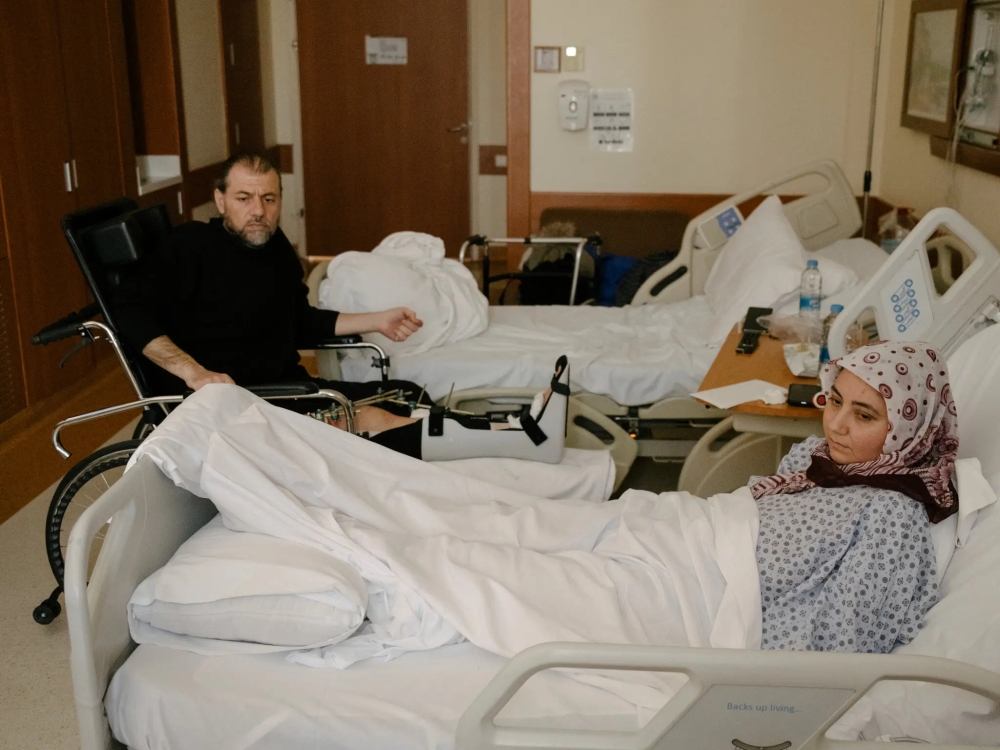
When the rescuers pulled out Ibrahim, his femur was broken in at least seven places, and his lower leg was crushed. The doctors operated repeatedly, screwing a rod to his bone to hold it together. Pinar’s face was so swollen that the twins did not recognize her. After three weeks of surgeries to save her arm, the doctors decided it should be amputated.
Ibrahim consoled Pinar, who said she feared not being able to wash or feed the twins or take care of herself. Ibrahim promised to help, to bathe and dress her, and never to grow tired of her.
“I will be your arm,” he told her.
With time and repeated surgeries, they stabilized and began rehabilitation. Ibrahim wore a leg brace and did excruciating physical therapy every day for his knee and ankle. He could barely walk, so he used a wheelchair to get to the hospital’s outdoor terrace.
Pinar could walk, but a large wound in her armpit opened and bled if she moved her shoulder too much. Still, when the Muslim holy month of Ramadan ended in April and guests visited the family for the holiday, she was well enough to receive their gifts of sweets and flowers. She served snacks, tea, and coffee as they crowded onto a couch, a cot and a wheelchair around Ibrahim’s and Pinar’s beds.
The adults tried to keep the mood festive, but Ibrahim’s worries pulled him into forlorn silences. When would they heal enough to leave the hospital? Where would they live? How would they go on without their sons?
A New Home
As summer approached, Ibrahim’s and Pinar’s thoughts turned to life after the hospital. The question was where to live. Their own home was gone; any talk of rebuilding was highly preliminary; and they could not crowd in with Ibrahim’s brother’s family.
A man Ibrahim knew through work offered them an apartment rent-free for six months and promised to charge a reasonable rent thereafter. It was their only real option, so they took it.
Approaching their new home, they were troubled to see how tall the building was: nine stories on top of a parking garage and a row of shops. Their apartment was on the top floor, leading them to imagine how far they would fall if it, too, collapsed in a quake.
They arrived to find their door decorated with streamers and balloons and the interior outfitted with furniture and housewares provided by a friend. The neighbors gave Pinar a bouquet of white flowers.
Everyone stepped inside and Pinar followed, looking at the group and smiling.
“Welcome,” she said and broke into tears.
More than two months after they left the hospital, Ibrahim was walking down the hall when his leg let out a crack so loud that his mother heard it in the living room and ran to find him moaning on the floor. He had broken his femur again, meaning yet another surgery and a second rod in his leg.
After a small earthquake in August frightened them, they started sleeping in a vacation bungalow owned by the municipality near a reservoir outside of town. It was a simple, one-story structure, with two rooms and basic furniture, built for tourists.
But they never really settled there, either.
‘I Made the Salad on My Own’
Pinar struggled to close zippers and open jars. To fasten her veil on her head. The indignities of living with one arm never ceased.
But she adjusted. She got a purse she could close with one hand. The twins helped her change their diapers.
She felt helpless in the kitchen, until an inspiring woman came to her aid.
Ezgi Kasisari was a Turk living in Britain. She had lost the use of her left arm to multiple sclerosis and had taken to social media to show how she was not only adapting, but living exuberantly.
Pinar saw a video of Ezgi cutting food with one hand on a special cutting board and messaged to ask where to get one. They chatted. The next time Ezgi came to Turkey, she brought Pinar a cutting board.
It had rubber feet and a suction cup to keep it steady, pins to hold produce and meat in place for cutting with one hand and an attachment for opening jars.
Soon after, Pinar sent a photograph of chopped carrots, greens, tomatoes and cabbage to a WhatsApp group of her friends.
“Girls, I made the salad on my own,” she wrote. “I also cooked today’s meal without getting help from anyone.”
In late December, a sharp pain erupted in Ibrahim’s abdomen and he was hospitalized with severe gallbladder inflammation.
After yet another surgery, he and Pinar returned to the apartment on the ninth floor with the cracks in the walls because the weather had gotten too cold to sleep at the bungalow.
Their efforts to find a new home of their own had hit dead ends.
Recently, Pinar’s friend Fatma Kaplan took her to buy a new iron. As they drove home, Pinar told Fatma that the woman who had bought the sweet shop from her and Ibrahim had gotten in touch to say that she had found old voice messages from the boys on the business’s WhatsApp account. Did Pinar want them?
“Are you crazy?” she had replied. “Of course, I want them!”
There were more than a dozen messages, each a time capsule from a lost life.
Pinar played them out loud in the car.
There the boys were, their voices pouring out of her phone, joking, engaging in adolescent antics and saying they were soooooo hungry to persuade her to make a favorite dish.
Fatma cried so much that she could not see the road. Pinar laughed with joy.
“When you listen to them, you smile,” she said. “As if they are alive. As if they have just gone somewhere and will come back soon. It is not like a year has passed. It is like yesterday.”
This article originally appeared in The New York Times.
Oman Observer is now on the WhatsApp channel. Click here