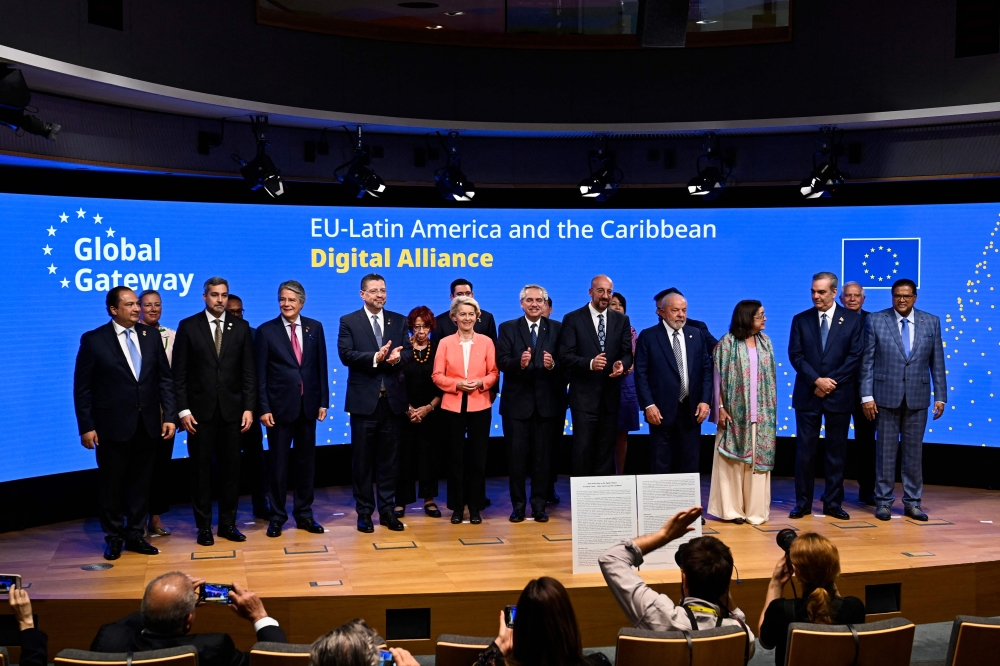





BRUSSELS: A summit between European, Latin American and Caribbean leaders on Tuesday highlighted their differences over how to tackle Russia's war in Ukraine.
As leaders from the EU and the Community of Latin American and Caribbean States (CELAC) met for a second day, diplomats were struggling to agree the language of a final communique.
A handful of Latin American countries -- diplomats cited Nicaragua, Cuba and Venezuela as the most adamant -- were opposed to agreeing a text holding Moscow responsible for the conflict.
Other leaders from the region were ready to sign up in support of Ukraine's sovereignty, but put more emphasis on the need for a negotiated peace, rather than a victory for Kyiv, in their their public declaration.
Leaders arriving for the talks expressed confidence that a text would be agreed, but some Europeans expressed frustration with the holdouts' views on the conflict.
Latin American leaders came to the summit hoping to make progress unblocking a stalled EU trade deal, and some Caribbeans wanted to discuss reparations for European colonialism and slavery.
They have expressed some frustration with Europe's insistence on the importance of the war in Ukraine, but officials still hoped to be able to release a final text.
Irish leader Leo Varadkar said talks had gone late into the night on Monday and that the debate was a valid one, even if the conclusion should be clear.
"A lot of countries will point out that there are other conflicts in the world, and I hear that," he told reporters.
"And they will say that other conflicts in the world perhaps haven't got the same amount of attention as Ukraine."
In the opening session on Monday, CELAC president Prime Minister Ralph Gonsalves of Saint Vincent and the Grenadines, cited the crisis in Haiti, the Palestinian struggle for statehood and various wars in Africa as deserving of European attention.
And he warned that "sanctions and blockades" triggered by the war in Ukraine would only serve "to penalise the most vulnerable populations.
As the leaders met in Brussels, Russia refused to extend a deal to allow Ukrainian grain exports through the Black Sea, drawing a warning from the UN that millions of the world's poorest would "pay the price". — AFP
Oman Observer is now on the WhatsApp channel. Click here