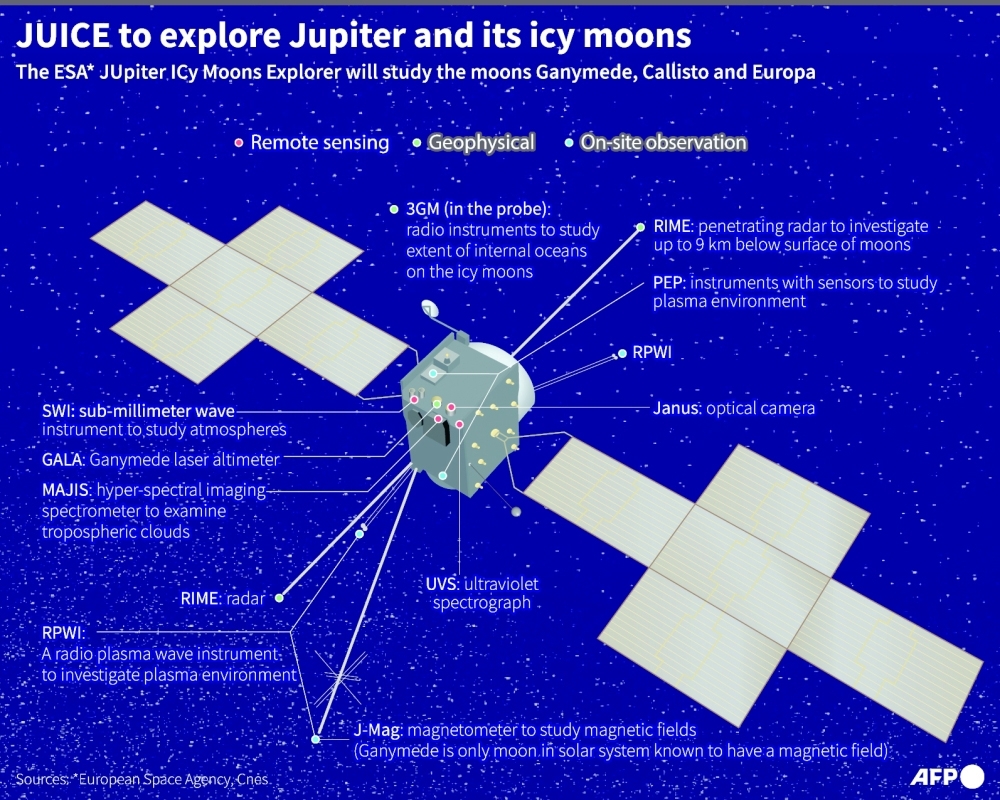





Kourou: The launch of the European Space Agency's JUICE mission to Jupiter's icy moons was postponed on Thursday for 24 hours due to bad weather, according to contractor Arianespace.
As lightning threatened, the delay was announced to the Jupiter control room in Kourou just minutes before the planned lift-off at 1215 GMT, as many people, including Belgium's King Philippe, were ready to watch the launch.
A few kilometres away, the Ariane 5 rocket was on its launch pad, prepared to blast off with its payload, the Jupiter Icy Moons Explorer (JUICE).
The next attempt will now take place within 30 seconds of the same time on Friday, the European Space Agency said.
The unmanned, six-tonne spacecraft aims to embark on an eight-year journey through the Solar System to discover whether Jupiter's icy moons are capable of hosting extraterrestrial life in their vast, hidden oceans.
The mission will mark the first time Europe has sent a spacecraft into the outer Solar System, beyond Mars.
The launch of the 1.6 billion-euro ($1.7 billion) mission comes during a crisis for European space efforts, after Russia pulled its Soyuz rockets in response to sanctions over the war in Ukraine.
Combined with repeated delays to the next generation Ariane 6 rockets and the failure of Vega-C's first commercial flight last year, Europe is struggling to launch its missions into space.
Thursday will mark the penultimate launch for Ariane 5 before it is replaced by the Ariane 6.
Scientists from Imperial College London have led the development of one instrument, known as the magnetometer.
Called J-MAG, it will measure the characteristics of magnetic fields of Jupiter and Ganymede - the only moon known to produce its own magnetic field.
Dr Caroline Harper, head of space science at the UK Space Agency,told PA: "The launch of Juice marks years of hard work and collaboration by scientists, engineers and space agencies all over the world, but the journey is far from over.
At its destination, the spacecraft will spend at least three years making detailed studies of the planet and three of its largest moons,Ganymede, Europa and Callisto.
Engineers and mission controllers have a very short launch window to send the spacecraft on its journey.
This is because Venus and Earth need to be in the perfect position for Juice to perform a manoeuvre known as gravitational assist, where it will use the gravity of these planets to slingshot towards Jupiter.
Juice is not equipped to search for signs of life but its aim is to explore the conditions that could support life.
Beneath the ice crust of Europa is thought to lie a huge ocean of liquid water, containing twice as much water as Earth's oceans combined.
But scientists are more interested in Ganymede, Jupiter's largest moon, which is thought to have a salty ocean beneath its icy shell.
One of Juice's key goals is to explore this body of water and determine whether this world may be habitable.
Data gathered from the J-MAG instrument will help characterise the depth and salt content of Ganymede's ocean.
If all goes well, Juice should reach Jupiter in July 2031 and will have enough fuel to make 35 flybys of the icy moons before orbiting Ganymede from December 2034.
Once the spacecraft runs out of fuel, Juice will perform a controlled crash into Ganymede, marking the end of the £14 billion mission. — Agencies
Oman Observer is now on the WhatsApp channel. Click here