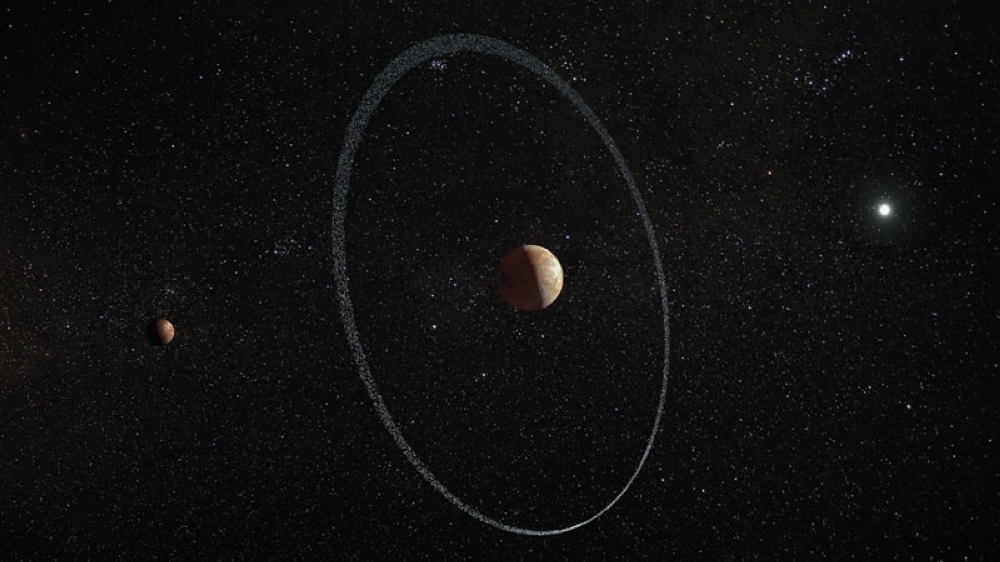





A small icy world far beyond Neptune possesses a ring like the ones around Saturn. Perplexingly, the ring is at a distance where simple gravitational calculations suggest there should be none.
“That’s very strange,” said Bruno Morgado, a professor in Brazil. Morgado is the lead author of a paper published in the journal Nature that describes the ring that encircles Quaoar, a planetary body about 700 miles in diameter that orbits the sun at a distance of about 4 billion miles.
Quaoar (pronounced KWA-wahr, the name of the creator god for the Indigenous Tongva people) is a little less than half the diameter of Pluto and about a third of the diameter of Earth’s moon. It is likely to be big enough to qualify as a dwarf planet, pulled by its gravity into a round shape. But no one can say that for sure, because images taken by even the most powerful telescopes have revealed Quaoar as only an indistinct blob. The blob also has a moon, Weywot (the son of Quaoar in Tongva belief).
Quaoar orbits the sun in the Kuiper belt, a region of frozen debris beyond Neptune that includes Pluto.
The ring is not visible in telescope images. Rather, astronomers found it indirectly, when distant stars happened to pass behind Quaoar, blocking the starlight. From 2018 through 2021, Quaoar passed in front of four stars, and astronomers on Earth were able to observe the shadow of the eclipses, also known as stellar occultations.
— KENNETH CHANG/ NYT
Oman Observer is now on the WhatsApp channel. Click here