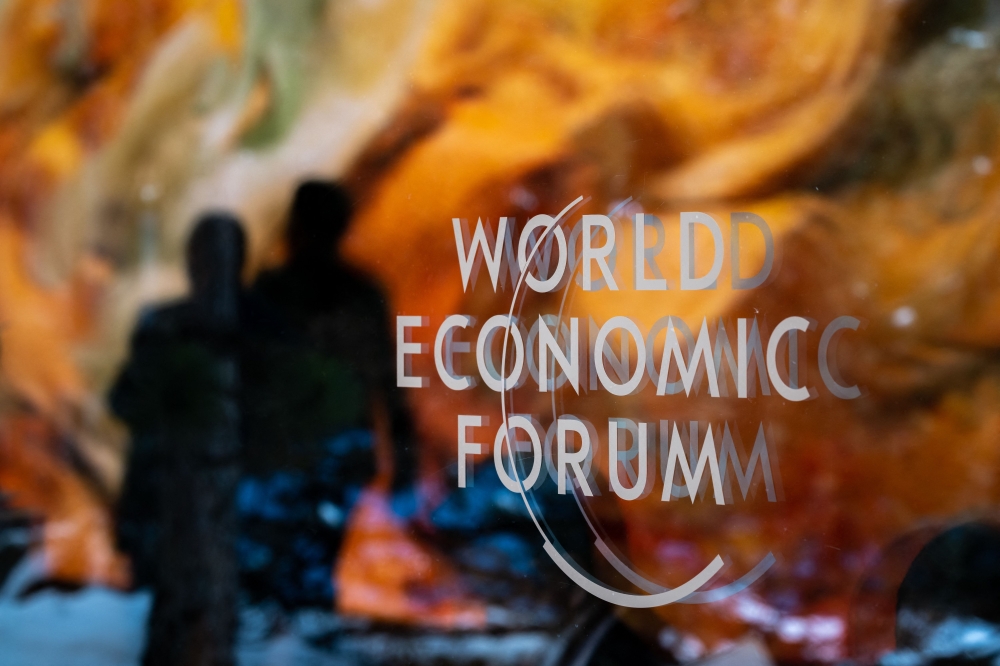
The World Economic Forum in Davos, Switzerland, finds itself navigating troubled waters.
Long the affluent symbol of a globalising world where the assumption was that more trade would bring more freedom, it now confronts international fracture, ascendant nationalism and growing protectionism under the shadow of war in Europe and sharp tensions between the United States and China.
The post-Cold War era, dominated by the idea that Western liberal democracy and free-market capitalism held all the answers, is over. This was the very ethos of Davos. It must now pivot to the new reality provoked by the Covid-19 pandemic, the war in Ukraine, the growth of extreme inequality and aggressive autocracies.
If the old is gone, the new order is not yet born. Power is shifting away from the United States as China’s military and economic heft grows, but the shape of an alternative international system is unclear.
One measure of a world transformed is that when thousands of Brazilian protesters, convinced without evidence of a stolen election last year, stormed the Brazilian Congress this month, their action felt like a copycat attack modeled on the assault on the US Capitol of January 6, 2021.
It is one measure of Donald Trump’s legacy that many people now make this association.
The gathering in the Swiss mountains this week of politicians, business leaders, technology gurus, environmentalists and other Davos patrons, only the second in person after a two-year pandemic-induced hiatus, will wrestle with questions once unthinkable.
To what degree is the world de-globalising as the threat to supply chains has become evident through Covid-19 and war?
Is it possible to end the trench warfare in Europe that has already taken tens of thousands of Ukrainian and Russian lives and led to talk, far-fetched but insistent, of possible nuclear “Armageddon,” a word used by President Joe Biden last year?
If the conflict in Ukraine persists through 2023, as now appears plausible, how can a war-induced global recession be avoided as investment-curtailing uncertainty persists and prices soar?
These are some of the issues that will confront the assembled crowd. China is sending a vice premier, Liu He, to Davos, the first time a Chinese leader has attended the forum since the pandemic began.
The American delegation will include Katherine Tai, the trade representative; John Kerry, Biden’s special envoy for climate; and Samantha Power, the administrator of the United States Agency for International Development. Volodymyr Zelenskyy, the Ukrainian president, has indicated that he will attend, although whether through video link or in person is unclear.
They will talk and they will exhort but Davos is about bringing people together, at least a certain class of people, and for now divisive pressures are strong.
The politics of recent years have been dominated by nationalist revolts against elites by the very people Davos overlooked, from the American heartland to what the French call “the periphery.”
Convergence has gone out of fashion. There is no political consensus any longer over how to deliver prosperity to a networked world.
Great power rivalry on a warming planet is the new reality. Economic opening did not lead to political opening in Russia or China, as had been widely predicted, with the result that rival democratic and autocratic blocs confront each other.
China’s Belt and Road Initiative has secured the allegiance of many countries through loans, infrastructure construction and trade accords. America now makes its own economics-must-serve-politics approach very clear.
On a recent visit to India, Treasury Secretary Janet Yellen said that the United States wanted to “diversify away from countries that present geopolitical and security risks to our supply chain.” — The New York Times
Oman Observer is now on the WhatsApp channel. Click here