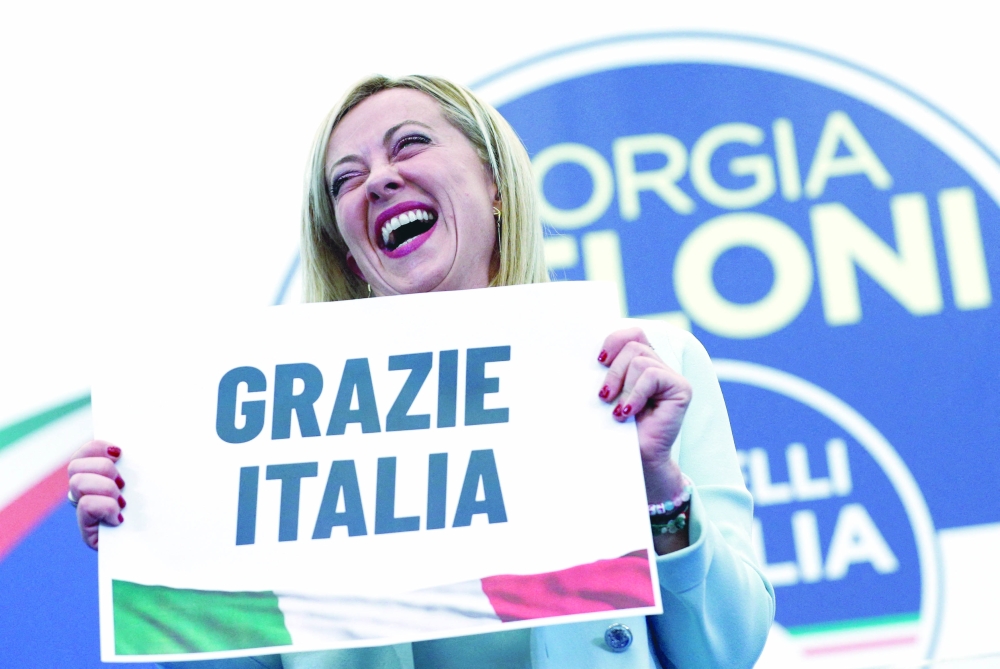





Throughout her time in the opposition to Prime Minister Mario Draghi’s national unity government, Giorgia Meloni, the hard-right leader who is poised to become the next Italian prime minister after a strong showing in Sunday’s elections, railed against everything from vaccine requirements to undemocratic power grabs.
But on the issue of Ukraine, perhaps the most consequential for the government, she unambiguously criticised Russia’s unwarranted aggression, gave full-throated support for Ukraine’s right to defend itself and, in a recent interview, said she would “totally” continue to provide Italian arms to the Ukrainians.
The same cannot be said for Meloni’s coalition partners, who have deeply admired Russia’s president, Vladimir Putin, and have often sounded like his apologists. Just days before the vote, former prime minister Silvio Berlusconi, once Putin’s best friend among leaders in Western Europe, claimed that “Putin was pushed by the Russian population, by his party and by his ministers to invent this special operation,” and that a flood of arms from the West had thwarted Russian soldiers in their mission to reach “Kyiv within a week, replace Zelenskyy’s government with decent people and then leave.”
The other coalition partner, Matteo Salvini, the leader of the League party, used to wear T-shirts with Putin’s face on them and has for years been so fawning towards Russia that he has frequently had to reject accusations that he has taken money from Moscow.
Recently, with Meloni apparently uncomfortable as she sat beside him, Salvini doubted the wisdom of sanctions on Russia, which he said hurt Italy more than Putin’s government.
How Meloni navigates those tensions in her coalition will now be a key factor in the European Union’s struggle to keep an unbroken front against Russia as the cost of sanctions begins to bite in winter.
If she wavers, especially on sanctions, European leaders who have stood up to Putin all these months fear it could begin a major unraveling of resolve, widening divisions in the EU and between the United States and Europe.
“We are ready to welcome any political force that can show itself to be more constructive in its relations with Russia,” the Kremlin spokesperson, Dmitry Peskov, said after the Italian election results, according to the Russian news service Tass.
But analysts said Russia should not expect a change from Meloni anytime soon, believing that her position on Ukraine is credible and that the weak showing of her partners in the election will allow her to keep them in their place without blowing up their alliance.
“I put my hand today on fire that she is not going to bend,” said Nathalie Tocci, the director of the Institute for International Affairs in Rome. “She’s very gung-ho about Russia.”
Despite a widespread suspicion that political calculation lay behind Meloni’s pivot during the campaign to less hostile positions on the EU and away from leaders such as Prime Minister Viktor Orban of Hungary and Marine Le Pen in France, analysts judged that on the issue of Ukraine, Meloni was not likely to budge.
In the past, Meloni has admired Putin’s defence of Christian values, which is consistent with her own traditionalist rhetoric. But unlike other hard-right politicians and newbie nationalists, like Salvini, Meloni was raised in a post-fascist universe in Italy where Russia — and especially communist internationalists — represented an Eastern force that threatened the sanctity and peculiarities of Western European identities.
For Meloni it was less difficult to step away from the Putin adoration that swept the populist-nationalist right over the past decade. During the campaign, she was happy to point out this difference with her coalition partners, as she was competing with them and it helped differentiate her and reassure the West of her credibility.
Pummeling the competition in Sunday’s election will have made it easier to withstand any attempted pressure from Salvini or Berlusconi, who both failed to break into double digits in the polls and were thus left with little leverage.
That is not to say that Meloni faces no pressure at home for a more forgiving stance. Italy, a country with deep and long ties to Russia, has long had reservations about sanctions against Moscow and getting involved in foreign wars.
“I think we should put the question up to the Italians in a referendum,” Stefano Ferretti, 48, a supporter of Meloni, said on election day. “Let’s see if they really want it.”
And Italy is not alone in Europe when it comes to doubts about a continued hard line against Russia, and turning away from its cheap energy, before a cold and economically painful winter.
In Prague this month, a day after the Czech government survived a no-confidence vote over accusations that it had failed to act on soaring energy prices, tens of thousands of protesters took to the streets to voice outrage on the issue while far-right and fringe groups led many demonstrators in calling for withdrawal from Nato and the EU.
In Sweden, a hard-right party more sympathetic to Putin was on the winning side in elections this month.
Orban has created complications for the EU in its efforts to present a united force against Putin by demanding, and receiving, carve-outs for oil imports in exchange for agreeing to an embargo on Russian crude oil imports, a sanctions measure that required unanimity among member countries.
On Monday, Orban applauded Meloni’s victory, writing on Facebook: “Bravo Giorgia, A more than deserved victory. Congratulations!”
But analysts did not foresee Italy, under Meloni, playing the same games that Hungary has done with sanctions. In her acceptance speech, she emphasised “responsibility,” and experts said she was a savvy politician who clearly understood that Italy’s leaving the fold would break the bloc’s Russia strategy.
As a reminder, though, only days before the vote, the European Commission president, Ursula von der Leyen, responded to a question about “figures close to Putin” poised to win elections in Italy by saying, “We’ll see.”
“If things go in a difficult direction — and I’ve spoken about Hungary and Poland — we have the tools,” she said.
The tools included the cutting of funds for member states that Brussels considers in violation of the rule of law. Last week, the commission — which is the EU’s executive arm — proposed to cut 7.5 billion euros of funds allocated to Hungary. - New York Times
Jason Horowitz
The writer is the Rome bureau chief of NYT covering Italy, the Vatican and Greece
Oman Observer is now on the WhatsApp channel. Click here