


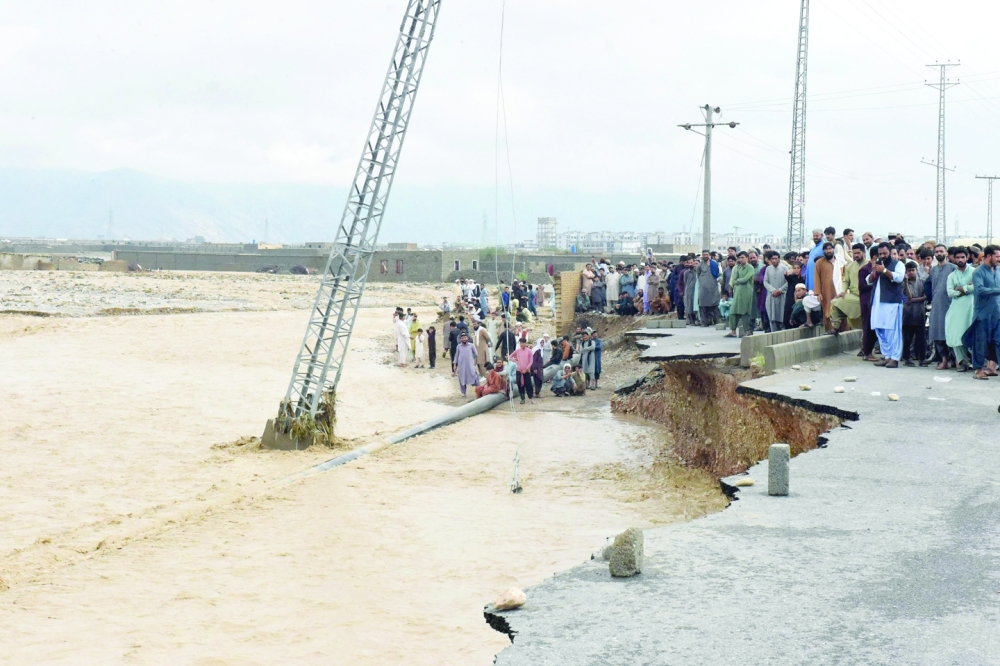





SUKKUR: Heavy rain pounded much of Pakistan on Friday after the government declared an emergency to deal with monsoon flooding it said had affected more than 30 million people.
The annual monsoon is essential for irrigating crops and replenishing lakes and dams across the Indian subcontinent, but each year it also brings a wave of destruction.
The National Disaster Management Authority (NDMA) said on Friday that more than 900 people had been killed this year -- including 34 in the last 24 hours -- as a result of the monsoon rains that began in June.
Officials say this year's floods are comparable to 2010 -- the worst on record -- when over 2,000 people died and nearly a fifth of the country was under water.
"I have never seen such huge flooding because of rains in my life," octogenarian farmer Rahim Bakhsh Brohi said near Sukkur, in southern Sindh province.
Like thousands of others in rural Pakistan, Brohi was seeking shelter beside the national highway, as the elevated roads are among the few dry places in the endless landscapes of water.
A statement on Friday from Prime Minister Shehbaz Sharif's office said 33 million people had been "badly affected" by the flooding, while the country's disaster agency said nearly 220,000 homes were destroyed and half a million more badly damaged.
Two million acres of cultivated crops had been wiped out in Sindh alone, the provincial disaster agency said, where many farmers live hand-to-mouth, season-to-season.
"My cotton crop that was sown on 50 acres of land is all gone," Nasrullah Mehar said.
"It's a huge loss for me... what can be done?"
Climate Change Minister Sherry Rehman, who on Wednesday called the floods "a catastrophe of epic scale", said the government had declared an emergency, and appealed for international assistance.
Pakistan is eighth on the Global Climate Risk Index, a list compiled by the environmental NGO Germanwatch of countries deemed most vulnerable to extreme weather caused by climate change.
Earlier this year, much of the nation was in the grip of a drought and heatwave, with temperatures hitting 51 degrees Celsius in Jacobabad, Sindh province.
The city is now grappling with floods that have inundated homes and swept away roads and bridges.
In Sukkur, about 75 kilometres away, residents struggled to make their way along muddy streets clogged with flood-borne debris.
"If you had come earlier the water was this high," 24-year-old student Aqeel Ahmed said, raising his hand to his chest.
Premier Sharif cancelled a planned trip to Britain to oversee the flood response, and ordered the army to throw every resource into relief operations.
"I have seen from the air and the devastation can't be expressed in words," he said on state TV after visiting Sukkur.
"The towns, villages and crops are inundated by the water. I don't think this level of destruction has taken place before."
A national fundraising appeal has been launched, with Pakistan's military saying every commissioned officer would donate a month's salary towards it. - AFP
Oman Observer is now on the WhatsApp channel. Click here


