







Jim Steinman, who died last year at 73, left behind one of the most distinctive catalogs of music in history, filled with chart-topping hits written for the likes of Meat Loaf, Bonnie Tyler and Celine Dion. With songs ranging from the restless (“All Revved Up With No Place To Go”) to the wrenching (“For Crying Out Loud”), Steinman spent decades establishing himself as a sophisticated songwriter with the spirit of a teenager.
“As far as Jim was concerned, life was about being forever young, and lusting after this and yearning after that,” said David Sonenberg, Steinman’s longtime friend, manager and now executor of his estate. “He was going to be 17 forever, and in some ways he was.”
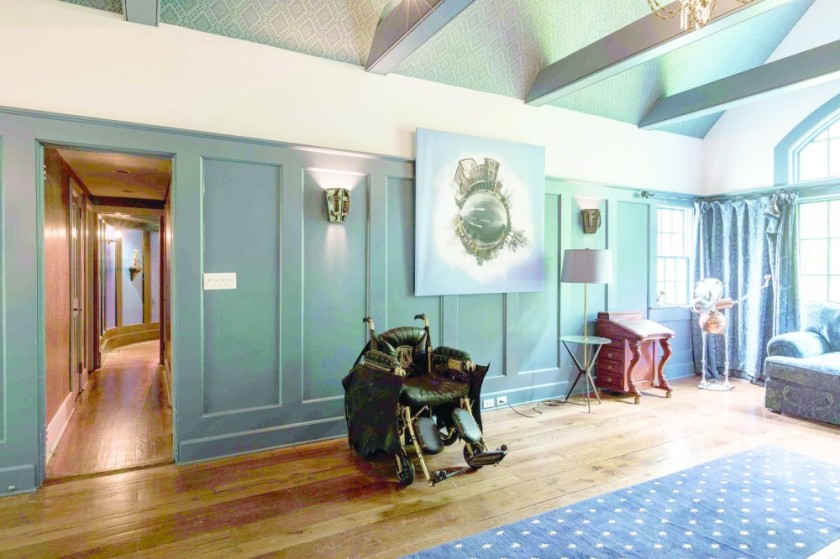
But perhaps nothing evokes Steinman’s legacy like the Connecticut house where he lived alone for about 20 years — a majestic museum of the self, attached to a quaint cottage in the woods of Ridgefield. He spent years expanding and re-imagining the house, transforming it into an embodiment of his own eccentric, complicated personality.
“The house — it’s a trip, it’s extraordinary, it’s one of a kind,” Sonenberg said. “People would walk in and their heads would spin.”
Steinman, a lifelong bachelor who had been in declining health for years, left no instructions about what he wanted done with the house after his death. Now his longtime friends are putting the property up for sale — with a provision: It is being sold “as-is,” which in real estate lingo normally means “in terrible condition.” In this case, it means that the sale includes nearly all of Steinman’s personal belongings, which remain in the house: the gothic furniture, spooky artwork, wall-mounted records, grand piano, even closets full of clothing.
“We are going to try to keep Jim’s vision and legacy intact,” said Jacqueline Dillon, Steinman’s longtime creative assistant and close friend. “Jim has been a pop-culture fixture for 50 years.”
Their hope is to sell the house — which, despite its 6,000-odd square feet, has just two bedrooms — to a musician, artist or writer, or someone seeking a creative retreat or performance space. The asking price is $5,555,569 — the $69 is a tribute to Steinman’s beloved Amherst College, where he graduated with the class of 1969 — and the annual property taxes are around $32,000.
Dillon described Steinman — by all accounts a reclusive, nocturnal introvert — as “super-shy, but always so kind, and with a lightning-quick wit.” She met him three decades ago at a concert, she said, and was soon recruited to launch his website, jimsteinman.com, to connect with fans and to monitor press mentions.
She is now helping to oversee the house sale. “This is not a sale where there is a comparable,” she said.
As with many of Steinman’s grandest achievements, the house almost never happened. It was Sonenberg who found it nearly 30 years ago. Driving through Ridgefield, he spotted the home on a secluded lot of about 1.5 acres and thought it would be perfect for his friend.
“The house was so charming,” said Sonenberg, whose own artistic dreams were dashed after he met Steinman in the 1970s. “I wrote a song called ‘Pear Tree in the Shade,’” he said. “Jim wrote a song called ‘Total Eclipse of the Heart.’”
Steinman, who started writing musicals for Joseph Papp at the Public Theater before conquering the pop charts with songs for Meat Loaf’s 1977 smash album “Bat Out of Hell,” was seeking a place to hide away and work. After years of delays, he and Meat Loaf (born Marvin Lee Aday) were completing production on “Bat Out of Hell II: Back Into Hell,” which (to no one’s expectation but their own) would become one of the bestselling albums of the 1990s.
Sonenberg suggested that Steinman buy the Ridgefield house: “I said, ‘It’s perfect — you’re by yourself, you never have any guests.’ And he said no, it was too small.”
Around that time, while Steinman was working with Andrew Lloyd Webber on the musical “Whistle Down the Wind,” he visited Lloyd Webber’s manor house, Sydmonton Court, in Hampshire, England, and “was just blown away,” Sonenberg said.
So Steinman decided to buy the Ridgefield cottage, paying about $425,000, and convert it into a soaring sanctuary, a creation as epic as his music.
“It is really special, almost otherworldly,” said Laura Freed Ancona, the listing agent, of William Pitt Sotheby’s International Realty. “Yes, it was a roof over Jim’s head. But it was also a creative space for him.”-- —NYT
Oman Observer is now on the WhatsApp channel. Click here


