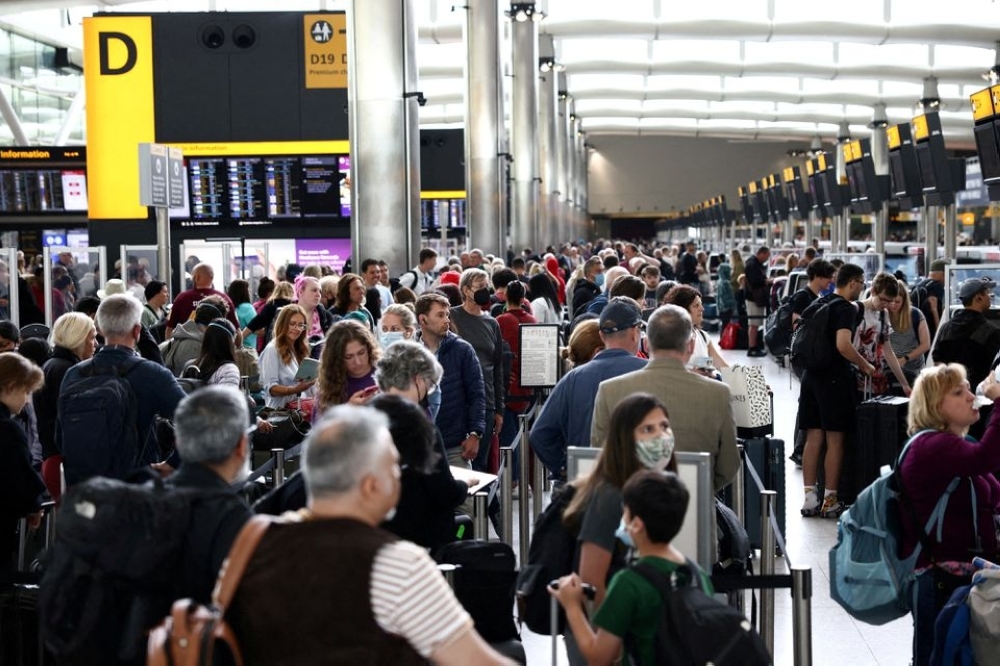





LONDON: London's Heathrow Airport apologised for unacceptable service in recent weeks, with long queues, delays for those with reduced mobility and baggage issues, as it struggled to cope with 40 years of passenger growth in four months.
The airport, which handled nearly six million passengers in June, said rebuilding capacity quickly was "very challenging".
Heathrow CEO John Holland-Kaye said: "We will review the schedule changes that airlines have submitted in response to the government's requirement to minimise disruption for passengers this summer and will ask them to take further action if necessary."
Last month, the British government and Civil Aviation Authority asked the sector to review summer schedules, including a slot amnesty to encourage airlines to remove flights without penalty.
British Airways, Heathrow's biggest airline, and other carriers have cancelled hundreds of flights to try to minimise disruption for passengers.
The airport, which was criticised by International Air Transport Association (IATA) boss Willie Walsh on Sunday for not preparing better for the surge in demand, said the entire aviation supply chain faced challenges.
It said on Monday it started recruiting in November, and it would be back to pre-pandemic levels in security staff by the end of July.
The problems at Heathrow, Britain's busiest airport, were compounded by very low arrivals punctuality because of delays at other airports and airspace congestion across Europe, it said.
Meanwhile, the pilots' union at Scandinavian airline SAS said on Sunday they would no longer allow exceptions under their ongoing strike to enable stranded charter flight passengers to get home, after a week-long walkout deepened Europe's travel woes.
The union representing pilots at the airline, SAS Pilot Group (SPG), agreed to the exceptions on Friday, and flights to bring home stranded passengers have flown over the weekend.
"Unfortunately SAS has once again shown itself to be an untrustworthy party, that doesn't follow the agreement or the intentions with the agreement," SPG president Martin Lindgren said in a statement.
According to the union, the extra flights were intended only for "destinations where there are few or no alternatives for a return trip".
But Lindgren said that, "to their great surprise", there had been a lot of flights to popular and well-trafficked holiday destinations such as Rhodes, Crete, and Split, "from where there are already alternate travel possibilities".
Because of this SPG had decided to no longer allow the exceptions after Sunday's flights.
Karin Nyman, acting head of media relations for SAS in Sweden, said the company was "very upset" at the union's decision.
Nyman said the company had been "very careful" to follow the "complex administrative requirements" for the some 70 flights flown over the weekend under the exception.
She added that there was "no logic" to the union's claim that those destinations had other travel arrangements available, given how the holiday season was in full gear.
"It's the absolute peak right now, all spots are fully booked with all airlines, which the pilot union also knows well," Nyman said, declining to comment on how negotiations with the union were going.
Pilots walked out on Monday after talks between the unions and the company broke down.
On Monday, SAS said that the strike "is estimated to lead to the cancellation of approximately 50 per cent of all scheduled SAS flights", impacting around 30,000 passengers a day.
The pilots are protesting against salary cuts demanded by management, as part of a restructuring plan aimed at ensuring the survival of the company, and the firm not re-hiring pilots laid off during the pandemic.
SAS management announced in February the savings plan to cut costs by 7.5 billion Swedish kronor ($700 million), dubbed "SAS Forward", which was supplemented in June by a plan to increase capital by nearly one billion euros. - Reuters/AFP
Oman Observer is now on the WhatsApp channel. Click here