




SEOUL: South Korea said on Tuesday it had successfully launched its homegrown space rocket and placed a payload into orbit in a "giant leap" for the country's quest to become an advanced space-faring nation.
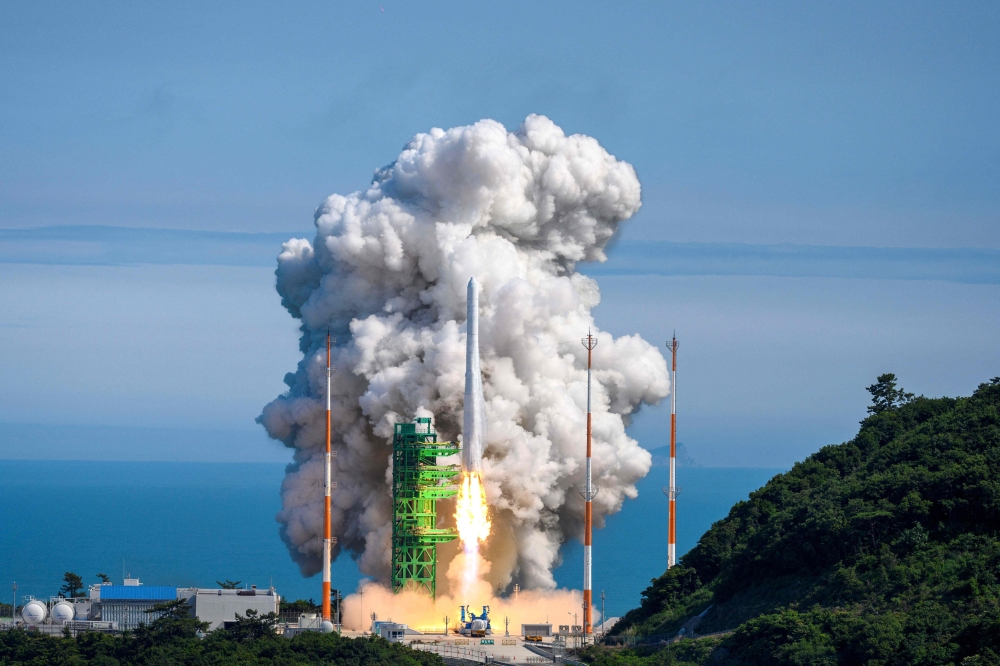
The Korea Satellite Launch Vehicle II, nicknamed Nuri and emblazoned with the South Korean flag, lifted off at 4 pm from the launch site in Goheung on the southern coast, trailing a column of flame. All three stages of the rocket worked, taking it to its target altitude of 700 kilometres, and it successfully separated a performance verification satellite and put it into orbit, Seoul said.
South Korea's space programme "has taken a giant leap forward'', said Lee Jong-Ho, Minister of Science and Technology, adding he declared the mission a success.
"South Korea has now become the seventh nation in the world to launch a space vehicle with homegrown technology'', he said, adding the government would continue its quest to become "an advanced space-faring nation".
South Korea will launch a Moon orbiter in August, Lee added. The Tuesday test, South Korea's second test launch of its homegrown space rocket, comes eight months after the first test failed to put a dummy satellite into orbit.
In the first test last October, all three stages of the rocket worked with the vehicle reaching an altitude of 700 kilometres, and the 1.5-tonne payload separating successfully.
But it failed to put a dummy satellite into orbit after the third-stage engine stopped burning earlier than scheduled.
In Tuesday's test, in addition to a dummy satellite, Nuri carried a rocket performance verification satellite and four cube satellites developed by four local universities for research purposes. The three-stage Nuri rocket has been a decade in development at a cost of 2 trillion won ($1.5 billion). It weighs 200 tonnes and is 47.2 metres long, fitted with a total of six liquid-fuelled engines.
In Asia, China, Japan and India all have advanced space programmes and the South's nuclear-armed neighbour North Korea was the most recent entrant to the club of countries with their own satellite launch capability. — AFP
Oman Observer is now on the WhatsApp channel. Click here