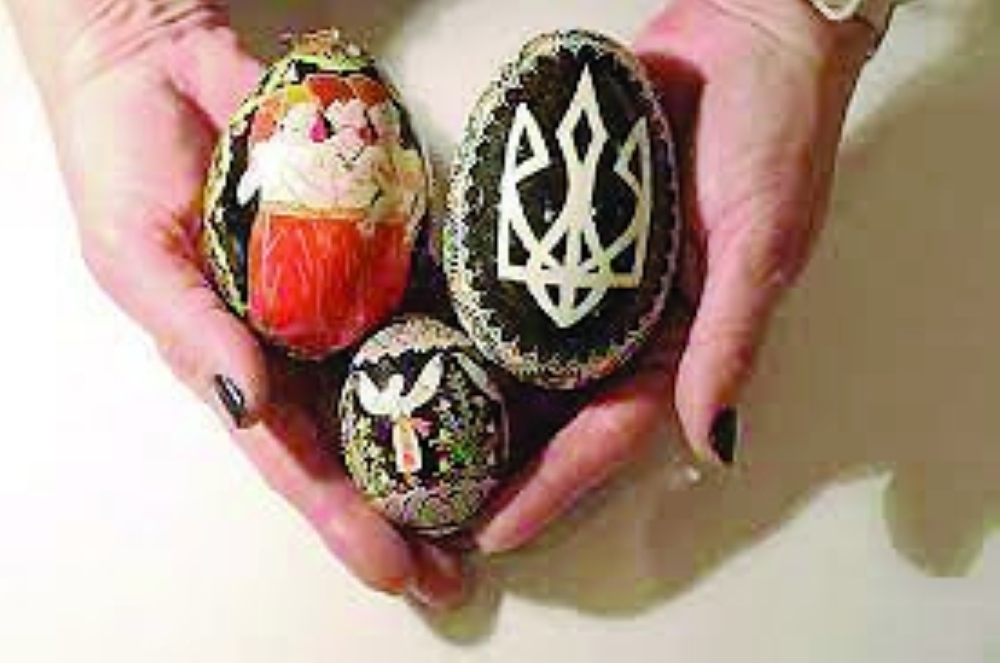





Maria Fedachtchin's fingers trembled a bit as she etched the first intricate lines of beeswax along the smooth,unblemished shell of an egg cradled in her palm.
She's learning to design pysanky, the ornately decorated traditional Easter eggs of Ukraine, where the 60-year-old was born and liveduntil her 1991 immigration to Chicago.
But her focus was rattled by news that Russian rockets had just struck her hometown of Lviv in western Ukraine, the area where her parents, sister and other loved ones still reside.
"My hands are shaking right now," she said, periodically glancing at her phone, hoping for text messages from relatives or news alerts."You don't know what can happen at any moment."
Fedachtchin was one of about a dozen women attending a recent pysanky workshop at the Ukrainian National Museum in Chicago. The tenor of the room was solemn, in contrast to the brightly colored eggs on display around the museum, showcasing the artwork of different regions of Ukraine as well as various historical periods.
The class started about a half-hour after back-to-back airstrikes hit Lviv, a historical cultural center of Ukraine and, more recently, a haven near the Polish border for Ukrainians evacuating following the full-scale Russian invasion that began in late February.
Several workshop participants had spoken to relatives overseas and learned they were safe; others were still awaiting calls.
Artist and instructor Anna Chychula began the class by recounting one of the many legends surrounding pysanky: There is said to be an evil monster shackled to a cliff and each Easter egg - singular pysanka -creates another link in the chain that binds him. The fate of theworld depends on the survival of these fragile eggs, according to ancient lore, or the beast will be unleashed upon the world.
Today, this mythical monster is widely believed to be embodied in Russian President Vladimir Putin, whose war on Ukraine continues inits sixth week.
"So you're doing very important, beautiful work today," said Chychula, whose pysanky have previously been featured at the Art Institute of Chicago and currently at the Field Museum. "Make the chain stronger. Know that you are making a difference. Because a pysanka is a hope. It is a prayer. It is a wish."
The war has ignited waves of egg decorating around the globe, from church groups to classes to pysanky fundraisers, with the proceeds from egg sales helping Ukraine relief efforts. The Facebook page Pysanky for Ukraine has more than 8,000 followers worldwide, many posting photos of their own eggs along with words of encouragement for those threatened or displaced by the war.
"This beautiful Ukrainian tradition was passed down to me from my maternal grandparents," one woman from Indiana posted on the site,with a half-dozen images of her pysanky.
"Prayers for peace to my family, and all families, still in Ukraine."
As Fedachtchin dipped her egg in yellow dye, she said her hand was growing increasingly steady, the artwork absorbing some of her concentration and worry. The painstaking technique becomes easier with time and practice, she said.
Her niece, who has small children, had already fled to Poland. Other relatives remained in Lviv, volunteering at night to help pick uprefugees at the train station and caring for those displaced by the war.
Her mother and father are in their 80s and don't want to leave their home, which is a few miles outside of Lviv.
As airstrikes racked the city, her mom spoke of gardening and washing the windows, to ready their house for Easter.
Fedachtchin and her sister had laughed, wryly: If an explosion were to shatter the windows, they asked, would it matter if the glass was clean or not?
"Life has to go on, no matter what," Fedachtchin said. "Because everything is crazy. Sometimes I want to wake up and say this is not real. How can it happen in the 21st century? It's unbelievable."— tca/dpa
Oman Observer is now on the WhatsApp channel. Click here