





@conradprabhu -
The Hajar Mountains of the Sultanate of Oman will serve as the backdrop of a landmark decarbonisation project that could contribute to the sequestration of gigatonnes of carbon dioxide (CO2) – the planet-warming greenhouse gas.
Driving this initiative is the partnership of UK-based Mission Zero Technologies (MZT), a direct air capture (DAC) startup, and 44.01, a pioneering Omani carbon removal start-up. Earlier this year, the two firms signed a Memorandum of Understanding (MoU) to collaborate on carbon removal projects, the first of which has been dubbed ‘Project Hajar’.
Project Hajar, according to a statement issued by the two companies, envisions the deployment of their respective technologies to “unlock gigatonnes of CO2 removal” in the Hajar Mountains of the Sultanate of Oman.
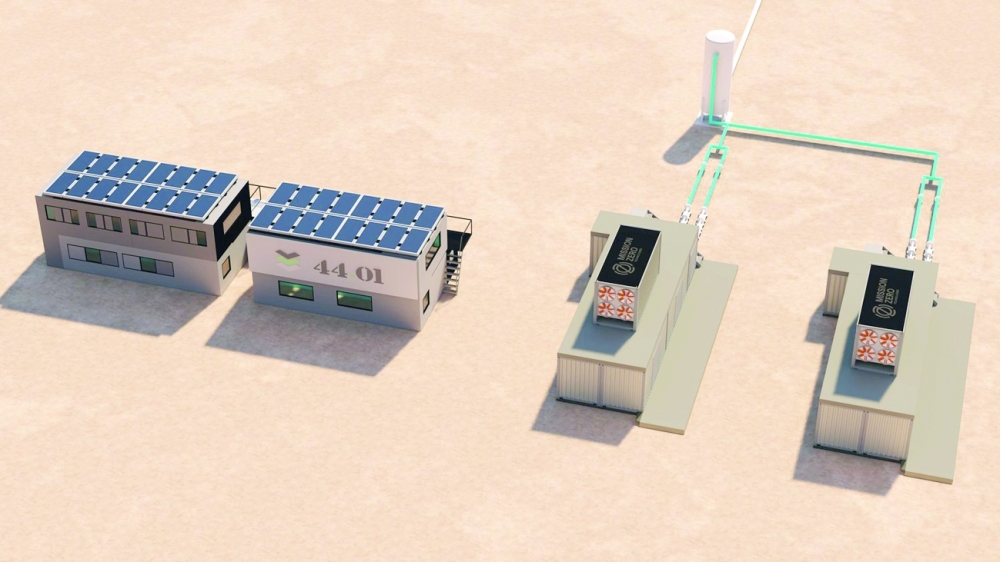
By combining MZT’s direct air capture (DAC) technology with 44.01’s carbon mineralisation process, the partnership aims to achieve the removal of around 1,000 tonnes of CO2 per annum in the initial demonstration phase. Green energy required for the initiative will come from a renewables project planned on site, with the overall facility slated for launch in 2024.
“We’re excited to welcome Mission Zero to our carbon sink,” said Talal Hassan, co-founder and CEO of 44.01. “Scaling both direct air capture and mineralisation approaches together could not be more crucial.”
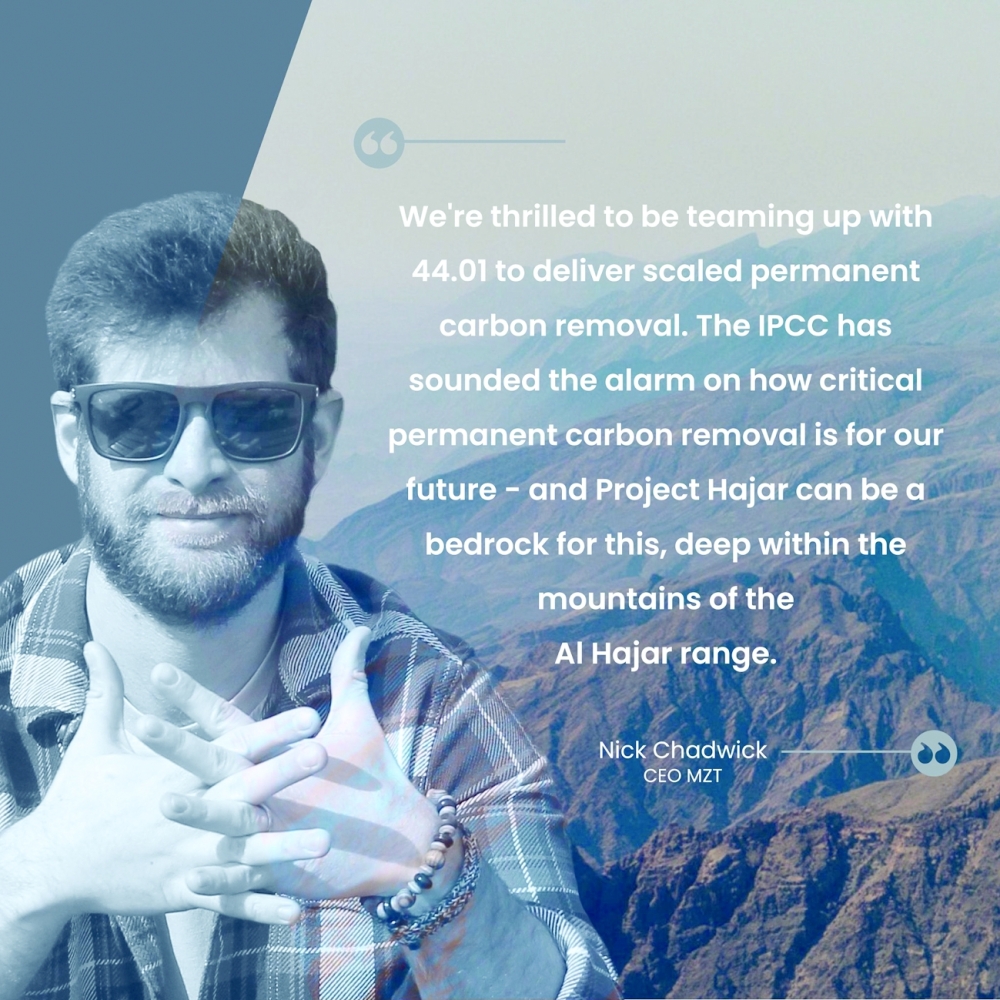
Nicholas Chadwick, CEO of MZT, added: “We're thrilled to be teaming up with 44.01 to deliver scaled and permanent carbon removal. The IPCC has sounded the alarm on how critical permanent carbon removal is for our future - and Project Hajar can be a bedrock for this, deep within the mountains of the Al Hajar range.”
The MZT – 44.01 partnership hopes to harness the Sultanate of Oman’s prodigious solar and wind energy resources to deliver a low-emissions carbon removal project that leverages their complementary technologies (DAC – Mineralisation) to sequester CO2 in peridotite rocks found in abundance in the Hajar mountains.
For 44.01, Project Hajar is the latest in an array of decarbonisation initiatives launched by the Muscat-based startup, which is dedicated to fighting climate change by converting captured CO2 into rock through its proprietary mineralisation process.
Last year, 44.01 (which derives its name from the molecular weight of carbon) announced a similar partnership with Switzerland-based Climeworks, a global leader in direct air capture. As a first step towards this end, it is setting up a demo-scale project at Khazaen Economic City in Barka.
The initiative, which has global implications for the goal of reversing rising CO2 levels in the atmosphere, will capitalise on peridotite’s well-known ability to store CO2 as part of a natural mineralisation process. Atmospheric CO2 naturally reacts with peridotite rocks rich in magnesium and calcium to precipitate carbonates.
More recently, 44.01 announced the production of the world’s first Blue Ammonia using the mineralisation route. Around 500 kg of Blue Ammonia was produced in a pilot project that involved the use of CO2 captured from an ammonia plant.
Last month, 44.01 was named among a select group of organisations nominated for the prestigious Earthshot Prize, billed as the most prestigious global environment prize in history. The prize is designed to incentivise change and help repair Planet Earth over the next ten years.
Caption:
Artist’s render of Project Hajar 44.01
Oman Observer is now on the WhatsApp channel. Click here