




ISLAMABAD — Pakistan’s Supreme Court on Thursday overturned Prime Minister Imran Khan’s move to dissolve parliament, setting the stage for a no-confidence vote widely expected to remove him from office and offering a major victory to opposition leaders, who said Khan had attempted an “open coup.”
Khan, the international cricket-star-turned-politician, and his allies dissolved parliament Sunday, effectively blocking a no-confidence vote. The move plunged the country into a constitutional crisis and sharply escalated the political instability that has embroiled Pakistan for weeks.
The recent developments have revived fears of unrest in the nuclear-armed nation of 220 million that has experienced repeated military coups since its founding 75 years ago.
The prospect of Khan being ousted by opposition parties, former allies, and defectors from within his own party in parliament is likely to damage his ability to rally widespread support before the next elections. While no prime minister in Pakistan has ever completed a full five-year term in office, Khan would be the first to be removed in a no-confidence vote.
In its verdict Thursday, the court agreed that the move violated the constitution and ordered that the no-confidence vote take place Saturday morning. If he loses that vote, as expected, a caretaker government will be formed and the country will prepare for elections in the coming months.
The ruling seemed to turn the political tides for the opposition parties, which had been taken aback when Khan evaded the no-confidence vote Sunday. In the days since, Khan, a populist leader, had dominated the political narrative and rallied support around his allegations of a U.S.-led conspiracy against him.
Now, it is likely that both the opposition and Khan must turn their attention to new elections. They will be a referendum on Khan’s political brinkmanship after a public rebuke to his leadership from both the country’s courts and lawmakers, including some of his political allies.
“Imran Khan will lose face,” said Ayesha Siddiqa, a research associate at SOAS University of London. “It will become very clear that he lost the confidence of the parliament, including members of his own party.”
The elections will also test whether the coalition of opposition parties — typically at loggerheads, but teaming up around the goal of the no-confidence vote — can remain united.
In a country where the military controls the main levers of power, the elections are also widely seen as an opportunity for military leaders to choose and elevate new political partners.
“Pakistani politics has two parallel strands,” said Arifa Noor, an Islamabad-based political analyst. “One is public support, and the other is military. One without the other doesn’t land you in the big seat.”
Khan, 69, came to power on a nationalist platform and pledges to tackle corruption. His popularity has taken a hit in recent months as inflation has surged. His relationship with key military leaders also soured after he refused to back the appointment of a new chief of the country’s intelligence agency last year.
Last month, a coalition of opposition parties called for a no-confidence motion and secured the votes needed to win. But minutes before the vote was to take place Sunday, Khan’s allies in the National Assembly blocked it and announced that he planned to dissolve the body, a move he later confirmed in a televised speech. He also called for early elections.
Hours later, Khan and his allies justified his moves by asserting that the opposition was conspiring with the U.S. government to oust him. U.S. officials have denied involvement in the campaign to remove Khan.
In recent days, Khan has tried to use such accusations to whip up support among his core base and draw people into the streets — offering a glimpse of the approach he will most likely use to attract public support before the general elections.
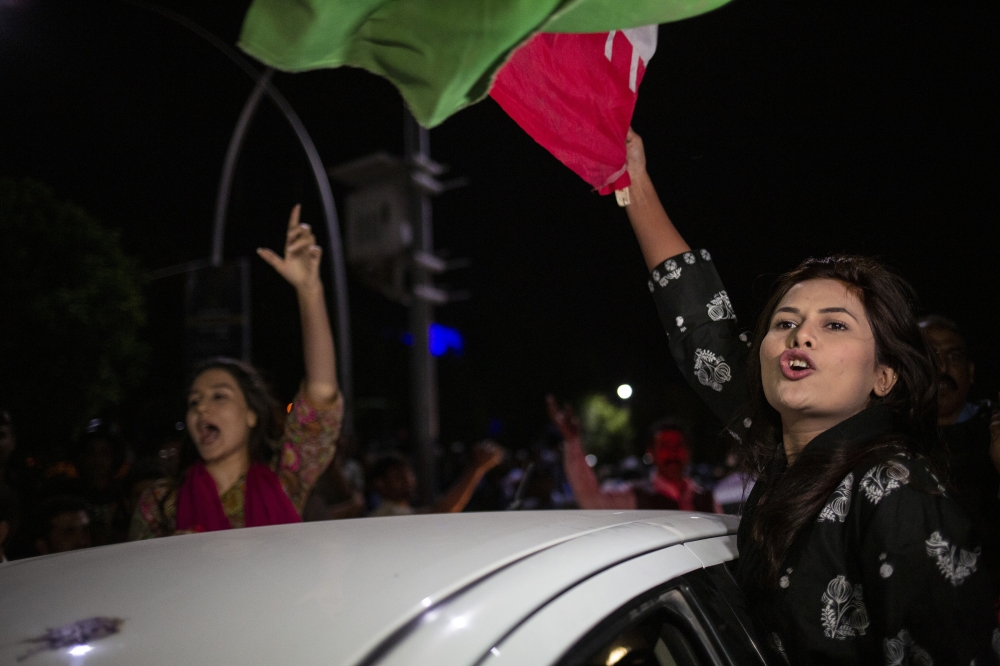
On Monday night, thousands gathered in Islamabad at a political rally for Khan’s Pakistan Tehreek-e-Insaf party. Men and women draped the party flag around their shoulders or hoisted it in the air while party leaders rallied the crowd.
Standing atop a platform above the crowd, Defense Minister Pervez Khattak shouted, “The youth will go to every street of the country to convey the message that they will oust traitors, and Imran Khan has promised that the country will not operate as a slave!”
The crowd erupted in applause. Below him, a group of women began chanting: “Traitors! Traitors! Traitors!”
Before the early elections, the country’s election commission, an independent federal body responsible for organizing and conducting elections to the national parliament, is expected to establish a caretaker government. The commission announced Thursday that general elections could be held in October at the earliest.
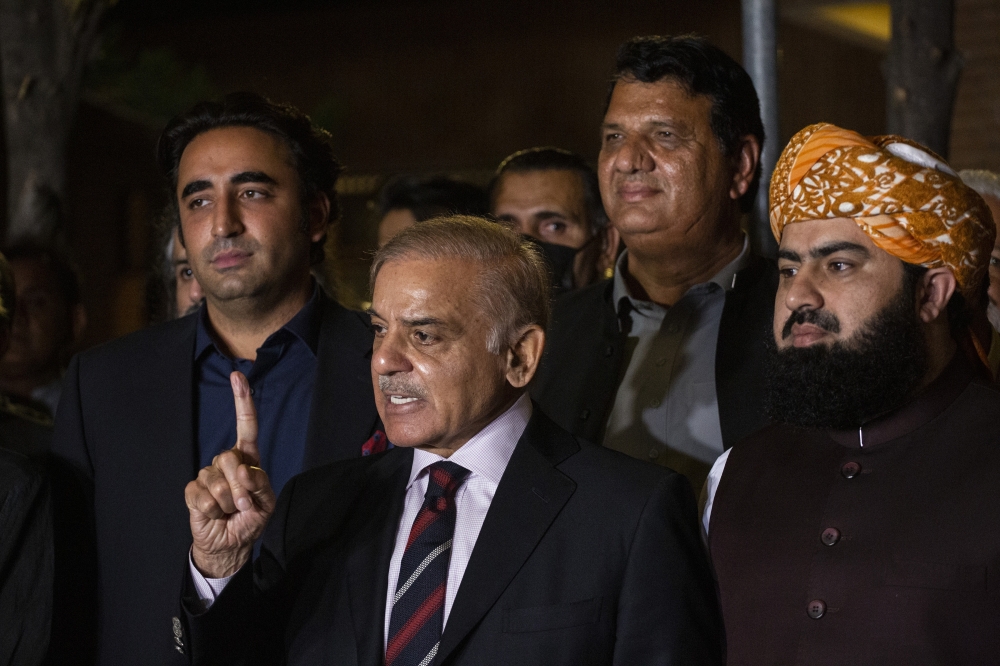
Kicking off that process Monday, Pakistan’s president, an ally of Khan’s, invited both Khan and Shehbaz Sharif, the leader of the opposition in the National Assembly, to propose names for the interim prime minister of a caretaker government.
Khan proposed Gulzar Ahmed, a recently retired chief justice who, like the prime minister, is a populist. The opposition did not put forth any names for the office, since its position was that nothing should be done toward a caretaker government until the court had issued its ruling on the effort to dissolve parliament.
It is unclear how Khan would fare in elections without the full backing of the country’s military, which was widely seen as having undermined the 2018 elections to pave the way for his victory. Khan has denied that accusation, as has the military.
But the fallout from his recent bid to remain in power could have long-lasting consequences.
Amid the turmoil, the Pakistani rupee sank to an all-time low Thursday. And the current crisis has further polarized the country and could escalate into unrest before the upcoming elections, analysts say.
“I’m not sure how an election campaign in which people are really charged up, and there’s a high level of intolerance, remains peaceful,” said Ijaz Khan, former chairman of the department of international relations at the University of Peshawar. “I have a real fear there will be more violence.”
This article originally appeared in The New York Times.
Oman Observer is now on the WhatsApp channel. Click here