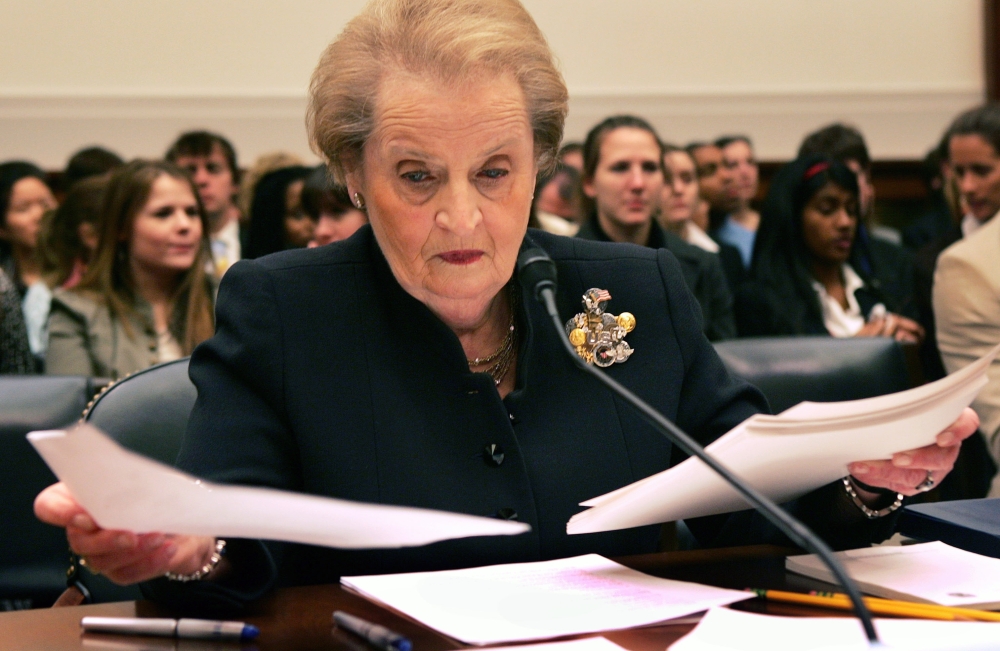





Madeleine K. Albright, a child of Czech refugees who fled from Nazi invaders and Communist oppressors and then landed in the United States, where she flourished as a diplomat and the first woman to serve as secretary of state, died on Wednesday in Washington. She was 84.
The cause was cancer, her daughter Anne said.
Enveloped by a veil of family secrets hidden from her for most of her life, Albright rose to power and fame as a brilliant analyst of world affairs and a White House counselor on national security. Under President Bill Clinton, she became the country’s representative to the United Nations (1993-97) and secretary of state (1997-2001), making her the highest-ranking woman in the history of the American government at the time.
It was not until after she became secretary of state that she accepted proof that as she had long suspected, her ethnic and religious background was not what she had thought. She learned that her family was Jewish and that her parents had protectively converted to Roman Catholicism during World War II, raising their children as Catholics without telling them of their Jewish heritage. She also discovered that 26 family members, including three grandparents, had been murdered in the Holocaust.
With her father, a diplomat, probably facing execution, the family’s odyssey from a Europe on the brink of World War II to safety in America took 10 years and two escapes to London. The first came as Nazi troops invaded Czechoslovakia in 1939, and the second came after the family’s postwar repatriation when Czech Communists with Soviet support overthrew the government of Czechoslovakia in 1948.
In America, Madeleine Korbel was a gifted student, married into the wealthy Albright-Medill newspaper family, and wrote many books and articles on public affairs. She also climbed the ranks of the Democratic Party to pinnacles of success as a counselor to President Jimmy Carter and as a foreign policy adviser to three presidential candidates: former Sen. Walter Mondale of Minnesota in 1984, Gov. Michael Dukakis of Massachusetts in 1988, and Clinton in 1992.
She was largely unknown until Clinton took office as president in 1993 and named her chief delegate to the United Nations. Over the next four years, she became a tough advocate for the global interests of the United States. But she and Clinton clashed repeatedly with Secretary-General Boutros Boutros-Ghali over peacekeeping operations in Somalia, Rwanda, and the Bosnian civil war.
Clinton had heartily endorsed humanitarian and peacekeeping operations when U.S. troops entered Somalia in 1992 to feed starving victims of civil war. But when 18 U.S. troops were slain by the forces of a Somali warlord in 1993 and the nation saw television images of a dead helicopter pilot dragged through the streets of Mogadishu, Clinton retreated from politically risky U.N. missions.
Thus the United States, like most other member states, held back from aiding a small force of U.N. peacekeepers when Rwanda descended into genocide and rape in 1994. As many as 1 million people were killed. Albright put the onus on Boutros-Ghali, calling him “disengaged.” But Boutros-Ghali said he had been rebuffed when he tried to see the president seek support.
Years later, Clinton apologized for America’s inaction in Rwanda. In a 2003 memoir, “Madam Secretary,” Albright wrote, “My deepest regret from my years in public service is the failure of the United States and the international community to act sooner to halt these crimes.” It was a regret she repeated, in much the same words, in an interview for this obituary.
Days after beginning his second term, Clinton nominated Albright as secretary of state. She was unanimously confirmed by the Senate (99-0).
Madeleine Albright was born Marie Jana Korbelova in Prague on May 15, 1937, the oldest of three children of Josef and Anna (Speeglova) Korbel. Her father was a press attache in the Czech Embassy in Belgrade, Yugoslavia, and had worked for Czechoslovakia’s first democratic president, Tomas G. Masaryk, who retired in 1935, and his successor, Edvard Benes.
At Wellesley College, Albright studied political science, edited the school newspaper, and graduated with honors in 1959. She also became an American citizen in 1957.
On a summer internship at The Denver Post, she met Joseph Medill Patterson Albright, the grandson of Joseph Medill Patterson, who founded The Daily News of New York, and the nephew of Alicia Patterson, the founder, and editor of Newsday on Long Island.
In 1959, she married Joseph Albright. The couple had three daughters, the twins Alice and Anne, and Katie, and were divorced in 1983. In addition to Anne, Albright is survived by her other two daughters, along with her sister, Kathy Silva; her brother, John Korbel; and six grandchildren. She lived in Washington.
This article originally appeared in The New York Times.
Oman Observer is now on the WhatsApp channel. Click here