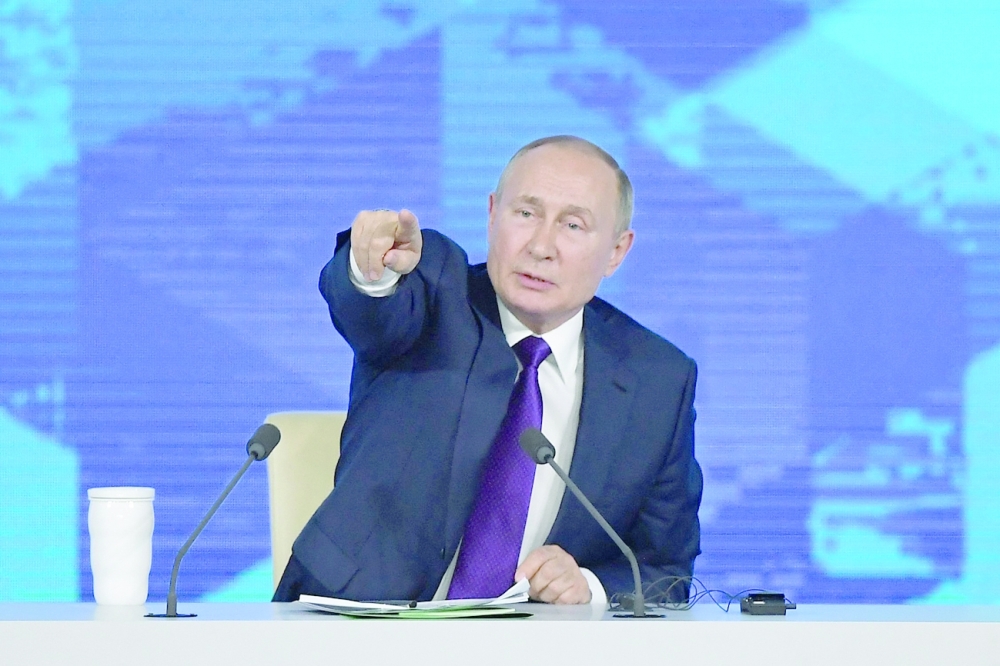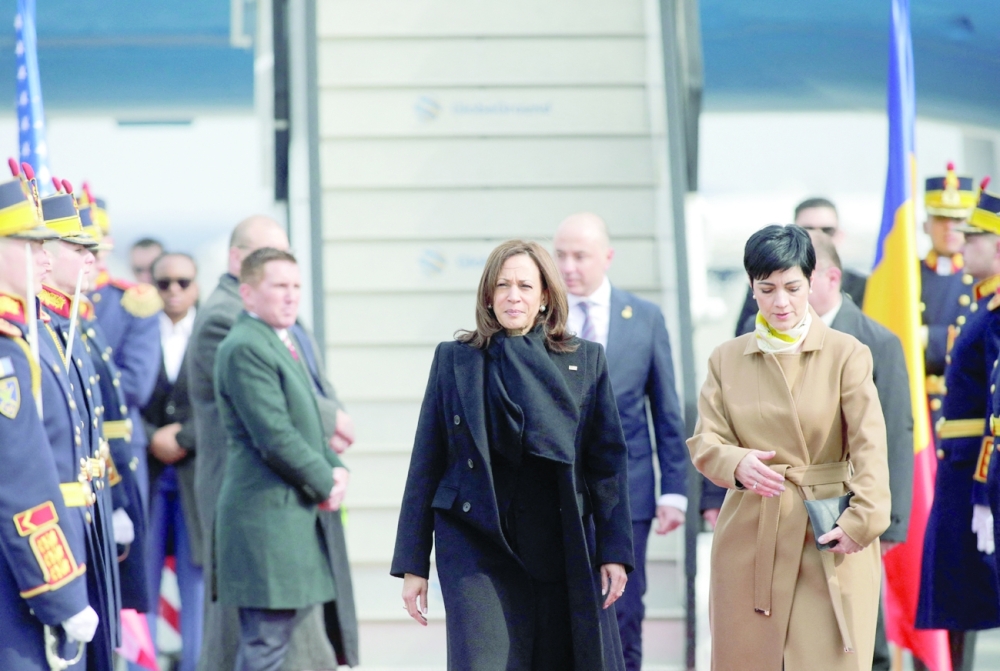





BUCHAREST: Russian President Vladimir Putin shows no sign of being willing to engage in diplomacy, US Vice-President Kamala Harris said on Friday during a visit to Romania in the third week of Russia's invasion of Ukraine.
Kamala Harris expressed US support for Romania's efforts to help refugees from Ukraine and restated America's commitment to protecting fellow Nato members during a tour of the alliance's eastern flank countries.
Romanian President Klaus Iohannis said it is necessary to make the Nato battlegroup in Romania operational as soon as possible.
"During talks, I have underlined the need to make the Nato battlegroup in Romania operational as soon as possible," Iohannis said.
On Thursday Kamala Harris met Polish leaders and Ukrainian refugees in Warsaw and offered US support to calls for an international war crimes investigation against Russia. Her visit to Poland came amid a rift between the United States and Poland over supplying warplanes to Ukraine.
Polish President Andrzej Duda asked for more help to house and feed Ukrainians fleeing the conflict, and said he had asked Harris that Washington speed up the process for refugees who sought to go to the United States and might have family there.
Kamala Harris mission became complicated at the last minute when Polish officials - surprising their US counterparts - announced that, rather than send Soviet-era fighter jets to Ukraine, as Ukraine has sought, they were sending the aircraft to the US Air Force base at Ramste in Germany.
This was Poland's way of extricating itself from a transaction that risked inviting Putin's wrath. But it turned what had been careful US negotiations on their head and left American officials struggling to make sense of it.
While rejecting the offer and calling the Polish preference to have the US deliver the planes to Ukraine "untenable," Biden administration officials have sought to downplay the obvious wrinkle in much-vaunted Nato unity.
The Pentagon then announced it had positioned two Patriot anti-missile batteries in Poland as what an official called a "purely proactive" measure to protect Nato's eastern flank from Russian air attack -- another sign of deep worries about Moscow's aggression.
"The Poles are nervous, of course they're nervous," Daniel Fried, a veteran diplomat and former US ambassador to Poland now at the Atlantic Council think-tank in Washington, said in an interview. "They have the Russian army destroying their neighbour... and making nuclear threats. [Putin] hates the Poles, not quite as much as he hates the Ukrainians."
This presents Harris with a formidable challenge, Fried said. "She must listen to the Poles," he said, to their concrete concerns and fears. And she must explain the longer-term US posture towards Russia and elaborate not what the US cannot do for Ukraine - like send fighter jets -- but what it can do.
"She knows this is messy," Fried said.
About 1.43 million Ukrainians have fled to Poland since the invasion began on February 24. Over that same time, more than 291,081 Ukrainians have fled to Romania.
In total, more than 2.3 million people have fled Ukraine as of March 10, according to the United Nations, which has warned that up to 5 million people could flee. That would make it the biggest humanitarian crisis in Europe since World War Two.
The US Senate on Thursday approved legislation to help Ukraine finance ammunition and other military supplies, as well as humanitarian support. -- Reuters
Oman Observer is now on the WhatsApp channel. Click here