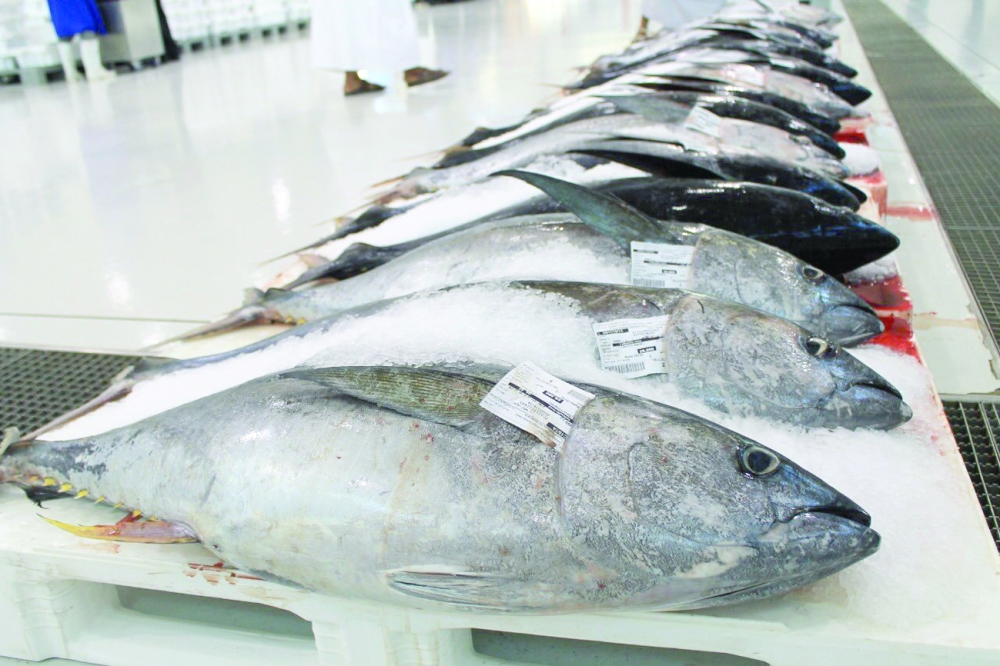





Climate change and global warming are expected to have a significant impact on the Sultanate of Oman’s marine life, especially the two species – yellowfin tuna and sardines that are critical to commercial fisheries.
As per the National Strategy for Adaptation and Mitigation to Climate Change (2020-2020), yellowfin tuna and sardines landings showed a trend of a sharp decline between 1991and 1997.
Sardines showed a lower decline between 1997 and 2003, while Yellowfin tuna landings increased during 1997 -2003 but continued to decline in the subsequent years.
The report, quoting the National Centre for Research in the US, said that reasons include the physical properties of water of the Arabian Sea have become warmer and more saline.
Average sea temperatures in the summer have risen since 1960 by over two degrees Celsius at the surface and above one degree Celsius at a depth of 300m.
Average salinity at lower depths has been increasing at a rate of 0.1 parts per thousand per decade since 1960.
The Western Arabian Sea has been witnessing changes in the chemical properties – acidity, dissolved oxygen, and nitrate concentrate are some of the key chemical properties that underline the productivity of marine diversity and commercial fisheries and significantly changed over the past decades, the report said.
Based on data from local oceanographic stations near the Sultanate of Oman, waters have become more acidic, the concentration of nitrate has declined by 30 per cent over the 30 years.
There has been a decline in dissolved oxygen concentration with levels of 1 milligram per litre now at a depth of 75 meters as opposed to 120 meters in the 1960s.
The chlorophyll concentration has declined by 40 per cent during the period 1950 to 2010.
These chemical changes have all contributed to fish kill incidents and compressing of large and small pelagic fishes over the Omani shelves.
The strategic solutions include knowledge for managing vulnerable marine resources by collecting and analyzing data on the impacts of climate variability and trends on marine biology, assessing climate change impact on fisheries by giving priority to threatened and endangered species, monitoring climate change effects on coral reefs as a biological indicator, investigation case studies for the impacts of climate change the social and economic relationships in fisheries and aquaculture.
Around three earth climate models have predicted an increase in temperature for the upper 200 meters of the Indian Ocean, where there is enough sunlight to allow photosynthesis.
The temperature is mild between 2060 but sharply increases after 2060, ranging between one degree and 2.5 degrees above historical temperatures by 2100.
@vinod_nair
Oman Observer is now on the WhatsApp channel. Click here