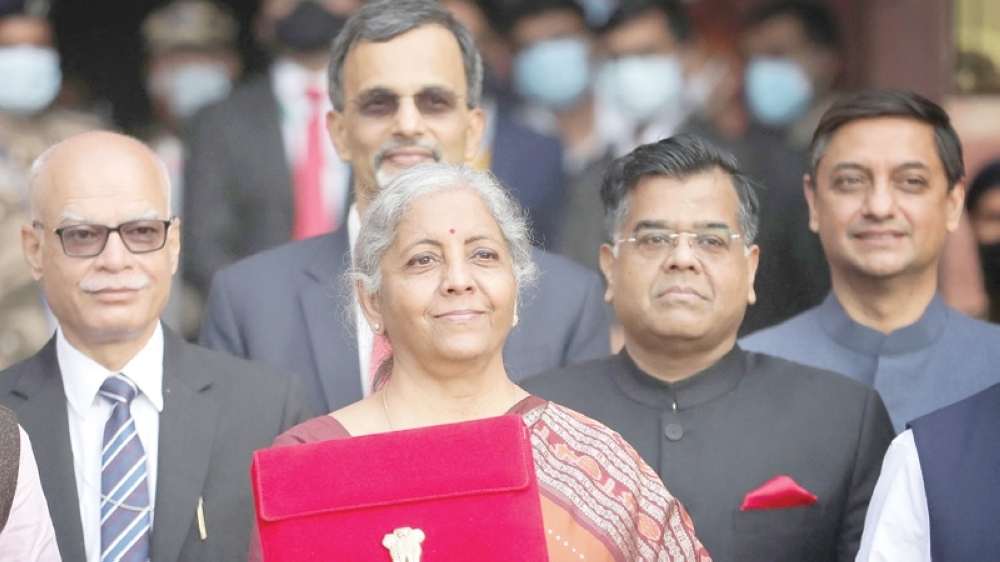





NEW DELHI: India unveiled on Tuesday a bigger budget of 39.45 trillion rupee ($529.7 billion) for the coming fiscal year, stepping up investment on highways and affordable housing to put growth on a firmer footing as the economy recovers from the pandemic.
The government has projected GDP growth at 8 per cent to 8.5 per cent compared with an estimated 9.2 per cent for the current fiscal year and a 6.6 per cent contraction the previous year.
All macro indicators indicated that Asia’s third-largest economy was well-placed to face challenges, helped by improving farm and industrial output growth, the government’s annual economic survey said on Monday. Here are some reactions from Indian businesses, economists and analysts:
ABHEEK BARUA, CHIEF ECONOMIST, HDFC BANK: “The 2022-23 budget finely balanced fiscal retreat with supporting economic recovery. It focussed on a familiar strategy of driving capital expenditure to drive growth, with the intention of crowding in private investment through higher public spending.
“Although markets could be disappointed with a higher fiscal deficit of 6.4 per cent of GDP for FY23 than expected, it is perhaps prudent to not undertake aggressive fiscal consolidation at this nascent stage of recovery.”
PRITHVIRAJ SRINIVAS, CHIEF ECONOMIST, AXIS CAPITAL, MUMBAI: “The finance minister is gunning for growth in FY23 budget at the cost of higher market interest rates. Higher spending in roads, rail, cargo terminals and irrigation is expected to crowd in private investment and improve efficiency of logistics. However, this push has come at the cost of delayed fiscal consolidation due to higher-than-expected fiscal deficits in FY22.”
AURODEEP NANDI, INDIA ECONOMIST, NOMURA: “It’s a big bang budget, but depends on where one stands on the bang perimeter. The massive ramp-up of capital spending and focus on infrastructure cemented the budget’s credentials as a growth-oriented one.
“But even as directionally, the fiscal deficit has been reduced to 6.4 per cent of GDP in FY23, as we had predicted, the government has announced a significantly large market borrowing to fund its plans.
“The sharp rise in bond yields after the budget announcement is testament to the surprise for bond markets, which now will need to absorb this large borrowing.”
RADHIKA RAO, ECONOMIST, DBS BANK, SINGAPORE: “Higher capex allocation was one of the key thrusts of India’s 2022 budget as the public sector takes to the wheel and hopes to draw in the private-sector players, while also backing new-age priorities including launch of sovereign green bonds, introduction of a digital rupee, and providing infra status to data centres among others.
“On the math, an increase in spending leaves deficit consolidation on a gradual slope than we expected, notwithstanding a double-digit nominal GDP growth. Market reaction was divided between upbeat equities while bond markets fret a sharp increase in borrowings as well as absence of tax measures to pave the way for bonds to be Euroclear-eligible and in turn ease inclusion into global indices.”
NIMISH SHAH, CHIEF INVESTMENT OFFICER — WATERFIELD ADVISORS: “While fiscal math is worrying the bond markets with yields up 15-20 bps, equity markets are in euphoria on the back of a budget that has shown credibility, continuity, and consistency.” — Reuters
Oman Observer is now on the WhatsApp channel. Click here