




The Omani government, represented by the Ministry of Finance, has outlined a sizable portfolio of initiatives aimed at achieving improvements on a number of government and public sector objectives.
Targeted for improvement through these landmark initiatives are, among other areas, individual and institutional productivity, digital transformation, governorate development, small-business mentorship, fiscal performance improvement, modernisation of the government financial system, merger of pension funds, central government procurement, supply chain financing, and the establishment of a unified treasury account.
The initiatives, listed here below, are classed into two broad sections: (A) Government Projects & Initiatives, and (B) Fiscal Performance Improvement Initiatives:
A) Government Projects and Initiatives:
i) Ejadah: A new system for measuring individual performance and institutional proficiency, which will be implemented by the Ministry of Manpower in January 2022. Ejadah aims to develop human resources by linking incentives and rewards with the level of productivity.
ii) Digital Transformation Projects: In this category, the Ministry of Transport, Communications and Information Technology will support four key initiatives: a) Activities in support of space exploration (b) Launch of a national platform for suggestions and complaints (c) Launch of the first package of electronic services through the unified government portal, and (d) Launch of a unified guide for government services
iii) Ministry of Economy projects: Governorate Development Programme, and follow-up of the implementation of strategic programmes
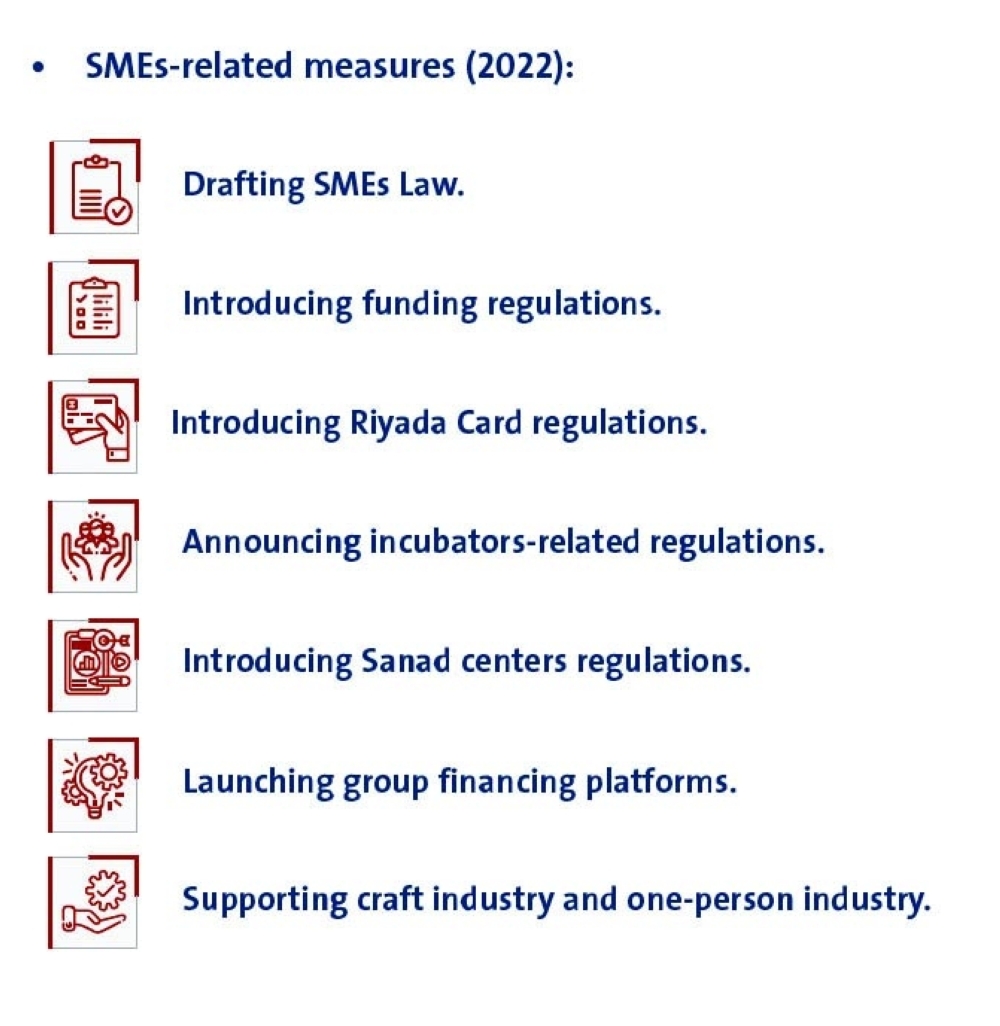
iv) SME-related initiatives: These include the drafting of a new SME Law, introduction of funding regulations, Riyada card regulations, announcing incubator-related regulations, new regulations for Sanad centres, launch of group financing platforms, and supporting craft industry / one person industry.
B) Fiscal performance improvement measures:
The financial challenges faced by the Sultanate of Oman have prompted the government to reconsider the priorities and align the objectives in accordance with Oman Vision 2040. Therefore, the government has taken the following set of measures in order to achieve fiscal sustainability while improving financial indicators and maintaining social welfare:
i) Revision of Financial Law and Executive Bylaws:
In light of modernizing laws and revising the regulations pertaining to economic and financial aspects, alongside the restructuring of the state’s administrative apparatus, the Financial Law and its Executive Bylaws are under revision in order to address the recent changes and to regulate the financial systems developed by the Ministry of Finance. Some of the systems include Program Based Budget, GFMIS and Treasury Single Account.
ii) Public Debt Law
This law aims to manage the funding the government obtains as a loan from banks, financial institutions and individuals to finance its public expenditures. The law also aims to: Regulate and manage public debt operations; Diversify the sources of funding; Monitor the level of indebtedness and associated risks; and Improve the cash flow management mechanisms.
iii) Government Financial System (Maliyah)
Maliyah is a modern system for managing public finance, the government units use Maliyah for planning, implementing, controlling, and reporting on the State’s budget. It will act as an information technology platform for the application of the rules, policies, procedures, and operations of public finance management.
Maliyah provides accurate, reliable, timely, and consistent financial information that supports the financial and economic decision-makers in creating fiscal policies, strategies, fiscal decisions, and discipline to achieve economic diversification and fiscal sustainability.
It helps develop a modern financial accounting and reporting system using a unified Chart of Accounts (CoA) and new budget classification which is in line with Government Financial Statistics (GFS).
It also enables better cash management and effective utilization of public funds by implementing and using cash forecasting (revenues and expenditures) and streamline treasury banking operation under the Treasury Single Account (TSA).
iv) Programme Based Budget (PBB)
An advanced approach of fiscal planning that identifies public spending priorities and links spending to objectives and activities.
v) National Register of Government Assets
The register is an integrated central system, seeks to take full account of government assets and draft a strategy to maximise returns. The Sultanate of Oman is among the leading countries to establish an integrated central system for managing government assets. The register aims to: Register and determine the actual value of Government assets; Generate more financial resources; Centralize Government assets management and enhance its efficiency; Secure more financial resources for the state budget; and Identify the Government assets for privatization and public-private partnership (PPP).
vi) Fee Setting Policy Handbook
The Fee Setting Policy Handbook comes as a unified and clear framework to standardize the pricing of government services, which would serve as a reference for the government units. Some other entities - such as OIA, pension funds, investment funds and free zones – can use the handbook when pricing their services. In its first phase, the handbook was applied to the Ministry of Heritage and Tourism, Ministry of Commerce, Industry and Investment Promotion and municipalities sector, which resulted in a: A reduction and cancellation of 548 services fees; Merging some municipal licenses. This entails that similar business activities will no longer require separate licenses; and Shifting 88 per cent of services provided by the Ministry of Commerce, Industry and Investment Promotion to the Invest Easy platform.
vii) Merger of Pension Funds:
Pursuant to the Royal Decree no. (2021/33) on systems of retirement and social security, a civil pension fund for public and private sectors shall be established under the name “Social Security Fund”. This is in addition to the establishment of a fund for military and security under the name “Military and Security Services Retirement Fund”.
viii) Common Contract
The Common Contract is an initiative aimed at modernizing the standard contracts of various Government units, in accordance with the latest practices adopted by the International Federation of Consulting Engineers (FIDIC). The Common Contract updates contract clauses as per the international practice so as to facilitate the process and save money and time. Drafted in Arabic and English in one document, it is possible to electronically fill the required data.
ix) Central Government Procurement
This initiative seeks to identify a central unit with the aim of integrating government procurements and contracts for all Government units. The unit shall carry out the following:
- Controlling all Government procurement and contracting process
- Enhancing purchasing power of the unit so as to be able to negotiate the quotations.
- Establishing a direct link with the main suppliers and service providers.
- Monitoring government inventory efficiently.
- Reducing public expenditures and the number of staff working in procurement departments.
- Building a close relationship with suppliers and enhancing training and support potentials.
- Migrating to e-business for key processes such as tendering, contracting and payment transactions.
x) Supply Chain Financing (SCF) Scheme
The Ministry of Finance is working with a group of banks, primarily based in Oman, to provide a simple and effective financing solution to the suppliers under contract with various Government units. The objective is to offer the suppliers an alternative option of getting their invoices settled in a timely manner without signing any financing agreement with the banks. The bank shall transfer the funds directly to the bank account of the supplier and then the Ministry of Finance will repay the funds to the same bank
xi) Tafakur Platform
An e-platform that aims to promote community participation between the Government and society by receiving ideas, suggestions and solutions that will help improve public financial management and achieve fiscal sustainability. The platform targets, during the pilot phase, all employees of the MOF and the target group will expand later depending on the outcomes of the pilot phase.
xii) Treasury Single Account
The Treasury Single Account (TSA) is a unified structure of government bank accounts, deal with government revenue and expenditure on a daily basis, thereby allowing for an optimal use of government cash resources. The TSA aims to: Enhance the efficiency of government cash management, by utilizing the unused cash; Improve monitoring the implementation of the State’s budget through providing accurate information on the expenditure and revenue; Reduce fees and costs of banking transactions; Facilitate payments; and Ease banking settlements.
Oman Observer is now on the WhatsApp channel. Click here