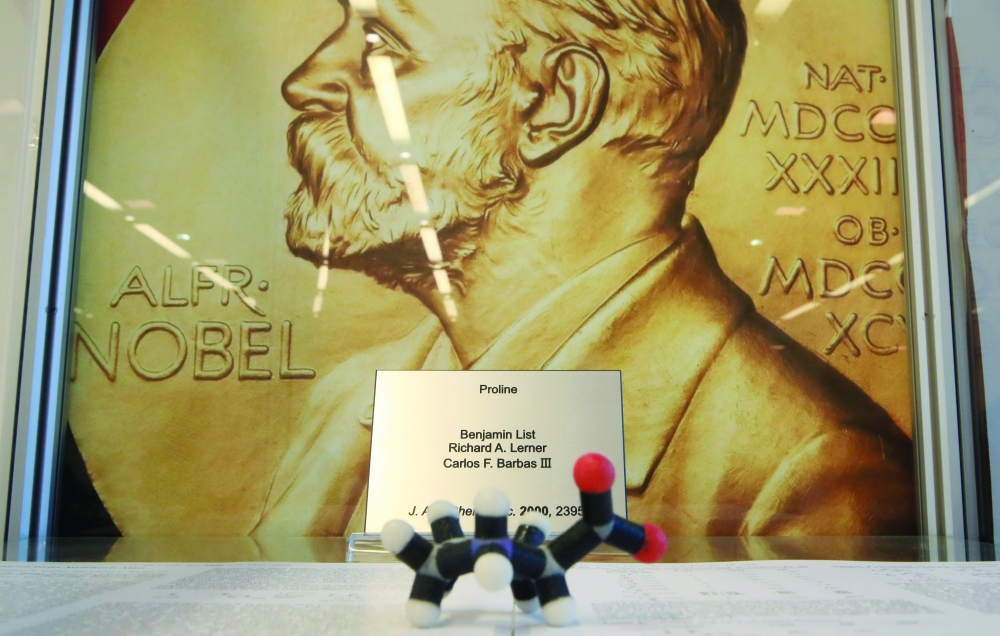





STOCKHOLM: The 2021 Nobel Prize in Chemistry was awarded on Wednesday to Benjamin List and David MacMillan for developing a new method for building molecules.
The Royal Swedish Academy of Sciences in Stockholm said their work had advanced pharmaceutical research and "made chemistry greener."
List and MacMillan, working independently of each other, had developed in 2000 "a third type of catalysis."
This method uses organic catalysts such as such as oxygen, nitrogen and sulphur - making it more environmentally friendly than other techniques, as well as cheaper, the academy said. Catalysts are essential in molecular construction because they speedup reactions.
The academy said that before List and MacMillan's breakthrough there had only been two known types of catalysts: metals and enzymes. "This concept for catalysis is as simple as it is ingenious, and the fact is that many people have wondered why we didn't think of it earlier," says Johan Aqvist, who is chair of the Nobel Committee for Chemistry.
"Using these reactions, researchers can now more efficiently construct anything from new pharmaceuticals to molecules that can capture light in solar cells," the academy's citation said.
List is a German chemist with the Max-Planck-Institut. MacMillan was born in Scotland and is a professor at Princeton University in the United States. Last year, the chemistry prize went to Emmanuelle Charpentier and Jennifer Doudna for developing the CRISPR-Cas9 method of genome editing.
This year's Nobel prizes kicked off on Monday with the awarding of the medicine prize. It went to two American molecular biologists for their work on how heat, cold and mechanical force can initiate nerve impulses in the human body.
On Tuesday, Nobel Prize in Physics went to a trio of researchers whose work has helped the world understand complex systems, including those governing Earth's warming climate.
Still to come is the Nobel Literature Prize on Thursday, the Peace Prize on Friday and economic sciences on Monday. - dpa
Oman Observer is now on the WhatsApp channel. Click here