




KHARTOUM: The general who heads Sudan's ruling transitional authority on Sunday pledged to reform the army, days after a failed coup.
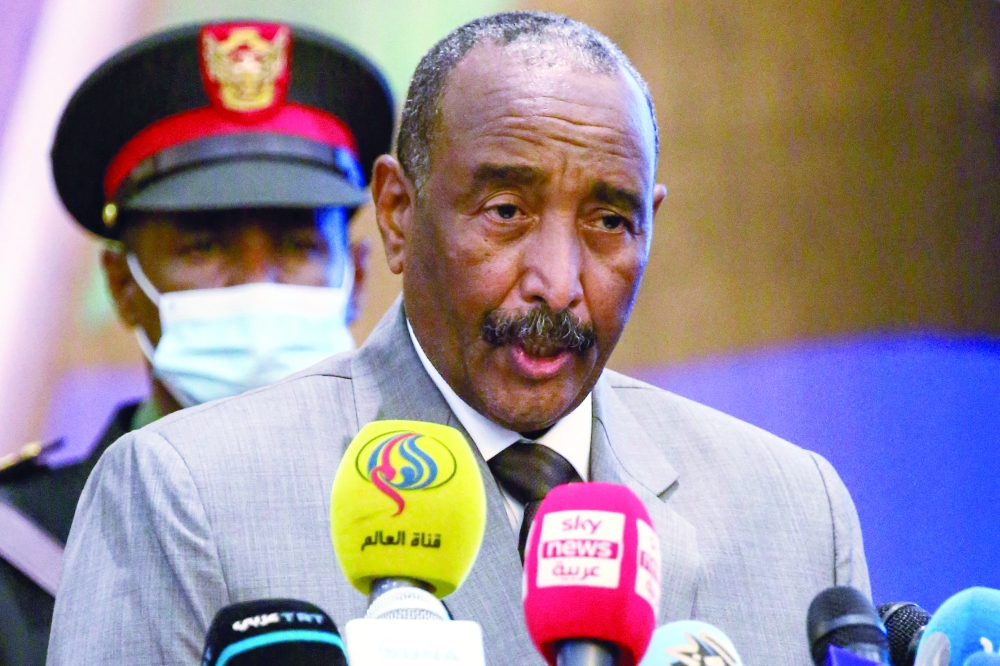
"We are going to reorganise the armed forces... Partisan activities are banned in the army," Sovereign Council chief General Abdel Fattah al Burhan said at the opening of a military hospital in Khartoum.
"The armed forces are committed to holding elections on the date fixed for ending the transition" in 2023, he said.
"After that, the army will leave the political scene and its role will be limited to protecting the country."
Sudan is led by a civilian-military administration under an August 2019 power-sharing deal signed after president Omar Bashir's ouster by the military in April that year following mass protests against his iron-fisted rule.
Sudan's government said it thwarted a September 21 coup attempt involving military officers and civilians linked to the regime of imprisoned Bashir. At least 11 officers were among those arrested.
Prime Minister Abdalla Hamdok has since called for reforms within the army, a highly sensitive issue in Sudan.
A transition to full civilian rule has remained shaky, reeling from deep fragmentation among political factions, economic woes and a receding role for civilian leaders.
Paramilitary leader and Burhan's deputy in the Sovereign Council, Mohamed Hamdan Daglo, has pointed a finger of blame at politicians after the failed coup.
"Politicians are the main cause behind coups because they have neglected the average citizen... and are more concerned fighting over how they can stay in power," Daglo said.
Meanwhile, Sudanese protesters blocked two key oil pipelines in Port Sudan, the main seaport on the Red Sea, over a peace deal with rebel groups, the oil minister said.
Warning of "an extremely grave situation", Oil Minister Gadein Ali Obeid said one pipeline transports oil exports from South Sudan while the other handles Sudanese crude imports.
"Entrances and exits at the port's export terminal have been completely shuttered" since early Saturday, he said.
Last October, several rebel groups signed a peace deal with Sudan's transitional government which came to power shortly after the April 2019 ouster of long-time ruler Omar al Bashir.
The protesters, from Sudan's Beja minority, say that the deal, with rebels from the Darfur region and Blue Nile and South Kordofan states, ignored their interests.
Beja rebels agreed a peace deal with the Bashir regime in 2006 after a decade of low-level conflict in Port Sudan and the east.
Port Sudan is the country's main seaport and a vital trade hub for its export-dependent economy.
The Khartoum government receives around $25 for every barrel of oil sold from South Sudan, according to official figures.
South Sudan produces around 162,000 barrels per day, which is transported by pipeline to Port Sudan and then shipped to global markets.
"There are enough (oil) reserves to last the country's needs for up to 10 days," Sudan's oil ministry said in a statement.
It warned the export pipeline could sustain damage after demonstrators prevented a vessel from loading crude.
Protests against the October 2020 deal have rocked east Sudan since last week.
On September 17, demonstrators impeded access to the docks in Port Sudan.
On Friday, demonstrators blocked the entrance to the airport and a bridge linking Kassala state with the rest of the country.
The unrest comes as Sudan grapples with chronic economic problems inherited from the Bashir regime.
Shortly after it began, the transitional government of Prime Minister Abdalla Hamdok said it had foiled a coup attempt by supporters of the ousted president. - AFP
Oman Observer is now on the WhatsApp channel. Click here