




DUBAI: One person is now dying from Covid-19 every two minutes in Iran, state TV said on Monday, as the Middle East’s worst-hit nation reported a new record daily toll of 588 fatalities.
With authorities complaining of poor social distancing, state media say hospitals in several cities have run out of beds for new patients. Some social media users have criticised the clerical establishment over slow vaccinations, with only about 4 per cent of the 83 million population fully inoculated.
Total deaths have reached 94,603, the ministry said, while cases rose by 40,808 in the past 24 hours to 4,199,537 in a fifth wave blamed on the highly transmissible Delta variant.
"Every two seconds one person gets infected in Iran and almost every two minutes one person dies from the coronavirus," state TV said, adding that most of Iran's 31 provinces have moved from the lower risk orange level to red alert.
That compares to a reported rate of about one death per three minutes a month ago.
In January, Iran's top authority Supreme Leader Ayatollah Ali Khamenei banned imports of US- and British-made vaccines, saying they were unreliable and may propagate the infection.
Iran has blamed US sanctions for hampering purchases and deliveries of vaccines from other nations.
Food, medicine and other humanitarian supplies are exempt from US sanctions reimposed on Tehran in 2018 after then President Donald Trump abandoned Iran's 2015 nuclear deal.
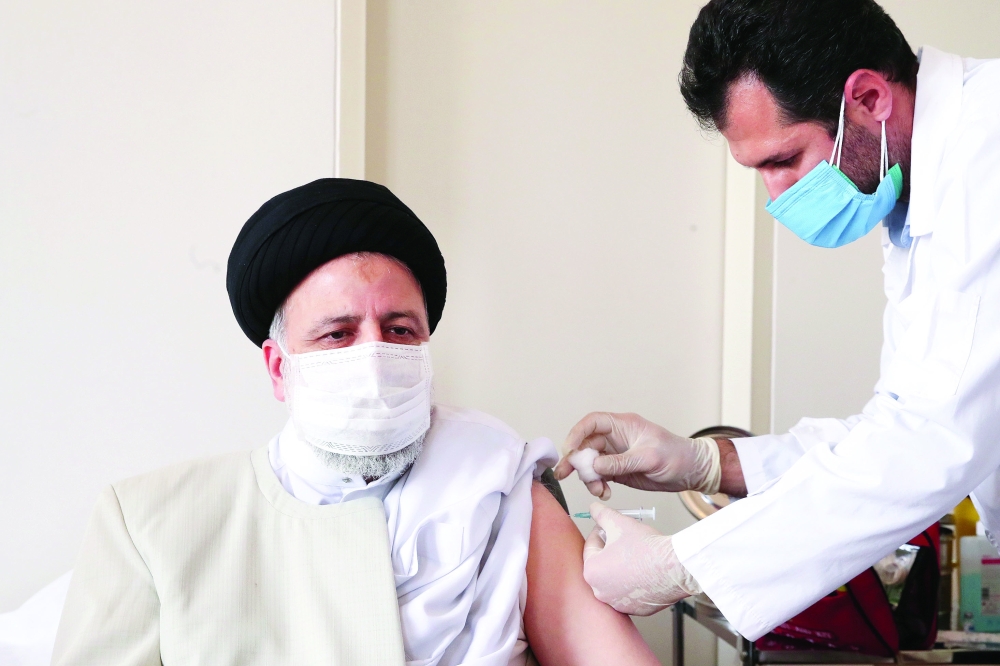
Iran's new President Ebrahim Raisi, who received his first dose of a homegrown Covid-19 vaccine in public on Sunday, has urged officials to speed up vaccinations and to use "all necessary means" for curbing the pandemic, state media reported.
Trying to speed up vaccinations using imported doses as well as its COVIran Barakat shot, Iran is also participating in the COVAX scheme, run by the GAVI alliance and the World Health Organization, that aims to secure fair access for poorer countries.
Tehran, with a population of over eight million, is facing the highest numbers of deaths, infections and hospitalisation, according to Nader Tavakoli, deputy head of the capital's virus task force.
He also told ISNA news agency "we will see deaths increase in the coming days".
"We have no idea when we would reach the peak of this fifth wave," Tavakoli said, adding that Tehran's hospitals and emergency wards are overburdened.
Iran has pinned its hopes on vaccinations to help with the health crisis, but the innoculation campaign launched in February has progressed slower than authorities had planned.
More than half of Iran's 448 counties including Tehran are currently listed as "red" -- the highest risk level on the country's colour-coded scale, according to the ministry.
In red zones, all commercial activity must shut down except for those considered essential, such as grocery stores and pharmacies.
But malls and small retail shops in northern and central Tehran were still operating, according to AFP journalists.
Iran has avoided imposing a full lockdown on the population, and instead resorted to piecemeal measures such as temporary travel bans and business closures.
Iran's last serious restrictive measure came in late July, when the government ordered government offices and banks in the Tehran and neighbouring Alborz province to close for six days. -- Agencies
Oman Observer is now on the WhatsApp channel. Click here