




BRUSSELS: The European Central Bank will start tapering its pandemic-related asset purchases after its September meeting and stop buying them by the end of March, according to a Reuters poll which showed the top economic risk was new COVID-19 variants.
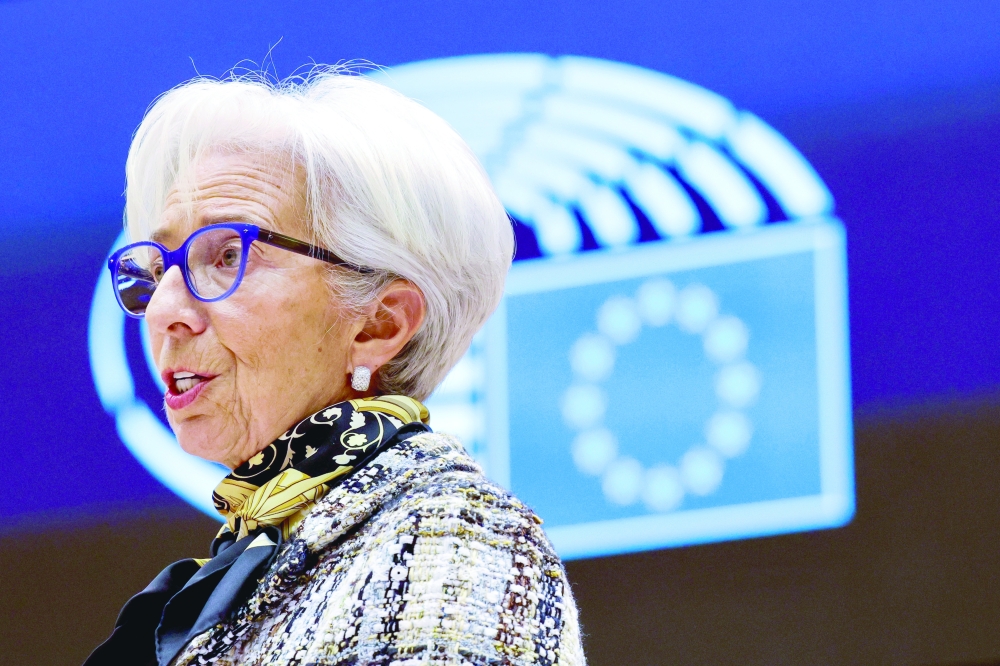
After announcing a new strategy last week that allows the central bank to tolerate inflation higher than its new 2% symmetric target, ECB President Christine Lagarde said on Monday the bank would change its policy guidance at its July 22 meeting. read more While those announcements came against a backdrop of slightly more optimistic growth and inflation forecasts for this year and next, high unemployment rates in most euro zone countries are underscoring the need for caution.
Just over 70% of economists, or 36 of 51, who responded to an additional question in the July 5-12 poll said the ECB would start tapering its Pandemic Emergency Purchase Programme (PEPP) after the September meeting, up from nearly 63% last month.
All of the 1.85 trillion euro PEPP envelope would be used up, according to the consensus view of 39 economists, with the lowest expectation pencilled in at 1.5 trillion euros.
"Judging from the current monthly pace of purchases, our assumption of only a gradual reduction of this pace after September, and in the remaining time until March, the envelope will likely be used in full," said Salomon Fiedler, European economist at Berenberg.
"Furthermore, by September, the vaccination campaign in Europe should be all but complete ... but if new variants are able to circumvent protection from current vaccines, renewed social distancing would once again put a damper on the economy." The poll of over 100 economists showed the euro zone economy would expand an average 4.5% this year and 4.3% next, up from 4.2% predicted for both years last month.
That compared to the European Commission's more optimistic projections of 4.8% growth for this year and 4.5% next, faster than the 4.3% and 4.4% expansion it had forecast in May.
While the latest poll consensus for this year was the highest since January, growth expectations for 2022 were the highest since polling began for that period in July 2020.
After probably having expanded 1.4% last quarter, the bloc's economy was forecast to grow 2.4% and 1.3% in Q3 and Q4, respectively, up from 2.3% and 1.2% predicted in June.
Annual growth forecasts for Germany, France and Italy were also upgraded to 3.5%, 5.7% and 4.8% this year on average from 3.2%, 5.4% and 4.1% predicted in an April poll.
While inflation in the single currency bloc was expected to rise and average above target in the second half of 2021, for the full year it was forecast to average 1.9% this year and slow to 1.4% next. — Reuters
Oman Observer is now on the WhatsApp channel. Click here