




The silverware industry in Oman is one of the most important and diversified metallurgical industries. The current generation excels in producing a lot of metal products and the most important of which is the Omani dagger or Khanjar.
Abdullah Al Farsi is one of the most popular and creative jeweler in Oman. His love for the dagger-making profession is exceptional, as he came from a prominent family that has passed on this craft from generation to generation. Abdullah, therefore, did not choose this profession, but it chose him.
"Like any child, I was sitting with my father and grandfather and I could see them working with the tools of this craft (it was visual nourishment for me as I grew up in this environment) and I smell glue and smoke. As I get older and when my father got sick and passed away, I was thrown into the frontline and started working in my passion," he shared.
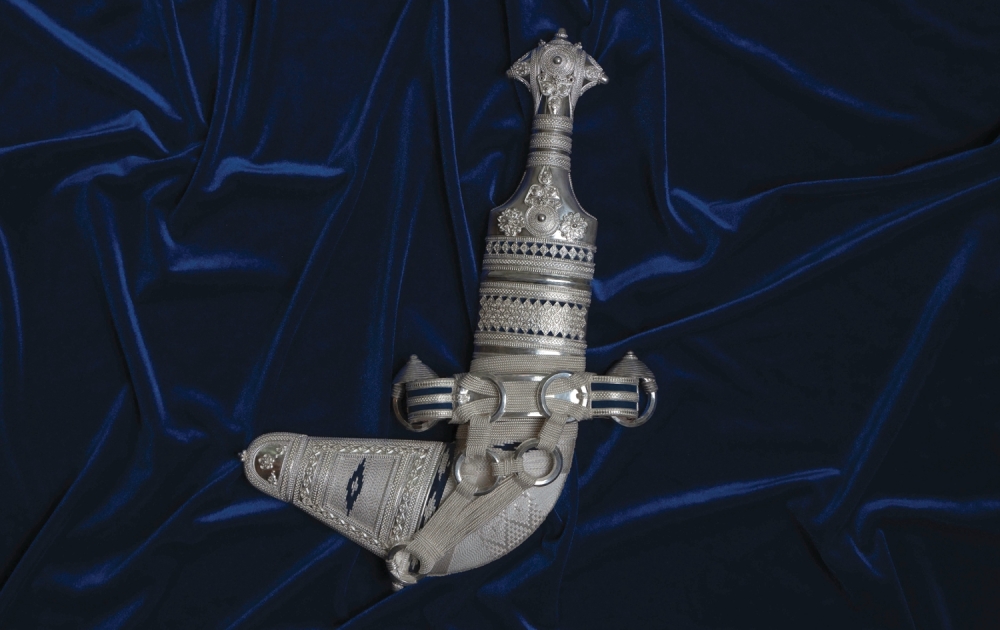
The Omani Khanjar is consists of eight parts that are closely tied to each other. Finishing one khanjar can take two to five weeks. It is also a laborious process that usually involves about five people each taking part in the khanjar-making process and each process requires mastery and different skillset including sewing, sculpting and carpentry.
The upper part of a khanjar is called "The head" or what the locals called the "Muqbad". It is made of different materials such as wood, sandalwood, precious stones and the horns of cows or buffaloes. This part is made by bringing a rectangular piece of material (about the size of the palm of the hand), then sculpting and decorating the piece with silver nails," he shared.
The "knife" or what is locally known as "Nassel" is the second part of the dagger. "We hammer iron and shape it as a sharp crescent," he explained.
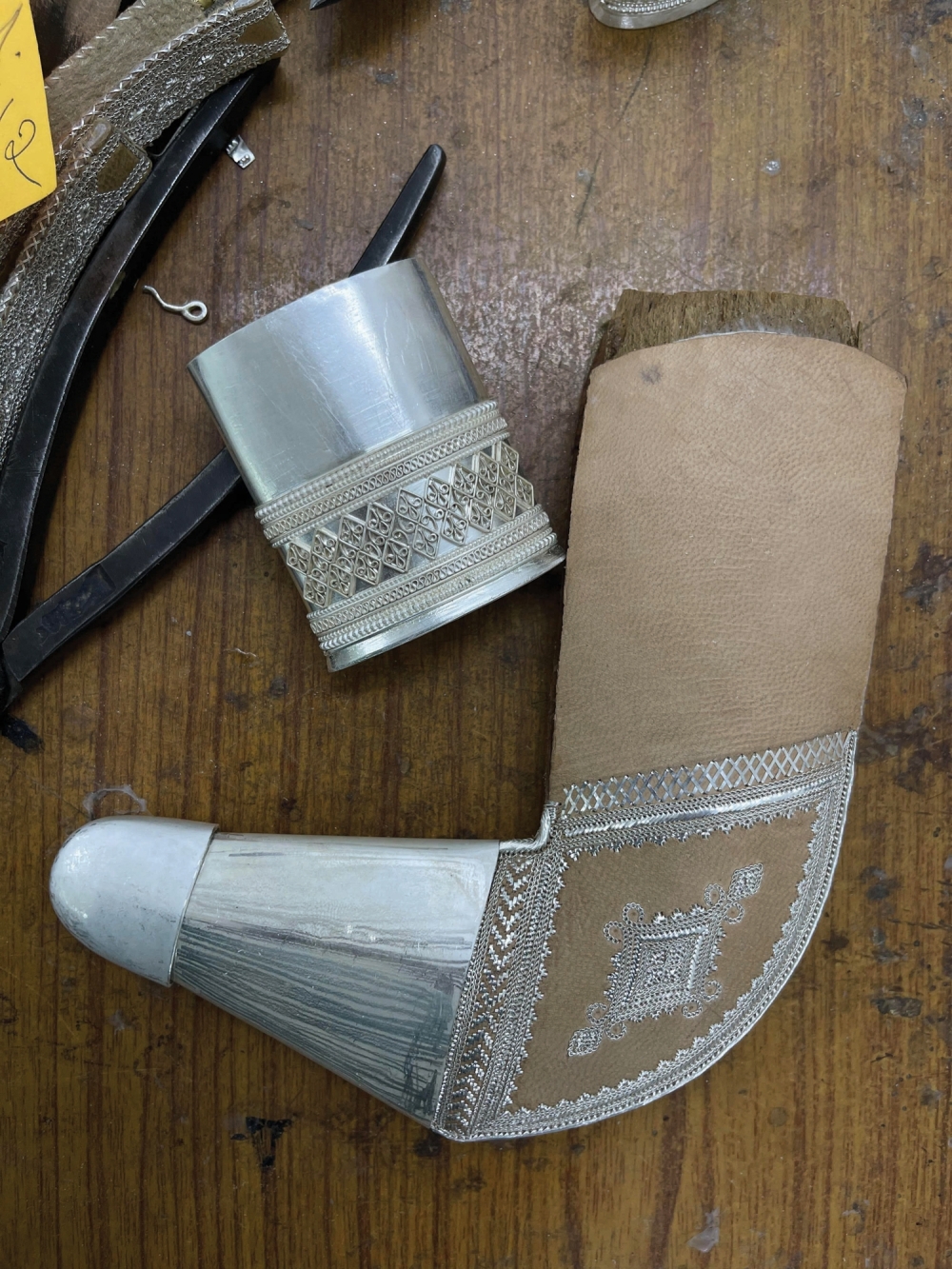
The third part where the knife is kept is called "Sudder" which is the middle part of the Kanjar. "It is made of two pieces of silver and decorated symmetrically. Both of which are formed in a rectangular shape and hollow from the inside to allow the entry of the knife," he said.
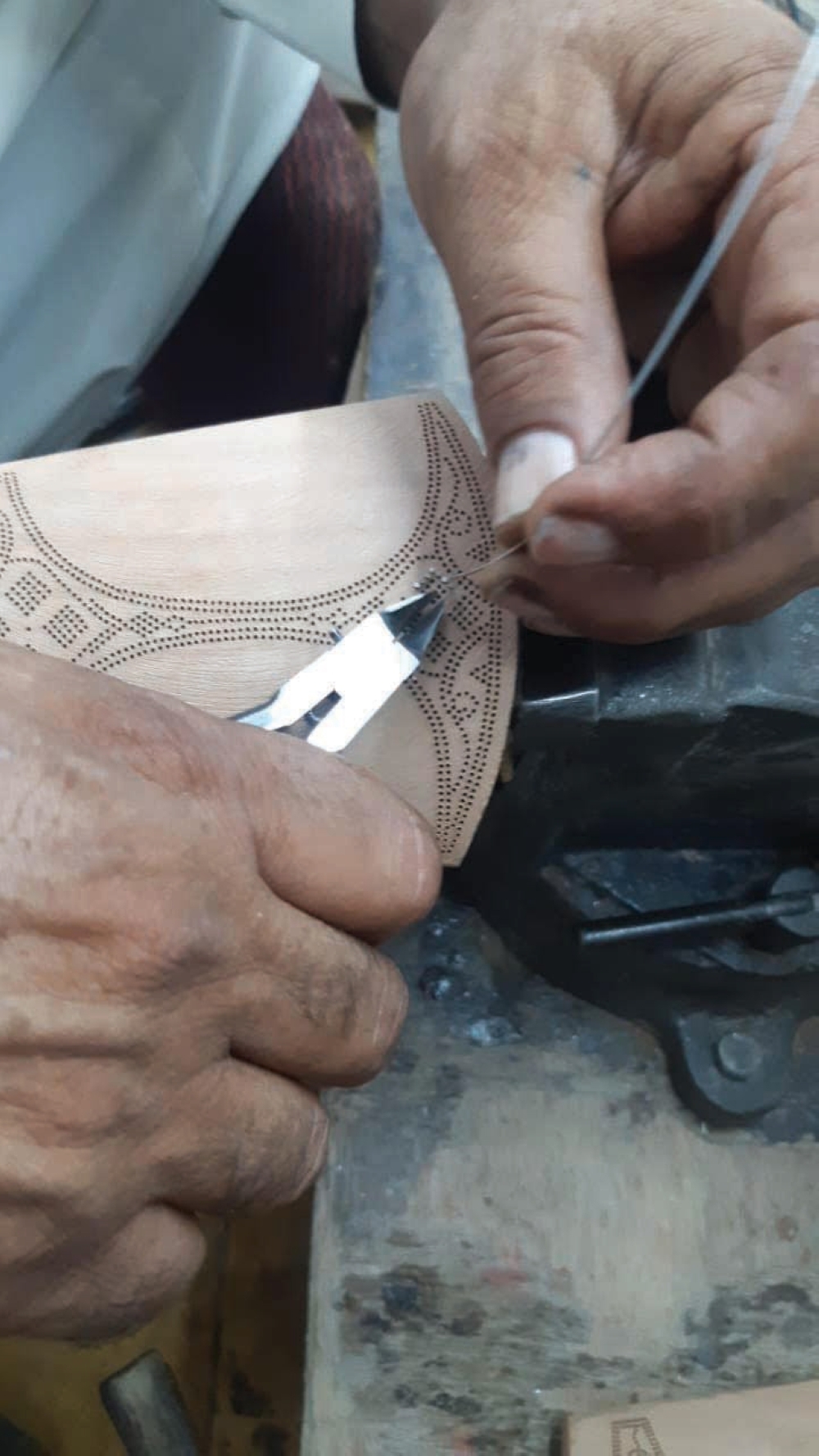
As for the "Tammas" part, it is a strip of leather that wraps in the middle of the dagger, specifically below the "Sudder". It is covered and decorated with silver wires. We glue it so it would stick the leather in the Khanjar. On the ends of Tammas, from the right and the left, two silver rings are installed to hold the belt that the Omani man uses to wear the dagger and tie it to his waist.
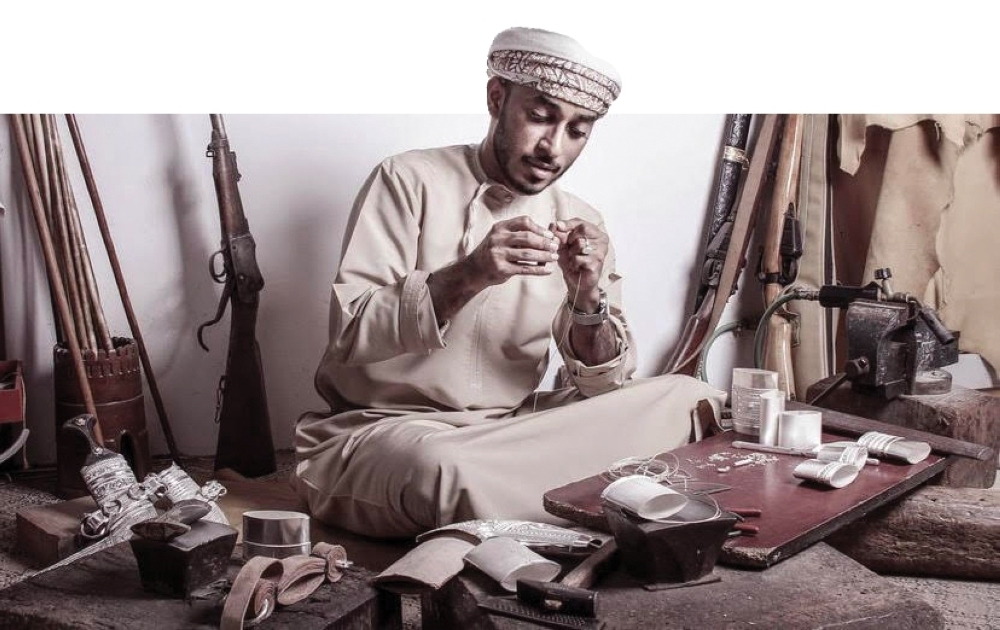
There are many forms and qualities of the belt. "It may be the leather belt (embroidered or which is sewn with soft silver wires) or the Zari belt (it is a local material and worked on it with cotton threads and fabrics," he shared.
The lower part of the dagger, which is in the shape of a crescent, is called the "qataa" and is made, also, to be a keeper of the knife (the traditional Omani weapon). "It is a piece of leather that is cut in a crescent shape. It is decorated by stitching it with soft silver wires (just like the Omani kumma stitching or the Omani traditional women’s clothing) and in an attractive and harmonious way. Then we stick the piece of leather in a piece of wood that is made in a crescent shape and hollow from the inside to allow the knife to enter," he explained.
At the end of the "qataa" is the "qaba". "It is a small silver piece and it is hollow from the inside and decorated with the same inscriptions and decoration of the "Sudder" (the middle part of the dagger). This is to make the dagger coordinated with the engravings and decorations from the top and the bottom. It is the last piece to give the dagger a beautiful, attractive shape," he added.
Abdullah shared that he has made more than 100,000 daggers, and each dagger has its own story. "I spend my time with love to produce silver pieces of art, some with precious stones, different animal horns and beautiful wood with a fragrant smell. It also includes gold, copper, iron, as well as leather and fabrics. I hope that all these unique daggers will be collected in an exhibition," he said.
When you order a khanjar from him, you determine the size you would like and the type you need. "There are about 8 types of daggers, and they are often distinguished by the shape of the engravings, the size and the type of metal it is made of or painted with," he said.
Dagger prices start from 400 OMR and it could go up to thousands. "Pricing is based on the weight of the silver used, the accuracy of the stitching (fine stacked stitching or light stitching), the type of "The head" (animal horn, wood or plastic) and the type of material used in the belt.
You can visit A Sayegh shop in Sur to see these different types or contact him via his Instagram account (abdullah_alsayegh1).
"This workshop was inherited by my father from his father who inherited it from their ancestors. Now it is under my care. I seek to pass this profession to my children," he pointed out.
Perhaps what makes this traditional industry survive and compete in the market till today is the importance of it for the state and for the Omanis as well.
"It is the emblem of the country. It is, also, an essential element of the Omani men's formal wear where it is also worn in all social and official occasions as a part of the traditional Omani costume like wedding, Eid and funerals and meeting officials," he mentioned.
Despite the progress made by the Omani society in all aspects of life and despite the tremendous development in the tools and means of production, the preservation of the authentic Omani heritage (such as the traditional national crafts) formed a basic pillar of the modern state and a feature of the distinctive features of the Omani society.
Oman Observer is now on the WhatsApp channel. Click here