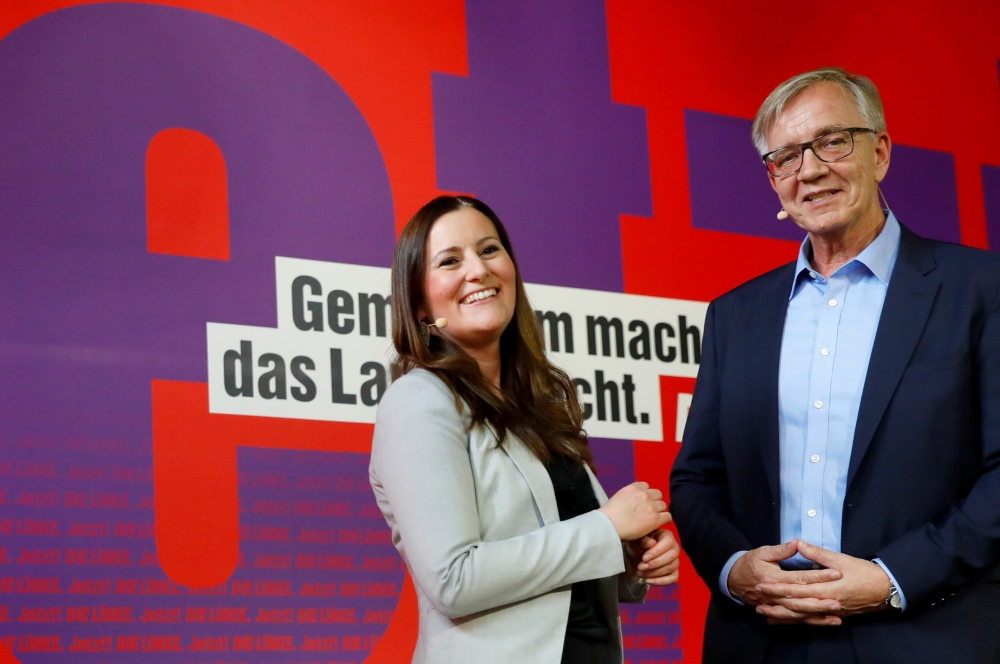





BERLIN: With less than five months to go before Germany chooses a new parliament and chancellor, the hard-left Die Linke party has presented its top candidates for the election campaign. Janine Wissler and Dietmar Bartsch, the co-leader of the party and the co-leader of its parliamentary faction respectively, will be the party's flagbearers in the lead up to the September 26 polls.
Die Linke won 9.2 per cent of the vote in the last Bundestag elections in 2017 and is currently polling at between 6 and 8 per cent. Key policies include reducing poverty, taxing the rich and disarmament.
So while it has no realistic chance of forming a government itself, it could form part of a future coalition government.
The two politicians span a wide generation gap, with Wissler - regarded as being on the left wing of the party - a relative newcomer at 39; experienced party strategist Bartsch is 63 years old.
"Our goal is to hit double figures this election year," Bartsch said on Monday. The surge of the Green party and the poor showing of centre-right has led to speculation that the Greens could lead a coalition with left-wing parties after the September elections, and that this coalition could include Die Linke.
The same three-way coalition has a track record at state level, including in the regional government in Berlin. The security and foreign policies of Die Linke however may rule out such a grouping at national level. Die Linke rejects Nato as a "war alliance," and rules out any role for German troops abroad.
Greens co-leader Robert Habeck recently called for Die Linke to adjust its policies and show it is "ready for government," but those calls have so far fallen on deaf ears.
Meanwhile, With his Social Democrats (SPD) lagging in the polls behind the Greens and the Christian Democrats, German Finance Minister Olaf Scholz on Sunday pledged to prioritise climate change as he leads the party into September general elections.
"It's about the future of our country... the path Germany must follow in the 21st Century," Scholz told a socially-distanced SPD party congress after winning 96.2 per cent support of 600 delegates to be their candidate in the September 26 election.
The poll marks a crossroads in German politics as Chancellor Angela Markel bows out after 16 years in power.
New Christian Democratic (CDU) leader Armin Laschet will look to replace Merkel, who currently runs a CDU-led coalition in which the SPD serves as junior partner.
But both traditional heavyweights are playing catch-up as latest polls place the Green Party in the lead with 26 per cent of voting intentions to 23-25 for the CDU as the SPD trails on 14-16.
Having won his party's nomination last year, 62-year-old former Hamburg mayor Scholz said he was in the process of laying a "foundation for change" and urged the party to "get to work."
Portraying himself as a "committed European" he said climate change had to be a top priority as it comprised "this century's essential human mission".
"We have already lost too much time... We want to achieve carbon neutrality by 2045 by the latest," he added. That target has been brought forward from an initial coalition pledge of 2045. The SPD also wants electricity to be produced exclusively via renewable sources by 2040. - dpa
Oman Observer is now on the WhatsApp channel. Click here